Fiber Reinforced Concrete vs Rebar: Full Cost Breakdown
Compare the true costs of fiber reinforced concrete vs rebar. Discover material, labor, and lifecycle pricing to optimize your concrete slab budget.

The Core Dilemma: Secondary vs. Primary Reinforcement
When evaluating fiber reinforced concrete vs rebar for slab-on-grade, driveway, or industrial flooring projects, the conversation often devolves into a simple price-per-square-foot comparison. This is a fundamental engineering error. To accurately forecast project costs, contractors and owners must distinguish between secondary reinforcement (controlling plastic shrinkage and temperature cracking) and primary structural reinforcement (resisting applied tensile and flexural loads).
Macro-synthetic fibers and steel rebar operate on entirely different mechanical timelines. Fibers engage immediately as the concrete cures to prevent micro-cracking, while rebar remains largely dormant until macro-cracks form and structural loads are applied. Understanding this distinction is the key to unlocking massive labor savings without compromising structural integrity.
Quick Cost Snapshot (Per 1,000 Sq. Ft. 4-Inch Slab)
- Fiber Material Cost: $95 - $140 (Dosed at batch plant)
- Rebar Material Cost: $850 - $1,150 (#4 bar at 18" O.C.)
- Labor Savings with Fiber: $1,200 - $1,800 (Eliminates tying and chair placement)
- Total Estimated Savings: $1.95 - $2.80 per square foot
Material Cost Analysis: Batch Plant Additives vs. Steel Grids
The most visible financial divergence between fiber reinforced concrete vs rebar lies in raw material procurement. Macro-synthetic fibers (typically polypropylene or polyolefin blends conforming to ASTM C1116) are dosed directly into the ready-mix truck at the batch plant. Steel rebar requires fabrication, delivery, on-site staging, and physical placement.
| Material Type | Specification / Dosage | Unit Cost (2026) | Cost per Sq. Ft. (4" Slab) |
|---|---|---|---|
| Macro-Synthetic Fiber | 5.0 lbs / cubic yard | $3.50 - $4.50 / lb | $0.18 - $0.23 |
| Steel Rebar (#3) | 18" O.C. both ways (0.50 lbs/sq ft) | $1.15 / lb (fabricated) | $0.58 |
| Steel Rebar (#4) | 18" O.C. both ways (0.89 lbs/sq ft) | $1.25 / lb (fabricated) | $1.11 |
| Welded Wire Mesh (6x6 W1.4) | Standard sheets (0.06 lbs/sq ft) | $0.85 / sq ft | $0.85 |
Note: Adding 5 lbs of macro-fibers to a standard 3,000 PSI ready-mix design typically increases the batch plant invoice by $18 to $25 per cubic yard. Because one cubic yard covers roughly 81 square feet at a 4-inch depth, the net material addition is minimal compared to purchasing, cutting, and tying steel.
Labor & Placement Economics: The True Cost Multiplier
Material costs only tell half the story. The decisive financial advantage of fibers emerges during the placement phase. According to the National Ready Mixed Concrete Association (NRMCA), eliminating the physical placement of reinforcement drastically reduces the critical path schedule for slab pours.
Time-Study: 1,000 Sq. Ft. Slab Placement
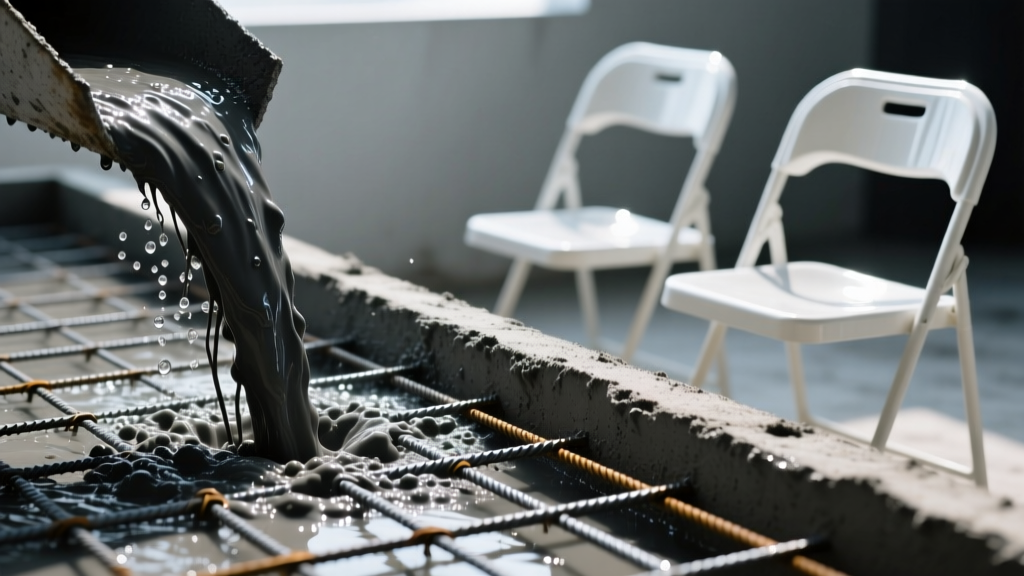
- Rebar Placement: Requires a two-person crew approximately 12 to 16 man-hours to lay out, cut, tie, and elevate #4 rebar on 3-inch plastic chairs at 18-inch centers. At a prevailing union labor rate of $75/hour, this equates to $900 to $1,200 in direct labor.
- Inspection Delays: Steel reinforcement requires a municipal or third-party special inspection prior to the pour. Failed inspections due to improper lap splices or inadequate cover (chairs knocked over during the pour) can delay the concrete truck, incurring standby fees of $150+ per hour.
- Fiber Placement: Zero on-site labor. The fibers are added to the drum at the batch plant and mixed for 4 to 5 minutes at high RPM. The concrete arrives ready to strike off.
Macro-synthetic fibers create a balling effect and increase the surface area within the mix, which can reduce the concrete slump by 1 to 2 inches. If your placement requires a concrete pump, you must instruct the batch plant to add a high-range water reducer (superplasticizer) to maintain workability without increasing the water-cement ratio. This additive typically costs an additional $5 to $8 per cubic yard—a minor expense that prevents catastrophic pumping blockages.
Lifecycle & Code Compliance: Where Fibers Fail
The most common and costly mistake in modern slab design is attempting to use synthetic fibers as a 1:1 replacement for primary structural steel in suspended slabs or heavily loaded industrial floors. The American Concrete Institute (ACI) 318 Building Code is explicit: synthetic fibers cannot be used to replace primary flexural reinforcement in structural members.
"Synthetic fibers are effective in reducing plastic shrinkage cracking and improving impact resistance, but they do not provide the structural tensile capacity required to replace deformed steel reinforcement in flexural members." — ACI Committee 544 Report on Fiber Reinforced Concrete.
Actual Failure Modes
- Plastic Shrinkage Cracking (Fibers Win): In the first 24 hours, concrete loses moisture rapidly. Fibers provide three-dimensional micro-reinforcement that holds the matrix together. Rebar, typically placed 2 inches below the surface, does nothing to stop surface-level plastic shrinkage cracks.
- Drying Shrinkage & Curling (Tie): Both fibers and rebar help limit the width of long-term drying shrinkage cracks, though heavily doweled joints are usually required in conjunction with both.
- Flexural Overload (Rebar Wins): If a forklift with a 15,000 lb point-load drives over a 5-inch slab with poor subgrade support, the slab will crack. Steel rebar will bridge the crack and hold the floor together. Synthetic fibers will pull out of the matrix, resulting in a faulted, unusable joint.
Decision Matrix: Scenario-Based Selection Framework
To optimize your budget without violating engineering principles, apply this decision framework to your specific application:
| Application Scenario | Recommended Reinforcement | Economic & Structural Rationale |
|---|---|---|
| Residential Driveways & Sidewalks | Macro-Fibers Only | Loads are light and distributed. Subgrade provides primary support. Fibers eliminate the cost of wire mesh, which is often stepped on and rendered useless during residential pours. |
| Warehouse Slab-on-Grade (Heavy Forklifts) | Hybrid (Fibers + Steel) | Use fibers for plastic shrinkage control and steel fibers or #4 rebar at joints/columns for structural load transfer. Reduces overall joint spacing requirements. |
| Suspended Decks & Structural Foundations | Epoxy-Coated Rebar | Fibers provide zero structural flexural capacity. Rebar is strictly mandated by code. Adding fibers here is a wasted material cost unless specifically required for fire-resistance ratings. |
| Exterior Flatwork in Freeze-Thaw Climates | Macro-Fibers + Air Entrainment | Steel rebar near the surface can corrode and spall the concrete if exposed to de-icing salts. Synthetic fibers are immune to chloride-induced corrosion. |
The Bottom Line on Cost Optimization
When comparing fiber reinforced concrete vs rebar, the most cost-effective strategy is not necessarily choosing one over the other, but rather deploying them where their mechanical properties align with the structural demands of the slab. For standard slab-on-grade applications supported by a well-compacted subgrade, substituting temperature and shrinkage steel with 5 lbs/cy of macro-synthetic fibers will reliably save between $2.00 and $2.50 per square foot in combined material and labor costs. However, for any application subjected to active tensile bending moments, steel rebar remains an irreplaceable, code-mandated necessity.
Written by
Priya KapoorPriya Kapoor is a real estate market analyst and construction economics researcher with expertise in housing affordability, development feasibility, and infrastructure investment. She holds a Master of Regional Planning from Cornell University and previously worked as a senior analyst at CBRE's Investment Properties group, where she modeled returns for $4B in mixed-use development pipelines. Priya now runs an independent research practice advising developers, municipalities, and REITs on construction cost forecasting and market timing. She publishes the quarterly "BuildMat Market Pulse" report tracking material price indices across 12 commodity categories. Based in Austin, TX, Priya serves on the board of Habitat for Humanity Austin and is a marathon runner.
More from Priya Kapoor
View all
Construction Cost
Cost to Build a 1600 Sq Ft Home in 2026: Full Breakdown
Accurate 2026 cost to build a 1600 sq ft home—material, labor, and regional pricing breakdowns included. Plan your budget with real-time estimates.
Aug 11, 2026

Wood & Lumber
Name the Types of Wood for Pressure Treatment and Preservation
Learn how to name the types of wood best suited for pressure treatment. Compare species treatability, chemical retention levels, and 2026 preservation costs.
Aug 4, 2026

Stone & Masonry
Stone Veneer Suppliers Lindenhurst: 2026 Cost Analysis
Analyze 2026 stone veneer costs in Lindenhurst, NY. Compare local supplier pricing, delivery fees, and Suffolk County installation labor rates.
Aug 4, 2026