QUIKRETE vs Concrete: Technical Specs & PSI Breakdown
Compare QUIKRETE vs concrete with technical specs, PSI ratings, ASTM standards, and cost data to choose the right mix for your structural project.
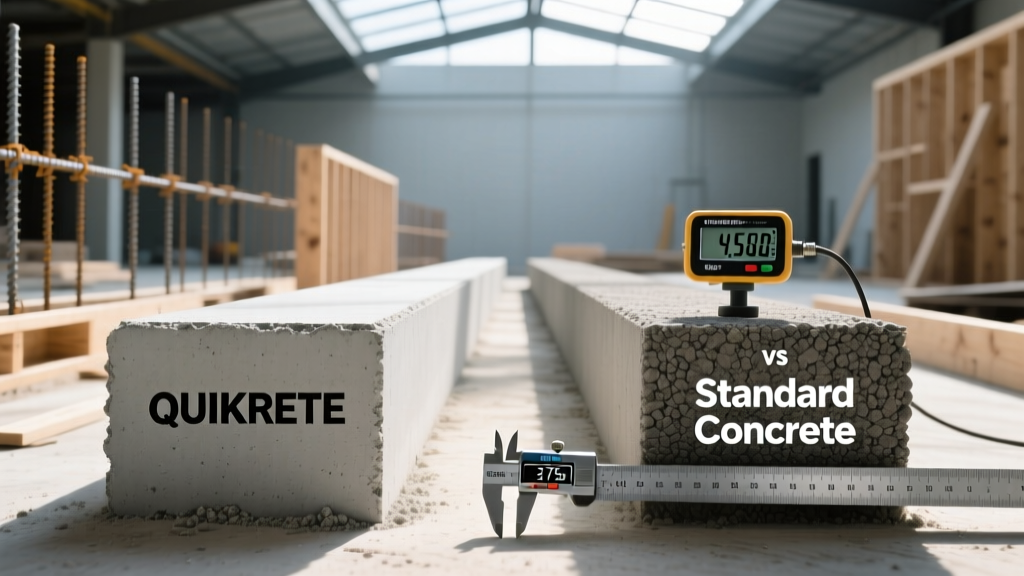
The Core Distinction: Brand vs. Material
When professionals and DIYers search for 'QUIKRETE vs concrete,' they are fundamentally comparing a proprietary bagged product line against batch-plant ready-mix concrete. QUIKRETE is a brand that manufactures pre-blended, dry cementitious materials. Concrete is the generic composite material consisting of Portland cement, water, fine aggregates (sand), and coarse aggregates (gravel or crushed stone). Understanding the technical specifications, compressive strength (PSI), and aggregate sizing of both options is critical for structural integrity and code compliance.
Technical Specifications: QUIKRETE Bagged Mixes
QUIKRETE formulates its bagged mixes to meet specific ASTM standards, primarily ASTM C387 for high-strength mortars and concretes. The brand offers several distinct formulations, each with unique hydration profiles and structural limits.
Standard Concrete Mix (No. 1101)
Designed for general structural applications, No. 1101 utilizes a blend of Portland cement, sand, and gravel with a maximum aggregate size of 3/8 inch. It achieves a compressive strength of 4,000 PSI after 28 days of curing. The recommended water-to-mix ratio is strictly 2.5 to 3 quarts of clean water per 80 lb bag. Exceeding 3 quarts drastically increases the water-cement (w/c) ratio, dropping the final PSI below 3,000 and increasing permeability.
High-Strength 5000 PSI Mix (No. 1007)
Engineered for heavy-load applications such as machinery pads and structural footings, No. 1007 incorporates a denser aggregate gradation and proprietary water-reducing admixtures. It reaches 5,000 PSI in 28 days. Due to the lower w/c ratio required for high strength, this mix exhibits a stiffer slump (typically 2 to 3 inches) out of the bag, requiring mechanical vibration for proper consolidation in deep forms.
Fast-Setting Concrete Mix (No. 1240)
Utilizing calcium sulfoaluminate (CSA) cement rather than traditional Portland cement, No. 1240 achieves 4,000 PSI in just two hours. This rapid hydration generates significant exothermic heat, making it ideal for cold-weather anchoring and post-setting, but problematic for mass pours where thermal cracking can occur due to rapid temperature differentials.
Ready-Mix Concrete: Technical Profile
Ready-mix concrete is batched at a local plant according to precise engineer-specified mix designs. Governed by National Ready Mixed Concrete Association (NRMCA) guidelines, ready-mix offers technical advantages that bagged products cannot replicate at scale.
- Aggregate Sizing: Ready-mix typically utilizes 3/4-inch or 1-inch coarse aggregate. Larger aggregate increases the shear strength and reduces the amount of cement paste required, lowering the heat of hydration and minimizing shrinkage cracking.
- Slump Control: Batch plants can target exact slumps (usually 4 to 5 inches for residential flatwork) using high-range water reducers (HRWRs) without compromising the w/c ratio or final PSI.
- Air Entrainment: In freeze-thaw climates, ready-mix plants inject microscopic air bubbles (ASTM C260) targeting 5% to 7% air content. This provides internal expansion chambers for freezing water, preventing surface spalling. Bagged mixes do not contain reliable air-entraining agents.
Head-to-Head Comparison Matrix
| Technical Feature | QUIKRETE No. 1101 (Bagged) | QUIKRETE No. 1007 (Bagged) | Standard Ready-Mix (4000 PSI) |
|---|---|---|---|
| 28-Day Compressive Strength | 4,000 PSI | 5,000 PSI | 4,000 PSI (Customizable up to 10,000+) |
| Maximum Aggregate Size | 3/8 inch | 3/8 inch | 3/4 inch to 1 inch |
| Typical Slump | 3 - 4 inches | 2 - 3 inches | 4 - 5 inches (adjustable via HRWR) |
| Air Entrainment | None / Uncontrolled | None / Uncontrolled | 5% - 7% (Targeted for freeze-thaw) |
| Yield per Unit | 0.6 cubic feet (80 lb bag) | 0.6 cubic feet (80 lb bag) | 27 cubic feet (1 cubic yard) |
Structural Limitations and Edge Cases
Choosing between bagged and ready-mix is rarely just about PSI; it is about structural mechanics and placement logistics.
The 3/4-Inch Aggregate Rule and Shear Strength
The most significant technical limitation of QUIKRETE bagged concrete is its maximum aggregate size (3/8 inch). In structural engineering, larger coarse aggregate provides better interlock, which directly translates to higher shear strength and lower drying shrinkage. For deep structural beams, retaining walls, or thick mat foundations, the lack of 3/4-inch aggregate in bagged mixes makes them technically inferior to ready-mix, regardless of the 28-day PSI rating.
Cold Joints and Placement Velocity
Concrete placement must be continuous to avoid cold joints—planes of weakness where fresh concrete meets partially set concrete. An 80 lb bag of QUIKRETE takes approximately 3 to 5 minutes to mix in a standard wheelbarrow or small mortar mixer. Pouring a 10x10 foot slab at 4 inches thick requires roughly 1.25 cubic yards, equating to 57 bags. Hand-mixing 57 bags will take over 3 hours, guaranteeing severe cold joints and structural failure in the slab. Ready-mix trucks discharge 1 cubic yard every 3 to 5 minutes, ensuring a monolithic pour.
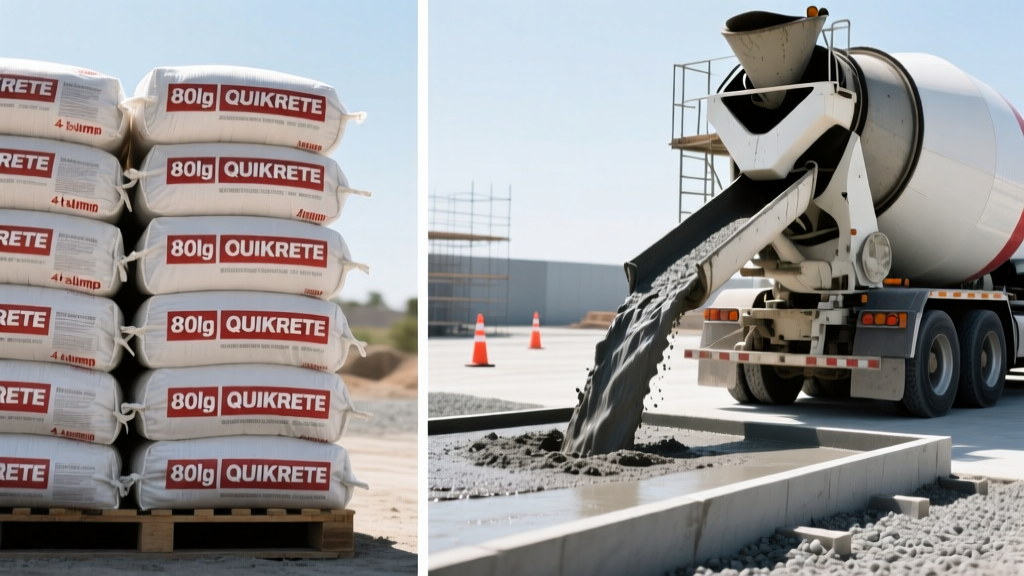
Cost Analysis: Bagged vs. Ready-Mix
Pricing fluctuates based on regional material costs, but the mathematical threshold for switching from bagged to ready-mix remains consistent.
The 1-Cubic-Yard Breakdown
QUIKRETE Bagged Route:
1 Cubic Yard = 27 cubic feet.
At 0.6 cubic feet per 80 lb bag, you need exactly 45 bags.
At an average retail price of $6.50 per bag, the material cost is $292.50.
Hidden Costs: Mixer rental ($75/day), water costs, and 4-6 hours of intense manual labor.
Ready-Mix Route:
Standard 4000 PSI ready-mix averages $165 to $185 per cubic yard.
Hidden Costs: Batch plants charge a 'short load fee' (typically $75 to $125) for orders under 10 cubic yards. Total delivered cost for 1 yard: $240 to $310.
Verdict: Once a project exceeds 0.5 cubic yards (approx. 23 bags), ready-mix becomes more cost-effective when factoring in labor and equipment rental.
Decision Framework: Which Mix for Your Project?
Use this technical decision matrix to specify the correct material for your application.
- Volume & Logistics: If the total volume is under 0.5 cubic yards AND the site lacks access for a 30,000 lb ready-mix truck, specify QUIKRETE No. 1101 or 1007.
- Freeze-Thaw Exposure: If pouring exterior flatwork in USDA Hardiness Zones 6 or colder, you MUST use ready-mix with specified 6% air entrainment. Bagged concrete will spall and degrade within 3 to 5 winters.
- Time-Critical Anchoring: For setting structural post bases, machinery anchors, or utility poles where load-bearing is required within 24 hours, specify QUIKRETE Fast-Setting (No. 1240).
- Structural Foundations & Slabs: For any monolithic slab, continuous footing, or suspended deck exceeding 50 square feet, specify ready-mix with 3/4-inch aggregate and a maximum 0.45 w/c ratio to ensure ACI 318 compliance and prevent cold joint failures.
Written by
Sarah WhitfieldSarah Whitfield is a chartered quantity surveyor (MRICS) and construction cost analyst with 15 years of experience in material pricing, procurement strategy, and project budgeting. She earned her degree in Construction Management from the University of Reading (UK) and has worked on projects ranging from $2M custom homes to $180M mixed-use developments across North America and Europe. Sarah currently leads cost estimating for BuildMat Insight, maintaining a proprietary database of 4,000+ material price points updated quarterly. She is a frequent contributor to RSMeans cost data panels and has presented at the International Cost Engineering Council (ICEC) congress. Based in Denver, CO, Sarah is an avid trail runner and volunteer mentor for Women in Construction.
More from Sarah Whitfield
View all
Wood & Lumber
What Are the Different Types of Wood? A Builder's Guide
Compare structural softwoods, finish hardwoods, and engineered lumber. Analyze Janka ratings, MOE values, and 2026 pricing for construction.
Aug 4, 2026

Walls & Panels
Steel Framing vs Wood Framing: Corrosion and Moisture Defense
Compare steel framing vs wood framing for moisture resistance. Learn about galvanized coatings, condensation risks, and corrosion protection strategies.
Jul 21, 2026

Stone & Masonry
How to Cut Stone Veneer: Wet Saw vs Grinder Comparison
Compare the best tools for cutting stone veneer. We review wet saws, angle grinders, and chop saws to help you achieve clean, chip-free cuts.
Jul 21, 2026