Troubleshooting Different Types of Concrete Mixers: Repair Guide
Expert repair guide for different types of concrete mixers. Diagnose gear wear, seal leaks, and hydraulic faults in drum, pan, and twin-shaft models.

The True Cost of Mixer Downtime
When a batch plant or mobile mixer goes down, the financial bleed is immediate. In the current 2026 construction landscape, idle ready-mix trucks and halted paving crews cost contractors between $800 and $1,500 per hour in delayed pours and cold joint remediation. Troubleshooting the different types of concrete mixers requires moving beyond basic motor checks and understanding the specific mechanical failure modes inherent to drum, pan, twin-shaft, and volumetric designs.
Diagnostic Matrix: Symptom-to-Mixer Mapping
Identifying the root cause depends heavily on the mixer architecture. Use this rapid-diagnostic table to isolate the failing subsystem before ordering replacement parts.
| Mixer Type | Primary Symptom | Most Likely Culprit | Immediate Field Fix |
|---|---|---|---|
| Drum (Batch) | Grinding noise, drum stalling under load | Ring/pinion backlash misalignment | Shim pinion bearing housing |
| Pan (Intensive) | Uneven mix, aggregate segregation | Scraper blade wear / arm deflection | Hardface blades, adjust arm pitch |
| Twin-Shaft | Cement slurry leaking from shaft ends | Mechanical face seal degradation | Flush seals, replace O-rings |
| Volumetric | Low slump, inconsistent yield per yard | Conveyor chain stretch, gate drift | Tension take-up bearings, recalibrate |
1. Drum Mixers (Tilting and Non-Tilting)
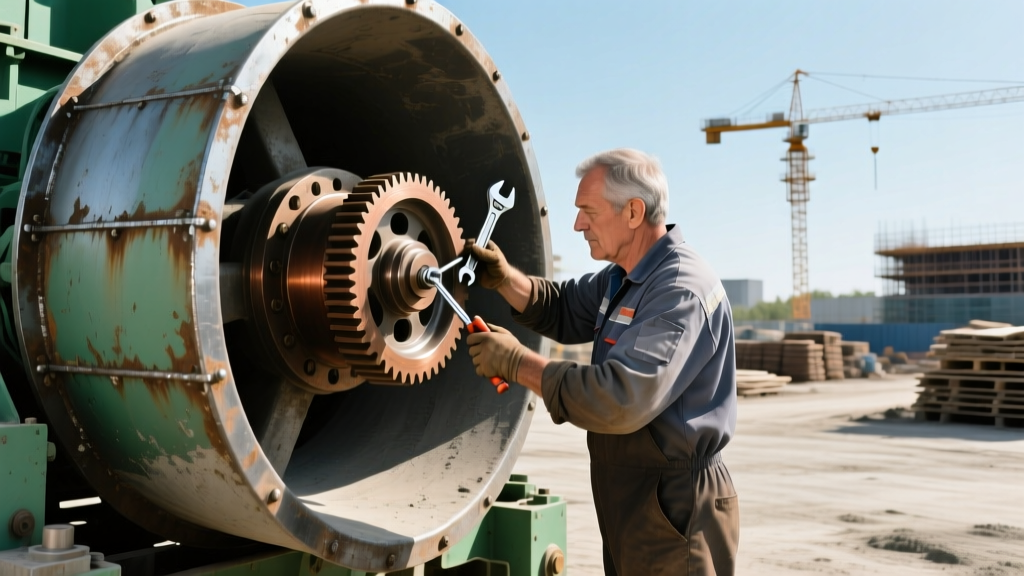
Drum mixers, such as the ubiquitous Multiquip MC94SH or larger 12-yard transit drums, rely on a simple but high-torque ring and pinion gear system. The most frequent catastrophic failure is gear tooth shearing caused by improper backlash or dried concrete buildup in the gear teeth.
Adjusting Ring and Pinion Backlash
If the drum shudders or emits a high-pitched whine during rotation, the pinion gear is likely riding too high or too deep in the cast-iron ring gear. The Fix: Loosen the pinion bearing housing bolts. Using a feeler gauge, measure the clearance between the mating teeth. The optimal backlash for a standard 9-to-12 cubic foot portable mixer is 0.060 to 0.080 inches. For larger transit drums, consult the OEM spec (typically 0.125 to 0.187 inches). Insert hardened steel shims behind the bearing housing to achieve the exact tolerance, then torque the housing bolts to 140 ft-lbs. Apply a heavy coat of NLGI #2 lithium-complex open gear lubricant to the ring gear immediately after adjustment.
V-Belt Drive Slippage and Motor Overheating
On belt-driven drum mixers, slippage generates excessive heat, glazing the belts and tripping the motor's thermal overload. Do not simply tighten the motor mount. Check the belt deflection: apply 10 lbs of thumb pressure at the midpoint of the longest belt span. Deflection should be exactly 1/2 inch. If the belts are mismatched in length (a common mistake when replacing them one at a time), the newer belt will carry 90% of the load and snap within 48 hours. Always replace V-belts in matched sets.
2. Pan Mixers (Intensive Mixers)
Pan mixers are the workhorses for precast plants and block yards due to their high-shear mixing action. However, this aggressive action accelerates wear on the internal scraper arms and discharge gates.
Scraper Arm Wear and Hardfacing
When the bottom and side scraper blades wear down by more than 1/4 inch, the mixer leaves a dead zone of unmixed aggregate near the pan walls, drastically altering the water-cement ratio of the final batch. The Fix: Instead of constantly buying OEM replacement blades, maintenance teams should hardface the leading edges of the scraper arms. Using a Lincoln Electric Stoody 101HC (or equivalent chromium-carbide) welding rod, lay down a 1/8-inch thick hardfacing bead in a waffle pattern on the wear surfaces. This extends blade life by up to 400% compared to bare AR400 steel. Ensure the scraper arms are pitched at the factory-specified angle (usually 15 to 22 degrees) to prevent the blade from 'plowing' rather than 'slicing' the mix.
Hydraulic Discharge Gate Faults
If the pan's bottom discharge gate hesitates or fails to seal completely, cement paste will bleed onto the plant floor, and batch weights will be inaccurate. This is rarely a hydraulic pump issue; it is almost always a mechanical linkage problem. Inspect the gate pivot pins for elongation. If the pin holes are wallowed out by more than 0.030 inches, the gate will drop out of alignment when the heavy mix pushes against it. Ream the holes and install oversized, hardened pivot pins, then adjust the hydraulic cylinder limit switches to ensure the gate closes with a firm 200-psi seating pressure.
3. Twin-Shaft Mixers
Twin-shaft mixers (like those from BHS-Sonthofen or Sicoma) offer the fastest mixing times for high-spec concrete but are highly sensitive to shaft seal failures and timing gear desynchronization.
The two counter-rotating shafts in a twin-shaft mixer are timed via external gears to prevent the mixing arms from colliding. If the timing gears wear and the shafts slip out of phase, the arms will crash into each other, destroying the gearbox. When replacing timing gears, the backlash between the timing gears must be shimmed to a strict 0.005 to 0.010-inch tolerance. Anything looser risks arm collision under heavy load.
Shaft Seal Slurry Intrusion
The most expensive failure on a twin-shaft mixer is cement slurry migrating past the shaft seals and destroying the main roller bearings. Modern 2026 twin-shaft models utilize mechanical face seals or advanced gland packing systems. The Fix: If you see a crusty white buildup around the shaft ends, the purge system has failed. Twin-shaft seals require a continuous purge of grease or air to keep abrasive fines out. Check the automatic grease purger lines for blockages. If the seal is already compromised, you must pull the shaft. When rebuilding, replace the tungsten carbide wear sleeves and use the OEM-specified polyurethane O-rings. Standard Buna-N O-rings will degrade rapidly when exposed to the high alkalinity (pH 12+) of portland cement slurry.
4. Volumetric Mobile Mixers
Volumetric mixers meter ingredients by volume rather than weight, making calibration and conveyor integrity the primary troubleshooting focus.
Conveyor Chain Stretch and Yield Drift
The sand and stone conveyor chains on volumetric mixers operate in highly abrasive environments. As the chain stretches, the sprocket timing drifts, causing the mixer to yield more aggregate per linear foot of conveyor travel than the calibration chart dictates. This results in harsh, unworkable concrete. The Fix: Measure a 10-foot span of the conveyor chain. If it has stretched beyond 3% (more than 3.6 inches over 10 feet), the chain must be replaced; tensioning it further will cause it to ride up and jump the sprocket teeth. When installing the new chain, apply a dry-film molybdenum disulfide chain lubricant. Wet, tacky lubricants will attract silica dust, forming a grinding paste that destroys the chain pins in weeks.
Preventative Maintenance Framework
To minimize emergency repairs across all concrete mixing technologies, implement this strict lubrication and inspection schedule:
- Daily: Purge twin-shaft and drum main bearings with NLGI #2 Lithium Complex grease until fresh grease purges from the seal lips. Flush pan mixer discharge gate hinges with water and apply dry graphite spray.
- Weekly: Inspect all V-belts for micro-cracking and check hydraulic fluid for milky discoloration (indicating water intrusion from the washout process).
- Monthly: Perform a yield test on volumetric mixers and check the calibration of the water flow meters. Clean the water meter strainer to prevent cavitation in the booster pumps.
Mastering the repair of these diverse systems requires a shift from reactive part-swapping to precision measurement and proactive metallurgy. By adhering to exact backlash tolerances, utilizing advanced hardfacing techniques, and maintaining rigorous seal-purge protocols, maintenance teams can extend mixer lifespans and eliminate costly mid-pour breakdowns.
Written by
Priya KapoorPriya Kapoor is a real estate market analyst and construction economics researcher with expertise in housing affordability, development feasibility, and infrastructure investment. She holds a Master of Regional Planning from Cornell University and previously worked as a senior analyst at CBRE's Investment Properties group, where she modeled returns for $4B in mixed-use development pipelines. Priya now runs an independent research practice advising developers, municipalities, and REITs on construction cost forecasting and market timing. She publishes the quarterly "BuildMat Market Pulse" report tracking material price indices across 12 commodity categories. Based in Austin, TX, Priya serves on the board of Habitat for Humanity Austin and is a marathon runner.
More from Priya Kapoor
View all
Construction Cost
Cost to Build a 1600 Sq Ft Home in 2026: Full Breakdown
Accurate 2026 cost to build a 1600 sq ft home—material, labor, and regional pricing breakdowns included. Plan your budget with real-time estimates.
Aug 11, 2026

Wood & Lumber
Name the Types of Wood for Pressure Treatment and Preservation
Learn how to name the types of wood best suited for pressure treatment. Compare species treatability, chemical retention levels, and 2026 preservation costs.
Aug 4, 2026

Stone & Masonry
Stone Veneer Suppliers Lindenhurst: 2026 Cost Analysis
Analyze 2026 stone veneer costs in Lindenhurst, NY. Compare local supplier pricing, delivery fees, and Suffolk County installation labor rates.
Aug 4, 2026