Fiberglass Pool vs Concrete: Mix Designs & Structural Guide
Analyze the fiberglass pool vs concrete debate through structural engineering, shotcrete mix designs, FRP composition, and backfill requirements.

Beyond Aesthetics: The Structural Reality of Pool Materials
The consumer debate surrounding a fiberglass pool vs concrete typically centers on surface maintenance, algae resistance, and installation speed. However, from a structural engineering and material science perspective, this comparison is fundamentally about contrasting a pre-manufactured, anisotropic fiber-reinforced polymer (FRP) shell with a site-cast, isotropic, steel-reinforced cementitious structure. Understanding the specific mix designs, compressive strengths, and soil-structure interaction requirements of both materials is critical for builders and engineers to prevent catastrophic structural failures.
The Concrete Standard: Shotcrete and Gunite Mix Designs
Concrete pools are not poured; they are pneumatically applied. The industry relies on two distinct methods: wet-mix shotcrete and dry-mix gunite. Both require rigorous mix designs to achieve the necessary structural integrity without excessive rebound or shrinkage cracking.
- Wet-Mix Shotcrete: All ingredients, including water, are mixed before entering the delivery hose. Compressive strength is highly predictable, typically achieving 4,000 to 5,000 PSI at 28 days. Rebound rates are lower (5% to 10%).
- Dry-Mix Gunite: Dry cement and aggregate are blown through the hose; water is added at the nozzle. Strength relies heavily on the nozzleman's skill to maintain a water-to-cement (w/c) ratio of 0.40 to 0.45. Rebound rates are higher (15% to 25%) and must be manually cleared to prevent structural weak planes.
Critical Mix Design Parameters for Pool Shells
According to structural guidelines referenced by the US Bureau of Reclamation for pneumatic concrete application, a high-performance pool shell mix design must adhere to strict parameters:
- Compressive Strength: Minimum 4,000 PSI at 28 days (f'c = 4000).
- Maximum Aggregate Size: 3/8-inch to 1/2-inch to prevent hose blockages and ensure proper encapsulation of the #3 or #4 steel rebar grid.
- Water-to-Cement Ratio: Strictly maintained between 0.40 and 0.45 to minimize plastic shrinkage and ensure high density.
- Fiber Reinforcement: Macro-synthetic fibers (polypropylene or polyolefin blends) are increasingly dosed at 3 to 5 lbs per cubic yard. These fibers do not replace structural rebar but drastically reduce early-age plastic shrinkage cracking by providing micro-level tensile bridging.
Fiberglass Shells: FRP Composition and Structural Limits
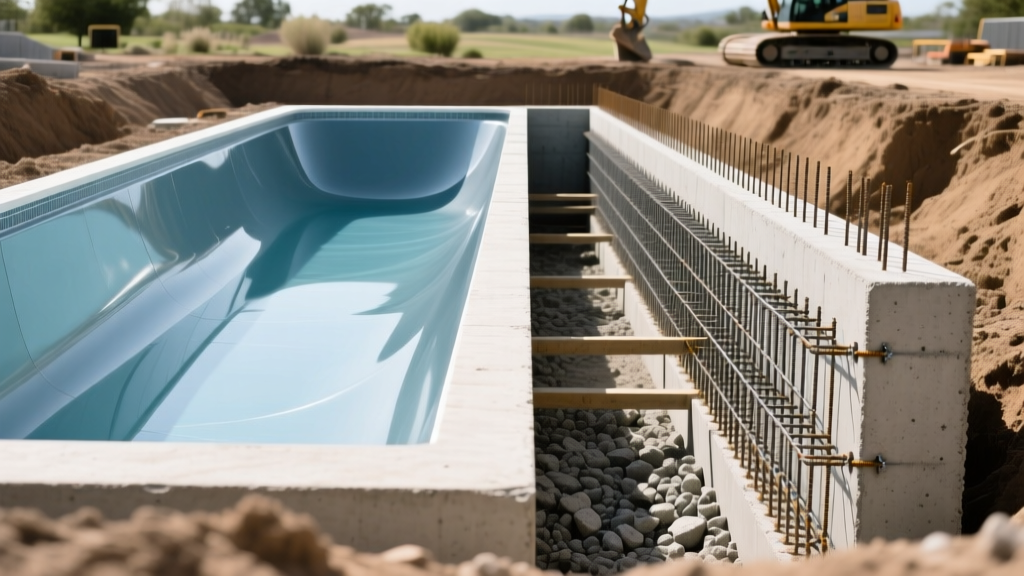
Fiberglass pools are manufactured using a composite layup process. The structural integrity of the shell relies on the synergy between a chemical-resistant gelcoat and a structural FRP laminate. Unlike concrete, which possesses high compressive and moderate tensile strength, fiberglass exhibits exceptional tensile strength but lacks inherent compressive rigidity, making it entirely dependent on its surrounding backfill for structural support.
The Fiberglass Layup Sequence
- Gelcoat (15-20 mils): An isophthalic polyester or vinyl ester resin layer that provides the watertight, UV-resistant, and chemical-resistant interior surface. Vinyl ester is superior for preventing osmotic blistering.
- Chopped Strand Mat (CSM): Randomly oriented fiberglass strands bound with a soluble binder, providing isotropic strength and building initial thickness.
- Woven Roving: Heavy, bidirectional fiberglass fabric applied in structural ribs and high-stress zones (like the deep end hopper and step returns) to maximize tensile load-bearing capacity.
Head-to-Head Structural & Material Comparison Matrix
| Property / Metric | Reinforced Shotcrete | Fiberglass (FRP) Shell |
|---|---|---|
| Compressive Strength | 4,000 - 5,000 PSI | ~15,000 PSI (Resin dependent) |
| Tensile Strength | ~400 PSI (Concrete) / 60,000 PSI (Rebar) | 10,000 - 18,000 PSI |
| Typical Shell Thickness | 8 to 12 inches | 3/16 to 5/16 inch |
| Soil Reactivity Tolerance | High (Self-supporting structure) | Low (Requires engineered backfill) |
| Hydrostatic Uplift Resistance | Excellent (Massive dead load) | Poor (Requires hydrostatic valves & ballast) |
Critical Failure Modes: Concrete Cracking vs. Fiberglass Osmosis
Every material has a specific failure mode dictated by its chemistry and application method. Recognizing these edge cases is vital for long-term structural viability.
Concrete Pool Failure Modes
- Rebound Inclusion: If the nozzleman fails to chip away the high-water, low-cement rebound material that bounces off the rebar, it becomes trapped in the shell. This creates a porous, weak plane that leads to delamination and localized structural failure.
- Alkali-Silica Reaction (ASR): If the ready-mix supplier uses reactive siliceous aggregates without supplementary cementitious materials (like fly ash or slag), ASR can cause expansive cracking from within the shell over a 5 to 10-year period.
Fiberglass Pool Failure Modes
Osmosis occurs when water molecules permeate the gelcoat and react with uncured styrene in the FRP laminate, creating acetic acid. This builds pressure and forms blisters on the pool floor. Furthermore, 'cobbling'—a visible wavy pattern of the fiberglass mat showing through the gelcoat—occurs when the gelcoat is applied too thin (under 15 mils) or cures too quickly in high heat, causing it to shrink and pull away from the structural ribs.
The Hidden Mix Design: Backfill and Base Requirements
The most significant structural difference in the fiberglass pool vs concrete debate lies beneath the surface. A concrete pool is a self-supporting, monolithic vault. A fiberglass pool is essentially a flexible membrane that requires a highly engineered surrounding matrix to distribute soil loads.
The Pool & Hot Tub Alliance (PHTA) strictly mandates specific backfill materials for fiberglass installations to prevent wall deflection and floor heaving. Native soil, particularly expansive clays, is strictly prohibited.
Controlled Low-Strength Material (CLSM) Mix Design
For sites with high water tables or poor drainage, builders use CLSM (flowable fill) as a backfill. As detailed by the National Ready Mixed Concrete Association, CLSM provides a fluid, self-compacting matrix that locks the fiberglass shell in place without exerting hydrostatic pressure during curing. A standard excavatable CLSM mix design includes:
- Cement: 94 lbs (1 sack) Type I/II Portland Cement
- Fly Ash: 150 lbs (Class F or C)
- Fine Aggregate: 2,800 lbs (Concrete sand)
- Water: 45 to 55 gallons (Adjusted for 8-10 inch slump flow)
- Yield: ~200 PSI compressive strength at 28 days (Strong enough to support the shell, weak enough to be excavated with hand tools if future plumbing repairs are needed).
2026 Cost Analysis: Material and Labor Breakdown
Pricing fluctuates based on regional aggregate costs and crane availability, but the structural material costs for a standard 16' x 32' pool footprint break down as follows:
- Concrete Shell (Shotcrete): 4,000 PSI mix costs $145 to $185 per cubic yard. A 16x32 pool requires roughly 65-80 yards. Combined with boom pump rental ($1,200/day), steel rebar ($4,500), and nozzleman labor, the structural shell costs between $18,000 and $24,000.
- Fiberglass Shell & Matrix: The pre-manufactured FRP shell costs $22,000 to $38,000. However, you must add a 100-ton crane lift ($1,500 to $3,000), 60 tons of clean 3/8-inch crushed stone backfill ($2,500), or CLSM flowable fill ($4,500). Total structural costs range from $26,000 to $43,000.
Decision Framework: Matching Material to Site Conditions
Do not select a pool material based solely on surface aesthetics. Base the decision on geotechnical and hydrological site data:
- Choose Reinforced Shotcrete if: The site features highly expansive clay soils, extreme topographical slopes requiring deep retaining walls, or if the design requires custom, non-geometric shapes (e.g., natural lagoon profiles or integrated structural spas).
- Choose Fiberglass (FRP) if: The site has stable, well-draining sandy or loamy soils, the design adheres to standard manufacturer molds, and the project timeline demands a watertight structure within 48 hours of excavation.
Written by
James ThorntonJames Thornton is a construction industry veteran with 25 years of hands-on experience in wood framing, lumber grading, and residential building codes. He started as a framing carpenter in rural Oregon, earned his ICC Residential Building Inspector certification, and eventually became a senior plan reviewer for the City of Portland Bureau of Development Services. James holds a B.S. in Wood Science & Technology from Oregon State University and is a certified lumber grader through the West Coast Lumber Inspection Bureau (WCLIB). He has inspected over 3,000 residential construction sites and authored the city's internal guide on advanced framing techniques (2x6 at 24" O.C.). James lives in Bend, OR, where he builds custom timber-frame cabins and competes in lumberjack sports.
More from James Thornton
View all
Insulation
Best Home Insulation Materials: Complete 2026 Guide
Compare top home insulation materials for 2026. Find R-values, installed costs per square foot, and best uses for fiberglass, spray foam, and mineral wool.
Aug 4, 2026

Sustainable Building
Certify Your Green Building Material for LEED and WELL
Step-by-step guide to certifying a green building material for LEED v5 and WELL v2. Master EPDs, HPDs, and VOC limits for 2026 project specifications.
Aug 4, 2026

Stone & Masonry
Veneer Stacked Stone Panels: Interior Design & Style Showcase
Discover how veneer stacked stone panels transform interiors. Explore modern design profiles, material pairings, and technical installation specs.
Aug 4, 2026