Freddy's Concrete vs Sundae: Patio Application Showcase
Compare Freddy's Concrete traditional flatwork with Sundae decorative overlays. Explore costs, durability, and patio application showcases.

The Application Dilemma: Traditional Pour vs. Decorative Overlay
When planning a high-traffic exterior flatwork project, homeowners and contractors frequently debate the merits of a full-depth traditional pour versus a specialized decorative resurfacing system. The comparison of Freddy's Concrete vs Sundae perfectly encapsulates this industry divide. Freddy's Concrete represents the gold standard for traditional, full-depth poured and stamped flatwork, utilizing high-PSI ready-mix designs and deep structural integrity. Conversely, Sundae specializes in advanced polymer-modified cementitious overlays and polyaspartic topcoats designed to resurface, protect, and aesthetically upgrade existing concrete slabs.
This application showcase dissects the material science, installation protocols, and long-term performance metrics of both methodologies. By examining real-world patio and driveway applications, we can determine exactly which system aligns with your structural requirements, budget, and aesthetic goals.
Choose Freddy's Traditional Pour if you are building on bare soil, require heavy vehicular load-bearing capacity, or need a completely new substrate.
Choose Sundae Overlays if you have an existing, structurally sound concrete slab that suffers from surface spalling, UV fading, or aesthetic fatigue, and you want to avoid the $2,000+ cost of demolition and haul-away.
Freddy's Concrete: Stamped and Poured Flatwork Showcase
Material Specs & Mix Design
A premium Freddy's Concrete application begins below the frost line. For a standard residential driveway or heavy-use patio, the specification calls for a 4,000 PSI air-entrained mix design. According to guidelines from the Portland Cement Association, air-entrainment is non-negotiable in freeze-thaw climates. The mix is batched with 5% to 7% microscopic air bubbles, which provide internal expansion chambers for freezing water, preventing catastrophic surface scaling.
- Compressive Strength: 4,000 PSI at 28 days.
- Water-to-Cement (w/c) Ratio: 0.45 maximum to ensure low permeability.
- Slump: 4 to 5 inches, optimized for stamping mats without excessive bleed water.
- Reinforcement: W2.9xW2.9 welded wire mesh or macro-synthetic fibers (e.g., FiberStrand) dosed at 7.5 lbs per cubic yard.
Application Showcase: The Stamped Driveway
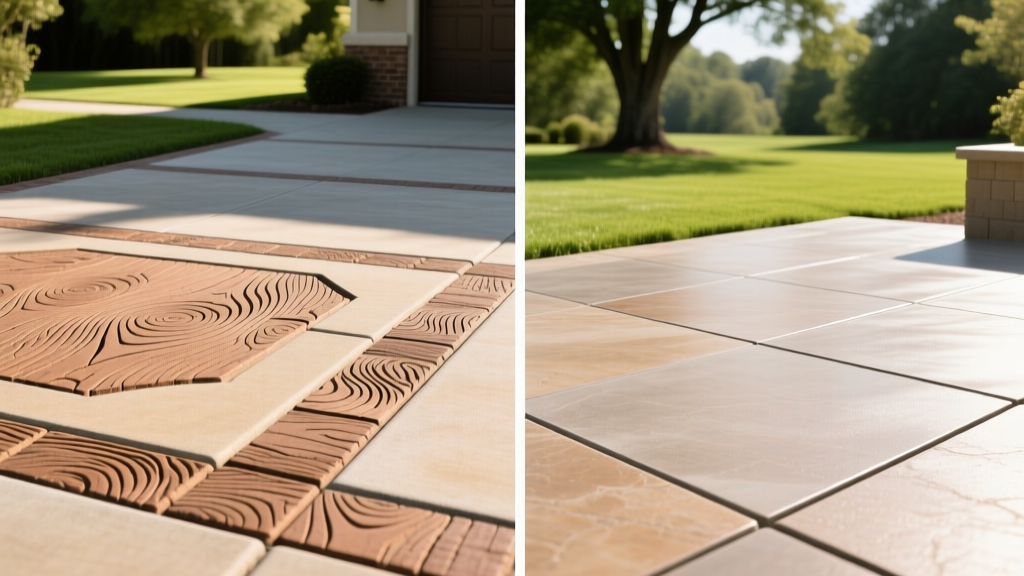
In a recent 600-square-foot driveway application, the Freddy's methodology showcased the necessity of precise jointing and curing. After the 4-inch slab was poured and struck off, color hardener (broadcast at 60 lbs per 100 sq ft) was troweled into the surface. The stamping phase utilized urethane mats with a 1/8-inch grout line to mimic slate.
The critical differentiator in this application was the control joint layout. Joints were saw-cut to a depth of 1 inch (exactly 25% of the slab thickness) within 18 hours of the pour. This preemptive relief guaranteed that inevitable shrinkage cracking occurred hidden within the faux-grout lines rather than marring the stamped slate pattern. The final cure and seal involved a solvent-based acrylic sealer applied at 400 square feet per gallon, yielding a wet-look finish that deepened the secondary color accents.
Sundae Decorative Overlays: Resurfacing & Coating Showcase
Polymer-Modified Overlay Specs
Sundae's application model bypasses the need for heavy excavation and ready-mix trucks by utilizing advanced overlay technology. Their flagship system relies on a polymer-modified cementitious overlay, typically applied at a thickness of 1/4 inch to 1/2 inch. Unlike standard concrete, which relies solely on Portland cement hydration, Sundae's overlay incorporates acrylic polymers and redispersible polymer powders. This dramatically increases the tensile and flexural strength, allowing the thin layer to bridge minor substrate imperfections without cracking.
- Compressive Strength: 5,500 PSI (higher than standard concrete due to low w/c ratio and polymer matrix).
- Tensile Strength: >600 PSI, crucial for resisting delamination forces.
- Topcoat: Aliphatic polyaspartic polyurea, providing 100% UV stability and zero yellowing.
- VOC Levels: Near-zero, allowing for safe application in enclosed patio spaces.
Application Showcase: The Pool Deck Renovation
Transforming a 15-year-old, sun-baked pool deck requires rigorous surface preparation. The Sundae application showcase began with mechanical shotblasting to achieve a Concrete Surface Profile (CSP) of 3 to 4. As noted by the American Society of Concrete Contractors, proper mechanical profiling is the single most critical factor in preventing overlay delamination.
Following shotblasting, a moisture vapor transmission (MVT) test was conducted using calcium chloride kits. With readings below 3 lbs/1000 sq ft/24 hours, the slab was cleared for the overlay. The Sundae crew applied a 3/8-inch knockdown texture overlay, which was then hand-troweled to create a seamless, slip-resistant surface. The final step involved a dual-component polyaspartic topcoat. Unlike traditional acrylics that degrade and chalk within two years under direct UV exposure, the polyaspartic topcoat chemically cross-links to form an impermeable, UV-stable shield that resists chlorine splash and pool chemicals.
Never apply a Sundae polymer overlay or polyaspartic coating over a slab with an MVT rating exceeding 5 lbs/1000 sq ft/24 hours. Trapped hydrostatic pressure will cause osmotic blistering and catastrophic delamination within 6 to 12 months. If MVT is high, a moisture-mitigating epoxy primer must be applied first.
Head-to-Head Performance Matrix
| Metric | Freddy's Traditional Pour | Sundae Overlay System |
|---|---|---|
| Substrate Requirement | Compacted gravel base (4-6 inches) | Existing structurally sound concrete |
| Thickness | 4 to 6 inches | 1/4 to 1/2 inch |
| Walkable Cure Time | 48 to 72 hours | 12 to 24 hours |
| Heavy Load Capacity | Excellent (RVs, Dump Trucks) | Moderate (Passenger vehicles only) |
| UV & Chemical Resistance | Moderate (Requires resealing every 2 yrs) | Exceptional (Polyaspartic topcoat) |
| Average Installed Cost | $10.00 - $16.00 per sq ft | $13.00 - $19.00 per sq ft |
Edge Cases & Failure Modes
Understanding how these systems fail is just as important as knowing how they are installed. Both Freddy's traditional pours and Sundae overlays have specific vulnerabilities that must be managed during the application phase.
Freddy's Concrete: Plastic Shrinkage & Joint Spalling
In high-wind or low-humidity environments, traditional pours are highly susceptible to plastic shrinkage cracking. If the rate of surface evaporation exceeds 0.2 lbs per square foot per hour, microscopic surface cracks will form before the stamping mats are even applied. To mitigate this, contractors must apply an evaporation retardant (such as E-CON) immediately after screeding. Additionally, if the stamping tools are pressed too aggressively before the concrete has achieved sufficient initial set, the edges of the faux-joints will spall and crumble, leading to permanent aesthetic defects.
Sundae Overlays: Thermal Shock & Edge Chipping
While Sundae's polymer overlays boast immense compressive strength, their thin profile makes them vulnerable to edge chipping and thermal shock. If the overlay is applied too close to an expansion joint without a corresponding soft joint being recreated in the overlay, the thermal expansion of the underlying slab will telegraph through and crack the overlay. Furthermore, dropping heavy, sharp objects (like metal patio furniture legs without rubber pads) on a 1/4-inch overlay can cause localized micro-fractures that compromise the polyaspartic topcoat, allowing water ingress and subsequent freeze-thaw damage.
Final Verdict for Your Project
The decision between Freddy's Concrete and Sundae ultimately hinges on the current state of your job site and your long-term maintenance tolerance.
If you are developing raw land, expanding your home's footprint, or need a surface capable of supporting 10,000-pound RVs and heavy delivery trucks, Freddy's traditional poured and stamped concrete is the only structurally viable option. The deep-profile substrate and heavy reinforcement provide unmatched load-bearing longevity.
However, if you are renovating an existing pool deck, patio, or walkway where the underlying concrete is structurally intact but visually degraded, Sundae's decorative overlay system offers superior performance. The combination of polymer-modified cement and an aliphatic polyaspartic topcoat delivers a UV-stable, chemical-resistant surface that dramatically reduces long-term maintenance, eliminating the need for the bi-annual resealing required by traditional stamped concrete.
Written by
David NakamuraDavid Nakamura is a licensed architect (AIA) and construction technology writer focused on sustainable building methods, mass timber engineering, and high-performance building envelopes. He holds a Master of Architecture from the University of Washington and is a certified Passive House Consultant (CPHC). David spent eight years at the Seattle firm Mithun, where he led the design of three LEED Platinum projects, before founding his own practice specializing in net-zero residential design. He serves on the editorial advisory board of GreenBuilder Magazine and has authored peer-reviewed papers on cross-laminated timber (CLT) connections for the Journal of Structural Engineering. In his spare time, David teaches woodworking at Pratt Fine Arts Center and kayaks the Puget Sound.
More from David Nakamura
View all
Construction Cost
Labor Cost to Build a Deck Per Sq Ft: 2026 Installation Guide
Discover the exact labor cost to build a deck per sq ft in 2026. This installation guide breaks down contractor rates, complexity factors, and hidden fees.
Aug 4, 2026

Construction Cost
How Much Does It Cost to Build a 3 Bedroom House? Financing Guide
Learn exactly how much it costs to build a 3 bedroom house and explore 2026 financing options, construction loan types, and budget frameworks for your build.
Aug 4, 2026

Construction Cost
Cost to Build a Tennis Court: 2026 Guide
How much does it cost to build a tennis court in 2026? Breakdowns for asphalt, concrete, and synthetic surfaces plus fencing and lighting.
Jul 30, 2026