Fiberglass Pools vs Concrete Pools: Installation Guide & Costs
Compare installation processes for fiberglass pools vs concrete pools. Discover timelines, site prep requirements, soil constraints, and exact cost breakdowns.

The Core Installation Divergence: Shell vs. Pour
When evaluating fiberglass pools vs concrete pools, the decision ultimately hinges on your property's physical constraints and your timeline tolerance. The installation methodologies for these two materials are fundamentally opposed. Fiberglass installation is a logistics-heavy, rapid-assembly process centered around transporting and craning a pre-manufactured, monolithic shell into an excavated pit. Concrete (specifically gunite or shotcrete) installation is a slow, multi-trade construction project built entirely from the ground up on-site using rebar cages and pneumatically projected concrete.
Understanding the mechanical and structural demands of each installation method is critical. A fiberglass shell relies on the surrounding backfill for structural support, whereas a concrete pool is a self-supporting, steel-reinforced structure that transfers loads directly into the underlying soil.
Site Preparation and Excavation Requirements
Before a single yard of dirt is moved, the site must be evaluated for access and soil composition. The physical footprint of the pool is only one factor; the staging area for equipment dictates feasibility.
| Site Constraint | Fiberglass Pool Requirements | Concrete Pool Requirements |
|---|---|---|
| Equipment Access | Requires a 12-to-14-foot wide clearance path for a large crane and flatbed truck delivering the shell. | Requires only a 3-to-4-foot wide gate access for skid-steer loaders, rebar tiers, and shotcrete hoses. |
| Overhead Clearance | Minimum 25-30 feet of vertical clearance to avoid power lines during the crane lift. | No major overhead restrictions; equipment operates at ground level. |
| Excavation Precision | Must be dug to exact shell dimensions with a 6-to-12-inch over-dig for the gravel base and plumbing trenches. | Dug to the outer edge of the rebar cage plus 12 inches for formwork and worker access. |
| Soil Bearing Capacity | Requires stable, undisturbed soil or a heavily compacted engineered base to prevent shell flexing. | Highly adaptable; structural engineers can design thicker bond beams and deeper footings for poor soils. |
Step-by-Step Installation Timelines
The most stark contrast between fiberglass pools vs concrete pools is the project duration. Fiberglass installations compress the structural phase into a matter of days, while concrete requires sequential trade scheduling and mandatory chemical curing periods.
Fiberglass Pool Installation (3 to 5 Weeks Total)
- Excavation and Base Prep (Days 1-3): The hole is dug, and a 6-inch base of clean, crushed 3/8-inch pea gravel is laser-leveled.
- Plumbing Rough-In (Day 4): PVC plumbing lines are glued and pressure-tested before the shell arrives.
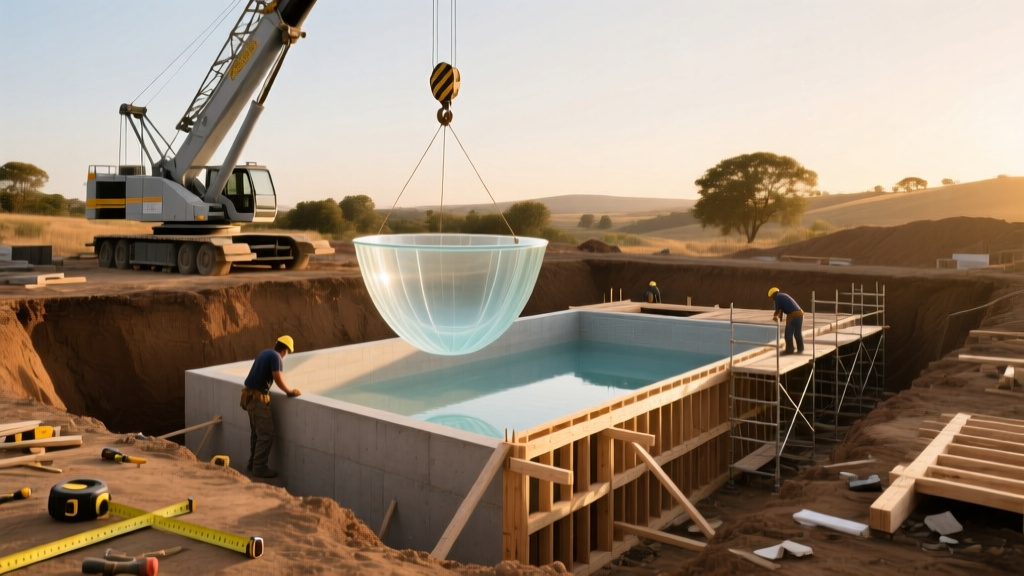
- Crane Lift and Setting (Day 5): The shell is lifted, set into the pit, and leveled. The pool is immediately filled with water while backfilling occurs simultaneously to equalize hydrostatic pressure.
- Backfilling and Deck Prep (Days 6-10): Clean gravel is backfilled in 12-inch lifts. The concrete deck is formed and poured.
- Startup and Balancing (Days 11-14): Equipment is connected, and water chemistry is balanced.
Concrete (Shotcrete) Pool Installation (8 to 12 Weeks Total)
- Excavation and Layout (Days 1-5): The hole is dug, and the exact pool shape is laid out with stakes and string.
- Plumbing and Rebar Tying (Days 6-12): Plumbing is trenched. A grid of #4 (1/2-inch) steel rebar is tied at 8-inch to 12-inch on-center spacing, elevated on chairs to sit in the middle of the concrete shell.
- Shotcrete Application (Day 13): A high-pressure hose projects a 4,000 PSI concrete mix onto the rebar cage, building a 8-to-12-inch thick shell.
- Moist Curing (Days 14-41): The concrete must be misted with water daily for 28 days to achieve full compressive strength and prevent plastic shrinkage cracking, as mandated by the American Concrete Institute (ACI).
- Coping, Tile, and Decking (Days 42-55): Perimeter coping and waterline tile are set in mortar. The deck is poured.
- Interior Finish (Days 56-60): Pebble Tec or quartz plaster is troweled onto the shell, and the pool is filled immediately.
If your property has a high water table, fiberglass pools require the installation of a hydrostatic relief valve in the main drain sump and a permanent gravel sump pit with a sump pump. If a fiberglass pool is drained in high-water-table conditions without these precautions, the buoyant force of the groundwater can literally push the empty shell out of the ground, destroying the surrounding deck and plumbing. Concrete pools, due to their massive weight (often exceeding 40,000 lbs empty), are far less susceptible to hydrostatic pop-up.
Backfilling and Plumbing: Where Mistakes Happen
Installation failures rarely stem from the pool material itself; they stem from improper backfill and plumbing practices.
The Fiberglass Backfill Imperative
A fiberglass shell is designed to hold water, not hold back dirt. The surrounding backfill provides the lateral support that prevents the walls from bulging inward when the pool is full. According to standards outlined by the Pool & Hot Tub Alliance (PHTA), installers must use clean, crushed angular gravel (never round river rock or native dirt). Native soil expands when wet, creating uneven lateral pressure that can cause the gelcoat to spider-crack or the walls to deform. The gravel must be watered and compacted in strict 12-inch vertical lifts.
Concrete Plumbing and Rebar Shadowing
Concrete pools fail when the steel reinforcement is compromised. "Rebar shadowing" occurs when the rebar cage is placed too close to the exterior soil or the interior finish (less than 2 inches of concrete cover). Moisture penetrates the porous concrete, rusts the steel, and causes the concrete to spall and crack from the inside out. Furthermore, because concrete is porous, all plumbing penetrations must be sealed with specialized hydrophilic waterstops to prevent leaks along the pipe conduits.
2026 Installation Cost Breakdown
When comparing the installation costs of fiberglass pools vs concrete pools, it is vital to separate the cost of the pool shell from the cost of the site work, labor, and materials required to put it in the ground. The figures below represent the installation and site-work costs only, excluding the base price of the fiberglass shell or the interior plaster finish for concrete.
| Cost Category | Fiberglass Installation | Concrete (Shotcrete) Installation |
|---|---|---|
| Excavation & Dirt Hauling | $3,500 - $6,000 | $4,500 - $8,500 (More access for heavy machinery) |
| Crane / Heavy Equipment Rental | $1,500 - $3,500 (Crane mandatory) | $500 - $1,500 (Skid steers and pumps) |
| Base Material (Gravel vs. Rebar) | $1,200 - $2,500 (Clean pea gravel) | $3,500 - $6,000 (#4 Rebar and tie wire) |
| Labor (Shell Set vs. Shotcrete) | $2,000 - $4,000 (1-day set crew) | $8,000 - $14,000 (Multi-week trade labor) |
| Backfill Material & Labor | $2,500 - $4,500 | $1,000 - $2,000 (Less backfill required) |
| Total Estimated Install Cost | $10,700 - $20,500 | $17,500 - $32,000 |
Note: Regional labor rates, soil conditions (e.g., solid rock excavation), and municipal permit fees will cause significant variance in these 2026 estimates.
Decision Framework: Which Installation Fits Your Site?
Use this framework to finalize your choice based on your specific property and project goals:
- You have wide, unobstructed access for a crane and flatbed truck.
- You need the pool operational within 30 to 45 days.
- You want to minimize long-term chemical and maintenance costs (the non-porous gelcoat prevents algae adhesion).
- Your design requirements fit within standard, pre-molded shapes and sizes (typically maxing out at 16x40 feet).
- Your backyard has narrow access gates (under 8 feet) or overhead power lines blocking crane access.
- You require a highly customized shape, infinity edge, or integrated shallow sun shelf that fiberglass molds cannot accommodate.
- Your lot features extreme slopes or poor soil bearing capacity requiring engineered, deep-footing structural solutions.
- You are willing to accept an 8-to-12 week construction timeline and higher long-term surface maintenance (acid washing and replastering every 10-15 years).
Ultimately, the choice between fiberglass pools vs concrete pools is dictated by the dirt. A site survey and soil bearing test will immediately eliminate one option or the other based on access and structural requirements, leaving you with the correct installation path for your property.
Written by
David NakamuraDavid Nakamura is a licensed architect (AIA) and construction technology writer focused on sustainable building methods, mass timber engineering, and high-performance building envelopes. He holds a Master of Architecture from the University of Washington and is a certified Passive House Consultant (CPHC). David spent eight years at the Seattle firm Mithun, where he led the design of three LEED Platinum projects, before founding his own practice specializing in net-zero residential design. He serves on the editorial advisory board of GreenBuilder Magazine and has authored peer-reviewed papers on cross-laminated timber (CLT) connections for the Journal of Structural Engineering. In his spare time, David teaches woodworking at Pratt Fine Arts Center and kayaks the Puget Sound.
More from David Nakamura
View all
Construction Cost
Labor Cost to Build a Deck Per Sq Ft: 2026 Installation Guide
Discover the exact labor cost to build a deck per sq ft in 2026. This installation guide breaks down contractor rates, complexity factors, and hidden fees.
Aug 4, 2026

Construction Cost
How Much Does It Cost to Build a 3 Bedroom House? Financing Guide
Learn exactly how much it costs to build a 3 bedroom house and explore 2026 financing options, construction loan types, and budget frameworks for your build.
Aug 4, 2026

Construction Cost
Cost to Build a Tennis Court: 2026 Guide
How much does it cost to build a tennis court in 2026? Breakdowns for asphalt, concrete, and synthetic surfaces plus fencing and lighting.
Jul 30, 2026