Brushed Concrete vs Stamped: Repair Troubleshooting
Discover expert troubleshooting for brushed concrete vs stamped repairs. Learn failure modes, color-matching techniques, and 2026 material costs.

The Divergence of Durability: Why Finish Type Dictates Repair Strategy
Homeowners and contractors frequently debate brushed concrete vs stamped concrete based on initial aesthetics and installation costs. However, the true divergence between these two finishes emerges years later when environmental stress, settling, or chemical exposure necessitates repairs. Troubleshooting a broom-finished driveway requires an entirely different material science approach than restoring a color-hardened, textured stamped patio. While brushed concrete relies on surface friction and uniform gray consistency, stamped concrete depends on a fragile, shallow layer of color hardener and a film-forming sealer to maintain its illusion of natural stone. Misapplying a brushed concrete repair technique to a stamped surface will instantly ruin the visual continuity, while treating brushed concrete with stamped repair protocols is a waste of premium materials.
Core Failure Modes: Brushed vs. Stamped Concrete
Before selecting a patching compound or sealer, you must correctly diagnose the failure. The table below outlines how identical environmental stressors manifest differently across these two finishes.
| Environmental Stressor | Brushed (Broom) Finish Manifestation | Stamped Finish Manifestation |
|---|---|---|
| Freeze-Thaw Cycles | Surface scaling and pop-outs exposing aggregate. | Delamination of the color hardener layer; micro-cracking in grout lines. |
| UV Radiation | Negligible visual impact; gray base remains stable. | Severe fading of secondary antiquing release colors; chalky acrylic sealer. |
| Subgrade Settling | Highly visible, straight tension cracks disrupting the broom striations. | Cracks disguised as natural stone joints if routed correctly, or glaring fractures across faux-stone patterns. |
| De-icing Salts | Accelerated spalling if air-entrainment was insufficient during the original pour. | Chemical etching of the acrylic sealer, leading to white, hazy blushing spots. |
Troubleshooting Brushed (Broom) Finish Concrete
Brushed concrete is notoriously unforgiving when it comes to patch blending. Because the finish relies on uniform, linear striations created by a stiff-bristled broom, any patchwork that disrupts this directional flow immediately draws the eye. According to the National Ready Mixed Concrete Association (NRMCA), surface scaling on broom finishes is most often caused by finishing operations that trap bleed water beneath the surface, creating a weak, non-durable top layer.
Fixing Spalling and Scaling on Broom Finishes
When the top 1/8 inch of a brushed driveway begins to flake off due to freeze-thaw damage, do not use standard vinyl concrete patchers. These shrink excessively and lack the compressive strength to withstand vehicular shear forces.
- Preparation: Scarify the scaled area using a 4-inch diamond cup wheel on an angle grinder to reach sound, solid concrete. Feather the edges to prevent a hard lip.
- Bonding: Apply a liquid bonding agent (such as Euclid Chemical's Eucobond) to the scarified substrate. Do not let it dry completely; apply the patch while tacky.
- Patching: Use a polymer-modified, high-build concrete resurfacer (e.g., Quikrete Concrete Resurfacer or Ardex CD).
- Re-Brooming: This is the critical step. Wait until the patch material loses its sheen and thumbprint resistance is achieved (usually 20-40 minutes depending on humidity). Use a coarse-bristle push broom and pull it in the exact same direction as the original broom lines. Applying too much pressure will flatten the ridges; too little pressure will fail to create deep enough grooves for traction.
The Stamped Concrete Repair Challenge
Repairing stamped concrete is less about structural restoration and more about forensic color matching and texture replication. The color on stamped concrete is not integral to the entire slab; it is achieved using a dry-shake color hardener that only penetrates the top 1/8 to 3/16 of an inch. If a heavy object chips the surface, or if a crack propagates through a faux-stone pattern, you are immediately dealing with a multi-layered restoration project.
Before attempting any localized sealer repair on stamped concrete, verify that the original installer properly power-washed the secondary powder release agent before the initial sealing. If residual release powder was trapped under the original acrylic sealer, applying a new coat of sealer over a patched area will cause a chemical reaction resulting in permanent white blushing. You must strip the failing sealer entirely using a chemical xylene wash before proceeding with color-matched repairs.
Routing Cracks Without Ruining the Pattern
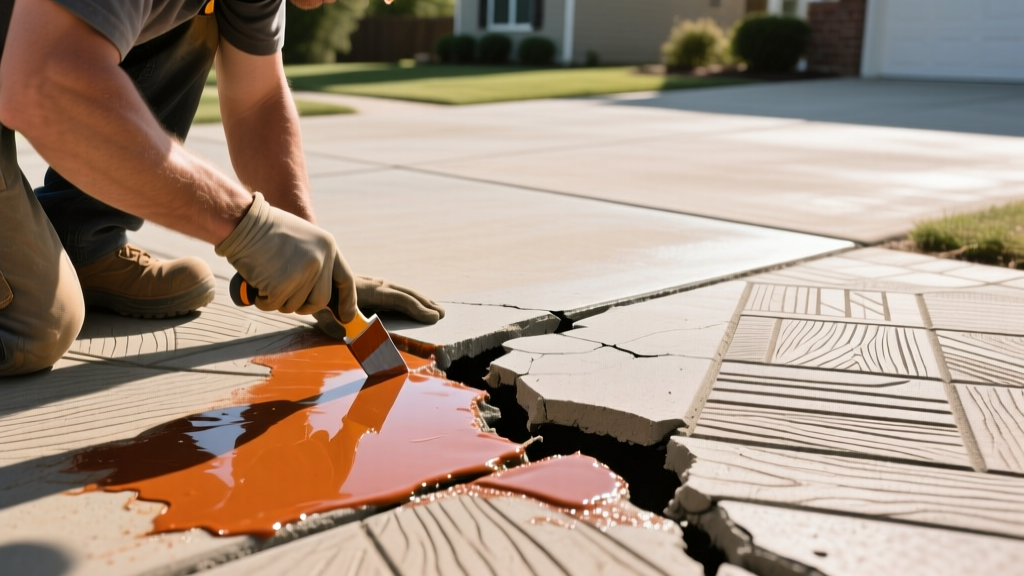
When a structural crack cuts directly across a stamped "flagstone" pattern, standard gray polyurethane caulk will look like a glaring scar. The Concrete Network recommends a technique called "camouflage routing" to hide these inevitable fractures.
- Widen the Crack: Use a crack-chasing blade on a circular saw to widen the crack to 1/4 inch, but only cut deep enough to clean out debris.
- Follow the Grout Lines: Where possible, use a 4-inch grinder to route the crack so it intersects with the existing faux-grout lines of the stamped pattern. This tricks the eye into perceiving the crack as a natural joint.
- Tinted Filler: Fill the routed crack with a high-modulus, color-matched polyurea or polyurethane joint sealant. Contractors often mix dry-shake color hardener powder directly into clear Sikaflex sealant to achieve an exact match to the surrounding antiqued stone.
2026 Material & Cost Matrix for Concrete Restoration
Material costs and product formulations have evolved. The following matrix provides current 2026 pricing and specific product recommendations for professional-grade troubleshooting.
| Product / Material | Best Application | Est. 2026 Cost | Key Technical Spec |
|---|---|---|---|
| Butterfield Color Pro-Grade Acrylic Sealer | Stamped concrete resealing and UV protection. | $195 / 5-gal pail | Solvent-based, enhances color depth, breathable. |
| Prosoco Siloxane PD | Brushed concrete driveways (penetrating sealer). | $240 / 5-gal pail | Does not alter surface traction, 7-10 year lifespan. |
| Ardex CD (Concrete Dressing) | Feather-edge patching on brushed surfaces before re-brooming. | $42 / 10-lb bag | Can be applied as thin as 1/16 inch without cracking. |
| Euclid Chemical Eucosol | Fixing localized sealer blushing on stamped patios. | $185 / 5-gal pail | High-solids acrylic, resists hot-tire pickup. |
Preventative Maintenance: Sealing Strategies
The most common troubleshooting call contractors receive is for sealer failure, which manifests entirely differently depending on the finish type. Understanding the Portland Cement Association's guidelines on freeze-thaw durability is critical when selecting a sealer, as the wrong chemistry will trap moisture and accelerate spalling.
Brushed Concrete: Penetrating Silane/Siloxane
Never apply a film-forming acrylic sealer to a brushed concrete driveway. Acrylics create a slippery surface film that destroys the friction coefficient created by the broom finish, creating a severe slip hazard when wet. Furthermore, acrylics trap vapor transmission. Instead, use a penetrating silane/siloxane water repellent. These sealers react chemically with the free lime in the concrete to form a hydrophobic resin within the pores, protecting against chloride ion ingress and freeze-thaw scaling without altering the surface texture or traction.
Stamped Concrete: Solvent-Based Acrylics
Stamped concrete requires a film-forming solvent-based acrylic sealer. The solvent carrier is necessary to "bite" into the existing color hardener and re-wet the antiquing release agents, providing the wet-look depth that makes stamped concrete resemble natural stone. Water-based acrylics often fail to reactivate the color, leaving the patio looking dull and washed out. Plan to reapply solvent-based acrylics every 2 to 3 years, as UV degradation will inevitably cause the film to chalk and wear away in high-traffic zones.
Frequently Asked Questions
Can I use a pressure washer to clean my stamped concrete before repairing a crack?
Yes, but you must strictly limit the pressure to 2,000 PSI and use a surface cleaner attachment rather than a zero-degree wand tip. Blasting stamped concrete with a concentrated high-pressure stream will strip the color hardener layer right off the slab, exposing the gray concrete beneath and creating a permanent, un-blendable light spot.
Why is my brushed concrete driveway developing white, powdery spots?
This is efflorescence, caused by water-soluble salts migrating to the surface and reacting with atmospheric carbon dioxide. To troubleshoot this, do not simply scrub it with water, which can drive the salts back into the pores. Apply a commercial efflorescence remover or a diluted solution of muriatic acid (1 part acid to 10 parts water), agitate with a stiff nylon brush, and neutralize the area with a baking soda and water solution before applying a penetrating siloxane sealer to prevent future moisture ingress.
Is it possible to convert a failing brushed concrete driveway into stamped concrete to avoid future patching?
While technically possible using stamped concrete overlays (a 1/2 inch polymer-modified micro-topping), it is rarely recommended for driveways. Overlays lack the structural thickness of a full 4-inch poured slab and are highly susceptible to delamination when subjected to the shear forces of vehicle tires turning on the surface. For driveways, full-depth replacement or targeted broom-finish patching remains the most durable 2026 standard.
Written by
Marcus ChenMarcus Chen is a licensed structural engineer (PE) and building materials analyst with over 12 years of experience across residential, commercial, and industrial construction. He holds a Master of Science in Civil Engineering from UC Berkeley and spent six years at Thornton Tomasetti before transitioning to independent consulting and technical writing. Marcus specializes in material selection for seismic-prone regions, concrete reinforcement strategies, and lifecycle cost analysis. His work has been cited by the American Concrete Institute (ACI) and the Structural Engineers Association of California (SEAOC). When he is not on a job site or at his desk, you will find him hiking the Sierra Nevada or restoring a 1920s craftsman bungalow in Oakland, CA.
More from Marcus Chen
View all
Construction Cost
How Much Did the Eiffel Tower Cost to Build?
How much did the Eiffel Tower cost to build in 1889? We adjust for inflation and compare its budget to modern skyscraper construction.
Aug 4, 2026

Fire Resistance
What Is a Fire Resistant Material? Testing & Certification Guide
Discover what is a fire resistant material through ASTM and UL testing. Learn how fire ratings, certifications, and assemblies work in construction.
Aug 4, 2026

Construction Cost
How Much Did the Burj Khalifa Cost to Build?
How much did the Burj Khalifa cost to build? We break down the $1.5B project and extract 5 money-saving strategies for your next build.
Jul 30, 2026