Gravel vs Concrete Driveway: Aggregate Types and Mix Design
Compare a gravel vs concrete driveway through the lens of aggregate mix design, cost per square foot, and structural durability for residential paving.

The Core Difference: Loose vs. Bound Aggregate Systems
When evaluating a gravel vs concrete driveway, the fundamental distinction lies in how the aggregate is bound. A gravel driveway relies on mechanical interlock and friction between loose, angular stones to distribute vehicular loads. A concrete driveway utilizes a cementitious paste to chemically bind those same aggregates into a monolithic, rigid slab. Understanding the material science behind both systems—specifically aggregate gradation and mix design—is critical for predicting load-bearing capacity, drainage, and long-term degradation.
Gravel Driveway Material Types & Gradation
Not all gravel is engineered for vehicular traffic. The success of a loose aggregate driveway depends entirely on selecting the correct stone gradation to minimize rutting and displacement.
Crusher Run (Dense-Graded Aggregate)
Crusher run, often specified under ASTM D2940, is the optimal choice for the surface layer of a gravel driveway. It consists of crushed stone mixed with stone dust (fines). When compacted, the fines fill the voids between the larger angular stones, creating a semi-rigid surface that resists tire displacement while still allowing subsurface water to percolate.
#57 Washed Stone
#57 stone is washed, meaning it contains no fines. While it offers superior drainage and is excellent for the base layer or French drain systems, it performs poorly as a driveway surface. The lack of fines prevents mechanical interlock, causing tires to spin and displace the stone, leading to rapid rutting.
Never use pea gravel for a driveway surface. Its rounded, smooth edges provide zero mechanical interlock. Under the shear force of a turning vehicle tire, pea gravel behaves like ball bearings, resulting in immediate displacement and severe traction loss.
Concrete Driveway Mix Design: The 4000 PSI Standard
Transitioning from loose gravel to a concrete driveway requires a precise mix design to withstand dynamic vehicular loads, deicing salts, and freeze-thaw cycles. For residential driveways, the industry standard is a 4000 PSI compressive strength at 28 days, paired with strict water-cement ratios and air entrainment.
Critical Mix Parameters
- Water-Cement (w/c) Ratio: Must be kept at or below 0.45. Higher water content increases workability but drastically reduces compressive strength and increases permeability, allowing chlorides from deicing salts to corrode any embedded reinforcement.
- Maximum Aggregate Size: 3/4-inch (19mm) is standard for driveway slabs. This size provides optimal volume stability while allowing the mix to be easily screeded and finished around edges and joints.
- Air Entrainment: In climates subject to freezing, the mix must include air-entraining admixtures to achieve 6% air content (± 1.5%). These microscopic, disconnected air voids provide expansion chambers for freezing water, preventing surface scaling and spalling. The Portland Cement Association emphasizes that proper air entrainment is the single most important factor for cold-climate concrete durability.
Standard 4000 PSI Driveway Mix Proportions
| Component | Proportion (by weight) | Function in Mix |
|---|---|---|
| Type I/II Portland Cement | 15% | Binding agent; dictates compressive strength. |
| Water | 7% | Hydration activation; kept low (0.45 w/c) for durability. |
| Coarse Aggregate (3/4" Crushed) | 45% | Provides bulk, structural strength, and volume stability. |
| Fine Aggregate (Concrete Sand) | 32% | Fills voids between coarse aggregate; aids workability. |
| Air (Entrained) | 1% (6% by volume) | Micro-voids for freeze-thaw expansion. |
According to the National Ready Mixed Concrete Association, specifying a low slump (4 to 5 inches) for driveway placements prevents excessive bleeding and surface crusting, which are primary causes of early-age shrinkage cracking.
Cost & Lifespan Matrix: Gravel vs Concrete Driveway
The financial comparison extends beyond initial installation. Gravel requires continuous material replenishment, while concrete demands a high upfront capital expenditure with minimal ongoing material costs.
| Metric | Gravel (Crusher Run) | Concrete (4000 PSI Broom Finish) |
|---|---|---|
| Initial Installed Cost (per sq. ft.) | $1.50 - $3.00 | $8.00 - $14.00 |
| Expected Lifespan | 5 - 10 years (before major regrading) | 30 - 50 years |
| Annual Maintenance Cost | $0.20 - $0.50 per sq. ft. (top-dressing) | $0.05 per sq. ft. (sealing every 3-5 yrs) |
| Load-Bearing Capacity | Moderate (prone to rutting under heavy RVs) | High (distributes point loads across slab) |
| Snow Removal Compatibility | Poor (plows displace surface material) | Excellent (smooth, monolithic surface) |
The Hybrid Approach: Exposed Aggregate Concrete
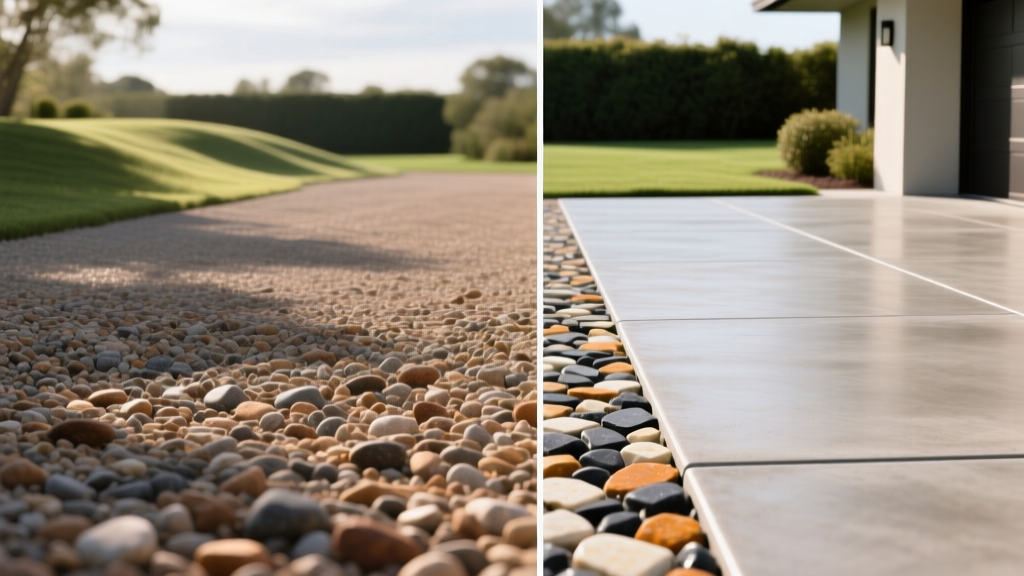
For homeowners drawn to the rustic aesthetic of a gravel driveway but requiring the structural integrity of concrete, exposed aggregate is the optimal synthesis. This technique involves pouring a standard 4000 PSI concrete mix, but utilizing a specific coarse aggregate blend (often decorative river rock or colored granite) in the top lift.
After placement, a surface retarder is sprayed onto the fresh concrete. This chemical delays the hydration of the cement paste at the very surface. The following day, the top layer of uncured paste is washed away with a pressure washer, revealing the tightly bound, interlocking coarse aggregate beneath. The result mimics the visual texture of loose gravel but performs as a rigid, 4000 PSI structural slab that will not rut, wash away, or impede snow plows.
Subgrade Preparation: The Hidden Failure Point
Both gravel and concrete driveways will fail catastrophically if the subgrade is improperly engineered. The native soil must be evaluated for its California Bearing Ratio (CBR). Expansive clays must be removed or stabilized.
For both systems, excavate 8 to 12 inches below the final grade. Install a non-woven geotextile fabric to prevent the migration of fine clay particles into the aggregate base. Compact a 4 to 6-inch layer of dense-graded aggregate base (DGA) to 95% Standard Proctor density before placing either the surface gravel or the concrete slab.
Concrete-Specific Subgrade Requirements
Concrete slabs require uniform support. If the subgrade has varying densities (e.g., half the driveway is on undisturbed soil, half on backfilled trench), the slab will experience differential settlement and snap along the transition line. A 2-mil polyethylene vapor barrier is also recommended beneath concrete to prevent moisture from the subgrade from migrating up through the slab, which can cause floor covering failures if the driveway extends into a garage, and reduces the risk of efflorescence.
Decision Framework: Which Should You Choose?
Selecting between a gravel vs concrete driveway requires aligning material properties with site-specific constraints and usage patterns.
Choose a Gravel Driveway If:
- Budget is the primary constraint: You need immediate vehicular access but lack the $10,000+ capital for a standard 1,000 sq. ft. concrete pour.
- The site features extreme gradients: On slopes exceeding 15%, concrete requires expensive broom-finishing or tining to prevent slip hazards when wet. Crusher run gravel naturally provides high-traction on steep inclines.
- Permeability is mandated: Local municipal zoning requires 100% permeable surfaces to manage stormwater runoff and reduce burden on municipal sewer systems.
Choose a Concrete Driveway If:
- Heavy static loads are present: You park heavy motorhomes, dump trucks, or boat trailers. Point loads from heavy RV jacks will punch through loose gravel, but are easily distributed by a 5-inch thick concrete slab reinforced with welded wire mesh (WWM) or macro-synthetic fibers.
- You require low-maintenance snow removal: Plowing a gravel driveway requires the plow blade to be lifted on skid shoes, leaving a 2-inch layer of packed snow and ice. Concrete allows the blade to scrape directly to the surface.
- Property valuation is a priority: Appraisers and real estate markets consistently assign a higher premium to homes with intact, well-finished concrete or exposed aggregate driveways compared to loose stone.
Written by
James ThorntonJames Thornton is a construction industry veteran with 25 years of hands-on experience in wood framing, lumber grading, and residential building codes. He started as a framing carpenter in rural Oregon, earned his ICC Residential Building Inspector certification, and eventually became a senior plan reviewer for the City of Portland Bureau of Development Services. James holds a B.S. in Wood Science & Technology from Oregon State University and is a certified lumber grader through the West Coast Lumber Inspection Bureau (WCLIB). He has inspected over 3,000 residential construction sites and authored the city's internal guide on advanced framing techniques (2x6 at 24" O.C.). James lives in Bend, OR, where he builds custom timber-frame cabins and competes in lumberjack sports.
More from James Thornton
View all
Insulation
Best Home Insulation Materials: Complete 2026 Guide
Compare top home insulation materials for 2026. Find R-values, installed costs per square foot, and best uses for fiberglass, spray foam, and mineral wool.
Aug 4, 2026

Sustainable Building
Certify Your Green Building Material for LEED and WELL
Step-by-step guide to certifying a green building material for LEED v5 and WELL v2. Master EPDs, HPDs, and VOC limits for 2026 project specifications.
Aug 4, 2026

Stone & Masonry
Veneer Stacked Stone Panels: Interior Design & Style Showcase
Discover how veneer stacked stone panels transform interiors. Explore modern design profiles, material pairings, and technical installation specs.
Aug 4, 2026