Pavers vs Concrete Cost Per Square Foot: 2026 Repairs
Compare the true pavers vs concrete cost per square foot over 20 years. Expert troubleshooting, repair pricing, and failure mode fixes for 2026.

The Hidden Lifecycle: Installation vs. Repair Economics
Homeowners and contractors obsess over the initial installation price when debating outdoor hardscapes, but the true financial divergence between materials emerges in years 5 through 20. When evaluating the long-term pavers vs concrete cost per square foot, you must shift focus from day-one pouring or laying expenses to the inevitable troubleshooting and repair phase. Poured concrete is a monolithic slab that fails structurally and cosmetically as a single unit, while interlocking pavers are a flexible matrix that fails locally at the joints and base. Understanding these distinct failure modes is critical for accurate lifecycle budgeting in 2026.
Poured Concrete Failure Modes & Repair Costs
Concrete is rigid. When the subgrade shifts, freezes, or washes out, the slab cannot flex. It cracks, settles, or spalls. Troubleshooting concrete requires heavy equipment, specialized chemical foams, or full-depth demolition.
1. Differential Settlement and Frost Heave
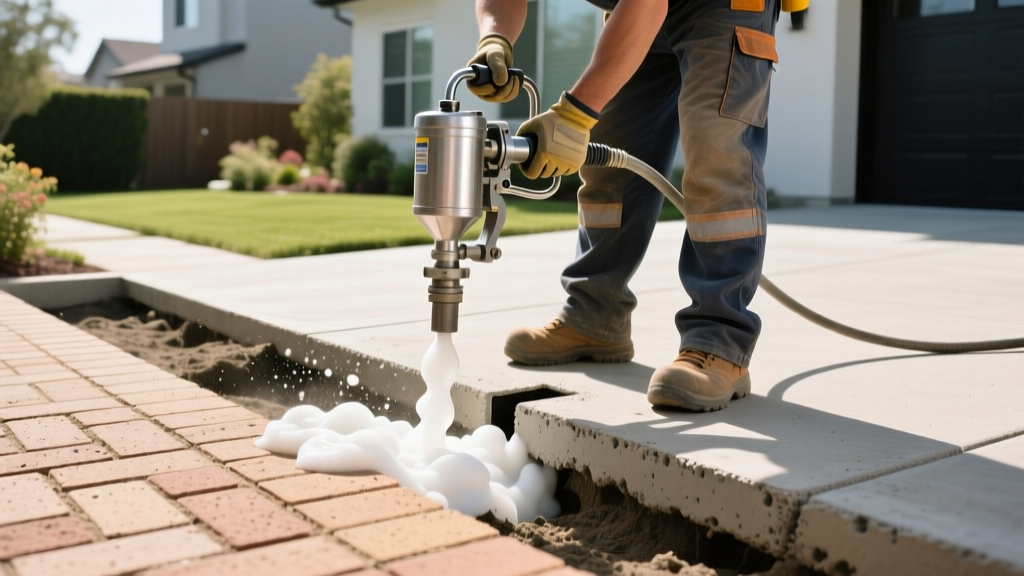
When a section of a driveway or patio sinks due to poor soil compaction or frost action, the resulting trip hazard requires immediate intervention. The modern standard for repair is polyurethane foam slabjacking, which replaces messy cementitious mudjacking.
- Troubleshooting Step: Drill 5/8-inch holes in a grid pattern across the sunken slab. Inject high-density, closed-cell polyurethane foam (typically 2.5 to 4.0 lb/cu ft density) to lift the slab back to grade.
- 2026 Repair Cost: $5.00 to $9.00 per square foot. Minimum contractor trip charges usually apply ($400-$600), making small isolated repairs disproportionately expensive on a per-square-foot basis.
2. Surface Spalling and Scaling
Freeze-thaw cycles combined with de-icing salts cause the top 1/4 inch of concrete to flake and pop off, exposing the aggregate. This is often caused by high water-to-cement ratios during the original pour or premature finishing.
- Troubleshooting Step: Pressure wash and acid-etch the surface. Apply a polymer-modified micro-topping or resurfacer (such as Ardex CD or Mapcrete) to restore a smooth, uniform finish.
- 2026 Repair Cost: $4.00 to $7.50 per square foot for professional resurfacing. DIY materials cost roughly $1.50 per square foot but require flawless execution to avoid peeling.
3. Structural Cracking
Hairline cracks (under 1/16 inch) are cosmetic, but cracks exceeding 1/4 inch indicate subgrade failure or lack of control joints. According to guidelines from the American Concrete Institute (ACI), routing and sealing is required for active cracks.
- Troubleshooting Step: Use a concrete saw to widen the crack into a V-shape, clean with compressed air, and fill with a self-leveling polyurethane sealant (e.g., Sikaflex Sl-1). If the crack is accompanied by a vertical offset greater than 1/2 inch, full-depth saw-cut removal and replacement is mandatory.
- 2026 Repair Cost: Routing and sealing costs $3.00 to $5.00 per linear foot. Full-depth slab replacement costs $12.00 to $18.00 per square foot due to demolition, hauling, and small-load concrete delivery premiums.
Interlocking Paver Failure Modes & Repair Costs
Interlocking concrete pavers, governed by standards from the Interlocking Concrete Pavement Institute (ICPI), are designed to move. They do not crack; instead, their failures are related to the joints, the edge restraints, and the underlying aggregate base.
1. Joint Sand Loss and Weed Intrusion
The most common paver issue is the degradation of jointing sand, leading to weed growth, ant infestations, and a loss of interlock friction which allows the pavers to shift.
- Troubleshooting Step: Do not simply add more sand over weeds. Use a hot-water pressure washer to strip the old joints completely. Allow to dry for 48 hours, then sweep in high-performance polymeric sand (e.g., Techniseal HP Next Gen) and mist with water to activate the polymer binders.
- 2026 Repair Cost: $2.00 to $4.00 per square foot for professional stripping and re-sanding. Materials for DIY cost about $0.60 per square foot.
2. Edge Restraint Failure (Spreading)
If the perimeter edge restraint fails, the entire paver field will spread outward, opening joints and causing a domino effect of settling. Plastic restraints secured with 10-inch spikes frequently fail in frost-prone climates.
- Troubleshooting Step: Excavate the perimeter. Remove the failed plastic restraint and pour a 6-inch wide by 8-inch deep concrete haunch (curb) directly against the paver edge, or install heavy-duty galvanized steel restraints driven into compacted base material.
- 2026 Repair Cost: $8.00 to $14.00 per linear foot. Because this is a perimeter repair, the cost per square foot of the total patio is negligible, but the absolute labor cost is high due to excavation and concrete mixing.
3. Localized Base Washout
Downspout discharges or broken irrigation lines can wash away the 4-to-6-inch crushed stone base beneath the pavers, causing a localized sinkhole.
- Troubleshooting Step: Zip up the affected pavers. Excavate the washed-out bedding sand and base stone. Re-compact the subgrade, install new 3/4-inch crushed angular aggregate in 2-inch lifts, screed new bedding sand, and reinstall the original pavers.
- 2026 Repair Cost: Usually billed as a minimum service call ($350 to $500 flat rate) rather than per square foot, as the repair area is typically under 20 square feet.
Head-to-Head 20-Year Repair Cost Matrix
The table below synthesizes the expected maintenance and repair expenditures for a standard 500-square-foot driveway or patio over a 20-year lifecycle, assuming moderate climate exposure and standard usage.
| Maintenance / Repair Event | Poured Concrete (500 sq ft) | Interlocking Pavers (500 sq ft) |
|---|---|---|
| Joint/Crack Sealing (Years 5, 10, 15) | $450 ($3/linear ft) | $0 (N/A) |
| Polymeric Sand Re-application (Years 7, 14) | N/A | $3,000 ($3/sq ft x 2) |
| Surface Resurfacing / Sealing (Year 10) | $2,750 ($5.50/sq ft) | $400 (Penetrating sealer) |
| Slabjacking / Base Repair (Year 12) | $1,500 (Partial slab) | $450 (Minimum trip charge) |
| Estimated 20-Year Total Repair Cost | ~$4,700 ($9.40 / sq ft) | ~$3,850 ($7.70 / sq ft) |
Troubleshooting Decision Framework: Repair vs. Replace
Use this diagnostic logic to determine when a repair is viable versus when full demolition is required.
For Poured Concrete:
- Is the crack active (widening over time)? If yes, routing and sealing will fail. You must address the subgrade or replace the slab.
- Is the vertical offset greater than 1 inch? Polyurethane foam jacking cannot reliably lift slabs more than 2 inches without risking fracture. If the drop exceeds 1.5 inches, replace the panel.
- Are there more than 4 major intersecting cracks in a single 10x10 panel? The slab has lost its structural monolith. Replacement is more cost-effective than repeated patching.
For Interlocking Pavers:
- Is the settling localized (under 20 sq ft)? Pull the pavers and fix the base. Never attempt to mudjack a paver base; the foam will blow out through the joints.
- Is the efflorescence (white powdery stain) persistent? This indicates chronic moisture trapped in the base. Repair requires removing pavers, installing a geotextile fabric, and improving site drainage before reinstalling.
- Are the pavers themselves crumbling? If the pavers were manufactured with high water absorption rates (failing ASTM C936 standards), no amount of sealing will stop spalling. Total replacement of the paver units is required, though the base can often be salvaged.
Proactive Maintenance to Protect Your Investment
The most effective way to manipulate the pavers vs concrete cost per square foot is to prevent the failure modes from occurring. Implement these strict maintenance protocols:
- Concrete Sealing: Apply a silane-siloxane penetrating sealer every 3 to 5 years. Unlike acrylic film-forming sealers that peel and trap moisture, siloxane sealers react chemically within the pores to repel water while allowing vapor transmission, drastically reducing freeze-thaw spalling.
- Paver Joint Inspection: Inspect polymeric joints every spring. If you notice sand levels dropping more than 1/4 inch below the paver chamfer, top-dress immediately with dry polymeric sand and mist. Allowing water to pool in empty joints will rapidly erode the bedding layer beneath.
- Subgrade Hydration Control: For both materials, ensure downspouts discharge at least 6 feet away from the hardscape edge. The vast majority of concrete slabjacking and paver base washouts are caused by concentrated roof runoff saturating the subgrade soils.
Written by
Marcus ChenMarcus Chen is a licensed structural engineer (PE) and building materials analyst with over 12 years of experience across residential, commercial, and industrial construction. He holds a Master of Science in Civil Engineering from UC Berkeley and spent six years at Thornton Tomasetti before transitioning to independent consulting and technical writing. Marcus specializes in material selection for seismic-prone regions, concrete reinforcement strategies, and lifecycle cost analysis. His work has been cited by the American Concrete Institute (ACI) and the Structural Engineers Association of California (SEAOC). When he is not on a job site or at his desk, you will find him hiking the Sierra Nevada or restoring a 1920s craftsman bungalow in Oakland, CA.
More from Marcus Chen
View all
Construction Cost
How Much Did the Eiffel Tower Cost to Build?
How much did the Eiffel Tower cost to build in 1889? We adjust for inflation and compare its budget to modern skyscraper construction.
Aug 4, 2026

Fire Resistance
What Is a Fire Resistant Material? Testing & Certification Guide
Discover what is a fire resistant material through ASTM and UL testing. Learn how fire ratings, certifications, and assemblies work in construction.
Aug 4, 2026

Construction Cost
How Much Did the Burj Khalifa Cost to Build?
How much did the Burj Khalifa cost to build? We break down the $1.5B project and extract 5 money-saving strategies for your next build.
Jul 30, 2026