Gunite vs Concrete Pool: The Ultimate Builder's Material Guide
Compare gunite, shotcrete, and poured concrete pools. Expert guide on PSI strengths, 2026 costs, curing times, and structural failure modes.

The Terminology Trap: Gunite, Shotcrete, and Poured Concrete
The phrase 'gunite vs concrete pool' is a colloquialism that obscures critical engineering distinctions. In structural engineering and pool construction, gunite is not a separate material from concrete; it is a specific pneumatic application method. To make an informed structural decision, you must separate the application technique from the material matrix.
Defining the Methods
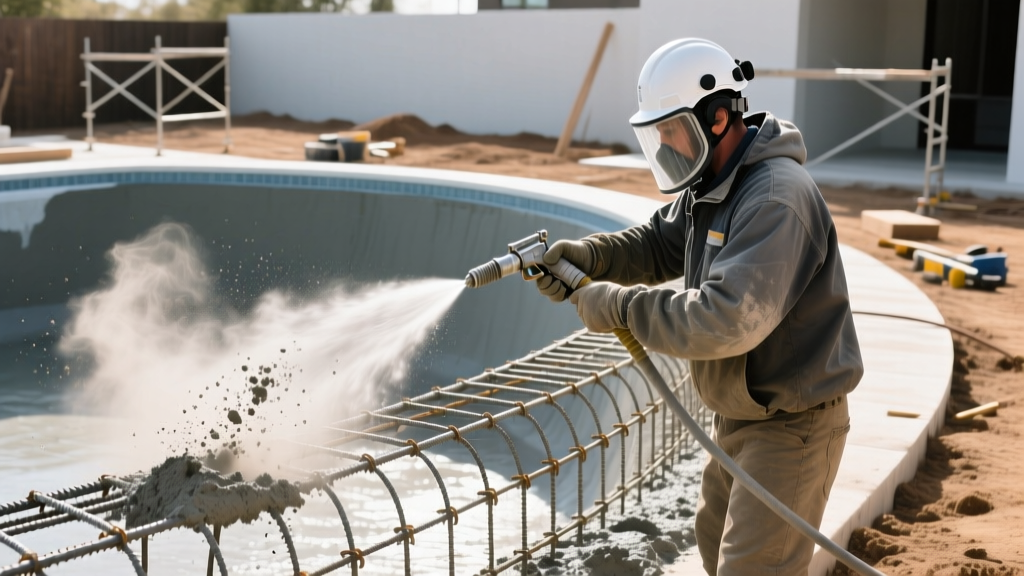
- Gunite (Dry-Mix Shotcrete): A pneumatically applied concrete where the dry cement and sand/aggregate mixture is propelled through a hose, with water injected at the nozzle immediately before discharge. The nozzleman controls the water-cement ratio in real-time.
- Wet-Mix Shotcrete: All ingredients, including water, are mixed before entering the pump. The wet concrete is pushed through the hose and pneumatically projected onto the rebar cage. This offers superior consistency and lower rebound rates.
- Poured (Cast-in-Place) Concrete: Traditional concrete poured into pre-built wooden or aluminum formwork. Rarely used for residential freeform pools due to the exorbitant cost of custom formwork, but common in commercial rectangular vessels and indoor basement pools.
When homeowners ask about 'gunite vs concrete,' they are typically comparing pneumatically applied dry-mix shotcrete against traditional cast-in-place poured concrete, or confusing gunite with wet-mix shotcrete. According to the American Concrete Institute (ACI) Committee 506, the structural integrity of any shotcrete application relies heavily on the nozzleman's skill and the aggregate grading, rather than just the mix design.
Structural Integrity: PSI, Aggregate, and Rebound
The structural superiority of a pool shell depends on compressive strength (PSI), aggregate size, and the mitigation of 'rebound'—the coarse, sandy material that bounces off the rebar cage during pneumatic application.
Material Data Highlights
- Gunite (Dry-Mix) Compressive Strength: 7,500 to 10,000+ PSI. The low water-cement ratio achieved at the nozzle creates an exceptionally dense, high-strength shell.
- Wet-Mix Shotcrete Compressive Strength: 5,000 to 7,000 PSI. Limited by the need to keep the mix workable in the pump hopper.
- Poured Concrete Compressive Strength: 3,000 to 5,000 PSI (standard residential mix designs).
- Maximum Aggregate Size: Gunite requires a strict 3/8-inch maximum aggregate to prevent hose clogging and ensure proper encasement of #3 and #4 Grade 60 rebar.
The Rebound Problem
Dry-mix gunite inherently produces 5% to 15% rebound. This rebound material is rich in sand and cement but devoid of the coarse aggregate necessary for structural cohesion. If a careless crew sweeps this rebound into the floor-to-wall cove (the critical structural joint of the pool) rather than discarding it, it creates a localized zone of high shrinkage and low tensile strength. Wet-mix shotcrete produces less than 5% rebound, while poured concrete produces zero, making them inherently more forgiving regarding material waste and structural inclusions.
Gunite vs. Poured Concrete: Head-to-Head Matrix
The following matrix isolates the structural and logistical differences between pneumatically applied dry-mix gunite and traditional cast-in-place poured concrete for swimming pool construction.
| Feature | Gunite (Dry-Mix Shotcrete) | Poured (Cast-in-Place) Concrete |
|---|---|---|
| Design Flexibility | Unlimited. Capable of complex freeform curves, vanishing edges, and integrated spas. | Highly restricted. Best suited for geometric, rectangular, or simple L-shapes. |
| Compressive Strength | 7,500 - 10,000+ PSI | 3,000 - 5,000 PSI |
| Shell Thickness | 8 to 12 inches (variable based on soil and engineering) | Uniform 8 to 10 inches (dictated by formwork) |
| Surface Finish | Rough, requires extensive hand-troweling and scraping to achieve plumb walls. | Smooth, mirrors the formwork. Requires minimal surface prep for waterproofing. |
| Labor Specialization | Requires certified, highly skilled nozzlemen to avoid shadowing and rebound inclusions. | Requires skilled carpenters for formwork and standard concrete finishers. |
Installation and 28-Day Curing Protocols
Concrete does not 'dry'; it cures via an exothermic hydration reaction. The application method drastically alters the curing protocol required to prevent plastic shrinkage cracking.
Gunite Curing Protocol
Because gunite is applied with a low water-cement ratio and exposed to ambient air, it is highly susceptible to rapid moisture loss. The Pool & Hot Tub Alliance (PHTA) mandates strict moisture retention for gunite shells.
- Initial Set (Hours 1-4): The shell is hand-carved and troweled. No water should be applied during this phase, as it will wash out the cement paste and ruin the surface matrix.
- Active Moisture Curing (Days 1-14): The shell must be misted with water 3 to 5 times daily. This continuous hydration prevents micro-cracking and allows the concrete to reach its target 7,500+ PSI.
- Alternative Chemical Curing: If manual watering is impossible, a solvent-based acrylic curing compound (e.g., W.R. Meadows CS-309) must be sprayed on immediately after final troweling to seal in moisture.
Poured Concrete Curing Protocol
Poured concrete cures inside sealed formwork, which naturally retains moisture. The forms are typically stripped after 48 to 72 hours. Once stripped, the exposed edges and interior basin require a standard 7-day wet cure or chemical membrane application, but the risk of catastrophic plastic shrinkage is significantly lower than with exposed gunite.
2026 Cost Breakdown: Shell Construction
Comparing costs requires isolating the structural shell (excavation, steel, and concrete) from the plumbing, coping, and interior plaster. The following estimates reflect 2026 national averages for a standard 15' x 30' (approx. 20,000-gallon) residential pool.
| Cost Component | Gunite Shell (Dry-Mix) | Poured Concrete Shell |
|---|---|---|
| Excavation & Soil Prep | $4,500 - $7,000 | $4,500 - $7,000 |
| Steel Rebar Cage (#3/#4 Grade 60) | $5,500 - $8,000 | $5,500 - $8,000 |
| Formwork Construction (Wood/Aluminum) | $0 (Not Required) | $12,000 - $18,000 |
| Concrete Material & Pumping | $14,000 - $22,000 | $8,000 - $12,000 |
| Labor (Shoot/Carve vs. Pour/Strip) | $8,000 - $12,000 | $15,000 - $22,000 |
| Total Shell Cost Estimate | $32,000 - $49,000 | $45,000 - $67,000 |
Note: Poured concrete pools are generally more expensive for residential applications due to the massive labor burden of building, bracing, and stripping custom formwork. Gunite remains the dominant choice for residential pools because it eliminates formwork costs while allowing unlimited geometric customization.
Critical Failure Modes to Inspect
Regardless of the method chosen, structural failure in concrete pools is rarely caused by the material itself, but by execution errors during installation. Inspect for these specific failure modes:
- Shadowing (Gunite/Shotcrete): Voids or honeycombs behind the rebar caused by the nozzleman holding the hose at an improper angle. The concrete fails to wrap entirely around the steel, leaving the rebar exposed to moisture and eventual spalling.
- Rebound Inclusion (Gunite): As mentioned, burying rebound material in the structural cove. This manifests as horizontal shrinkage cracks near the pool floor within the first 12 months.
- Cold Joints (Poured Concrete): If a concrete truck is delayed and the initial pour begins to set before the next truck arrives, a 'cold joint' forms. In a pool shell, this is a primary pathway for hydrostatic leaks and structural shear failure.
- Rebar Proximity to Soil: Both methods require a minimum 2-inch concrete cover over the rebar. If the steel cage sags and touches the excavated dirt, moisture from the soil will wick into the steel, causing rust-jacking that will crack the shell from the inside out.
Decision Framework: Choosing Your Shell Method
Use this framework to determine the optimal structural method for your specific project parameters.
Choose Gunite (Dry-Mix) If:
- Your design includes freeform curves, tanning ledges, or integrated spas.
- Site access is tight, making it difficult for large ready-mix concrete trucks and crane-lifted formwork to reach the excavation.
- You require a shell with ultra-high compressive strength (8,000+ PSI) for expansive or unstable soil conditions.
Choose Poured Concrete If:
- You are building a strictly geometric, rectangular commercial pool or an indoor basement pool where formwork is easy to brace.
- Your local municipality requires perfectly smooth, form-finished exterior walls for specialized waterproofing membrane adhesion.
- You have a severe shortage of certified, ACI-trained shotcrete nozzlemen in your regional market.
For 95% of residential custom pool projects, pneumatically applied concrete (gunite or wet-mix shotcrete) is the superior engineering and economic choice. The key to longevity is not the choice between gunite and poured concrete, but rather hiring a contractor who strictly enforces rebar cover spacing, discards all rebound material, and adheres to a rigorous 14-day moisture curing schedule.
Written by
David NakamuraDavid Nakamura is a licensed architect (AIA) and construction technology writer focused on sustainable building methods, mass timber engineering, and high-performance building envelopes. He holds a Master of Architecture from the University of Washington and is a certified Passive House Consultant (CPHC). David spent eight years at the Seattle firm Mithun, where he led the design of three LEED Platinum projects, before founding his own practice specializing in net-zero residential design. He serves on the editorial advisory board of GreenBuilder Magazine and has authored peer-reviewed papers on cross-laminated timber (CLT) connections for the Journal of Structural Engineering. In his spare time, David teaches woodworking at Pratt Fine Arts Center and kayaks the Puget Sound.
More from David Nakamura
View all
Construction Cost
Labor Cost to Build a Deck Per Sq Ft: 2026 Installation Guide
Discover the exact labor cost to build a deck per sq ft in 2026. This installation guide breaks down contractor rates, complexity factors, and hidden fees.
Aug 4, 2026

Construction Cost
How Much Does It Cost to Build a 3 Bedroom House? Financing Guide
Learn exactly how much it costs to build a 3 bedroom house and explore 2026 financing options, construction loan types, and budget frameworks for your build.
Aug 4, 2026

Construction Cost
Cost to Build a Tennis Court: 2026 Guide
How much does it cost to build a tennis court in 2026? Breakdowns for asphalt, concrete, and synthetic surfaces plus fencing and lighting.
Jul 30, 2026