Cost of Patio Pavers vs Stamped Concrete: 2026 Pricing & Mix Guide
Compare the 2026 cost of patio pavers vs stamped concrete. Explore mix designs, base prep requirements, hidden repair costs, and long-term ROI.

The Material Science: Wet-Cast Slabs vs. Dry-Cast Pavers
When evaluating the cost of patio pavers vs stamped concrete, homeowners often focus solely on surface aesthetics. However, the fundamental difference in pricing stems from their distinct manufacturing processes and structural mix designs. Stamped concrete is a wet-cast, monolithic slab, while pavers are individual, dry-cast units. Understanding these material properties is critical for predicting long-term performance and true lifecycle costs.
Stamped Concrete Mix Design Requirements
A durable stamped concrete patio requires a highly specific ready-mix design. Because the surface must accept detailed polyurethane stamping mats without tearing, the mix utilizes a maximum 3/8-inch aggregate (often pea gravel) rather than the standard 3/4-inch stone used in structural flatwork. To support the weight of outdoor furniture and foot traffic without micro-cracking, the mix must achieve a minimum compressive strength of 4,000 PSI at 28 days.
In regions subject to freeze-thaw cycles, the mix design must incorporate 5% to 7% air entrainment per American Concrete Institute (ACI) guidelines. These microscopic air voids provide chambers for expanding water to freeze into, preventing the slab from spalling or scaling. The slump is typically restricted to 4 to 5 inches; a wetter mix will cause the stamping tools to sink too deeply, blurring the pattern and compromising the surface paste.
Concrete Paver Manufacturing and Strength
Concrete pavers are not simply small slabs of standard concrete. They are manufactured using a dry-cast, zero-slump method. According to Interlocking Concrete Pavement Institute (ICPI) and ASTM C936 standards, concrete pavers must achieve a minimum compressive strength of 8,000 PSI—double that of a standard stamped slab. The zero-slump mix is vibrated and pressed under immense hydraulic pressure, resulting in a dense, low-porosity unit with a maximum water absorption rate of just 5%. This extreme density is what allows pavers to resist de-icing salts and freeze-thaw damage far better than monolithic concrete.
2026 Installed Cost Breakdown
The upfront cost of patio pavers vs stamped concrete varies significantly based on site preparation, material grade, and regional labor rates. As of 2026, specialized flatwork labor and aggregate base materials have driven prices upward. Below is a comparative cost matrix for a standard 400-square-foot patio installation.
| Cost Component | Stamped Concrete (4,000 PSI) | Concrete Pavers (ASTM C936) | Clay Pavers (ASTM C1272) |
|---|---|---|---|
| Material Cost | $4.50 - $6.50 / sq ft | $3.50 - $7.00 / sq ft | $8.00 - $14.00 / sq ft |
| Base Preparation | $2.00 - $3.50 / sq ft | $4.50 - $6.50 / sq ft | $4.50 - $6.50 / sq ft |
| Labor & Installation | $6.00 - $10.00 / sq ft | $9.00 - $14.00 / sq ft | $12.00 - $18.00 / sq ft |
| Color & Finishing | $2.50 - $4.50 / sq ft | Included in material | Included in material |
| Total Installed Cost | $15.00 - $24.50 / sq ft | $17.00 - $27.50 / sq ft | $24.50 - $38.50 / sq ft |
Contractors quoting pavers at a lower price than stamped concrete are often cutting corners on the base. Pavers require a 6-to-8-inch base of open-graded, crushed angular aggregate (ASTM C33) compacted in 2-inch lifts. Stamped concrete requires only a 4-inch compacted base beneath the 4-inch slab. If a paver base is undersized, the patio will experience differential settling within two years.
Color Technologies and UV Stability
The method used to color these materials impacts both the initial price and the long-term maintenance budget.
Stamped Concrete: Surface vs. Integral Color
Stamped concrete typically relies on a two-step coloring process. Integral color (iron oxide pigments added to the ready-mix truck) provides a base hue, but the true vibrancy comes from a dry-shake color hardener applied to the surface before stamping. Color hardeners contain cementitious binders and fine aggregates that actually increase the surface abrasion resistance and compressive strength of the top 1/8 inch of the slab. However, UV exposure will eventually degrade the acrylic sealers used to protect this color, requiring reapplication every 2 to 3 years at a cost of $1.50 to $2.50 per square foot.
Pavers: Face-Mix vs. Through-Body Color
High-quality concrete pavers utilize a face-mix manufacturing technique, where a 1/4-inch layer of highly pigmented, fine-aggregate concrete is bonded to a structural base layer. This ensures vibrant color without compromising the structural integrity of the paver. While concrete pavers can experience slight UV fading over a decade, clay pavers (fired in kilns at 2,000°F) offer permanent, through-body color that will never fade, though they command a premium price.
Long-Term Maintenance and Repair Economics
The true cost of patio pavers vs stamped concrete must factor in how each material handles structural failure and environmental stress.
- Cracking and Settlement: Monolithic stamped concrete will inevitably develop control joints (saw cuts) to manage shrinkage. If the subgrade washes out or tree roots intrude, the slab will crack. Repairing a cracked stamped patio requires saw-cutting, demolishing, and patching the section, which will never perfectly match the original faded color or stamp alignment. Pavers, however, are a flexible pavement system. If settling occurs, individual pavers are simply pulled up, the base is re-tamped, and the units are replaced with zero visible evidence of repair.
- Joint Maintenance: Stamped concrete joints are sealed to prevent water infiltration. Paver joints are filled with polymeric sand, which hardens when wet to resist weed growth and ant excavation. Polymeric sand typically requires replacement every 5 to 7 years, costing roughly $1.00 to $1.50 per square foot for professional cleaning and re-sanding.
- Frost Heave Resistance: In northern climates, pavers outperform stamped concrete. Because pavers are individual units with sand joints, they can shift slightly during freeze-thaw cycles and settle back into place. A stamped concrete slab subjected to frost heave will fracture, requiring costly mud-jacking or full replacement.
Decision Matrix: Which Material Fits Your Project?
Use this framework to determine the most cost-effective and structurally sound choice for your specific site conditions.
Choose Stamped Concrete If:
- Budget is the primary constraint: You need a large, continuous surface area (over 600 sq ft) and want to minimize the high labor costs associated with laying individual units.
- The subgrade is highly stable: Your site consists of undisturbed, well-draining native soil (like sandy loam) with no mature trees nearby whose roots could disrupt the slab.
- You prefer a seamless look: You want to mimic large-format natural stone or slate without the visual interruption of joint lines.
Choose Patio Pavers If:
- You live in a severe freeze-thaw climate: The flexible interlocking system will survive frost heave and ground movement without catastrophic cracking.
- Utility access is required: The patio will be built over main water lines, sewer cleanouts, or irrigation valves. Pavers can be removed and replaced to access buried utilities.
- Long-term repairability is a priority: You want a surface where localized damage (like a grease stain or a chipped unit) can be fixed by swapping a single stone rather than patching a slab.
According to the National Ready Mixed Concrete Association (NRMCA), proper curing is the most critical factor in stamped concrete longevity. The slab must be kept continuously moist or treated with a high-quality membrane-forming curing compound for a minimum of 7 days to achieve its designed 4,000 PSI strength and prevent plastic shrinkage cracking.
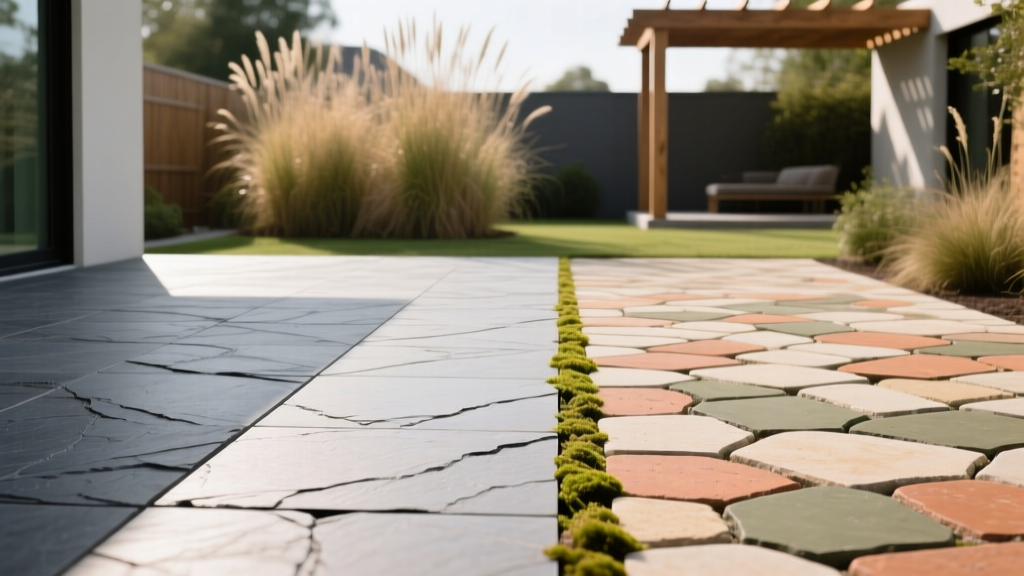
Ultimately, the cost of patio pavers vs stamped concrete comes down to a trade-off between initial labor expenses and long-term structural resilience. Stamped concrete offers a lower entry price and a seamless aesthetic, provided the mix design includes proper air entrainment and the subgrade is meticulously compacted. Pavers demand a higher upfront investment in base materials and installation labor, but their 8,000 PSI density and flexible interlocking design yield a significantly lower lifecycle cost in regions prone to ground movement and freezing temperatures.
Written by
Marcus ChenMarcus Chen is a licensed structural engineer (PE) and building materials analyst with over 12 years of experience across residential, commercial, and industrial construction. He holds a Master of Science in Civil Engineering from UC Berkeley and spent six years at Thornton Tomasetti before transitioning to independent consulting and technical writing. Marcus specializes in material selection for seismic-prone regions, concrete reinforcement strategies, and lifecycle cost analysis. His work has been cited by the American Concrete Institute (ACI) and the Structural Engineers Association of California (SEAOC). When he is not on a job site or at his desk, you will find him hiking the Sierra Nevada or restoring a 1920s craftsman bungalow in Oakland, CA.
More from Marcus Chen
View all
Construction Cost
How Much Did the Eiffel Tower Cost to Build?
How much did the Eiffel Tower cost to build in 1889? We adjust for inflation and compare its budget to modern skyscraper construction.
Aug 4, 2026

Fire Resistance
What Is a Fire Resistant Material? Testing & Certification Guide
Discover what is a fire resistant material through ASTM and UL testing. Learn how fire ratings, certifications, and assemblies work in construction.
Aug 4, 2026

Construction Cost
How Much Did the Burj Khalifa Cost to Build?
How much did the Burj Khalifa cost to build? We break down the $1.5B project and extract 5 money-saving strategies for your next build.
Jul 30, 2026