Paver Patio vs Stamped Concrete: Cost, Durability & ROI Compared
Compare paver patio vs stamped concrete for your outdoor project. Explore installation costs, freeze-thaw durability, maintenance, and long-term ROI.

The Core Dilemma: Monolithic Slab vs. Modular Hardscape
Choosing between a paver patio and stamped concrete dictates not only the immediate aesthetic of your outdoor space but also its structural behavior, maintenance burden, and lifespan. Stamped concrete offers a continuous, monolithic surface that mimics high-end materials like flagstone or slate at a lower initial cost. Interlocking concrete pavers provide a modular, flexible system that shifts with soil movement and allows for localized repairs. Both require rigorous subgrade preparation, but their failure modes and long-term cost trajectories diverge significantly after installation.
Quick Decision Framework
- Choose Stamped Concrete If: You have a stable, well-draining subgrade, live in a mild climate with minimal freeze-thaw cycles, and want a seamless surface with lower upfront labor costs.
- Choose Paver Patio If: Your region experiences harsh winters, your soil is expansive (clay-heavy), you anticipate needing utility access beneath the patio, or you want a 50+ year lifespan with zero cracking.
Installed Cost Breakdown: Where Does Your Money Go?
While material costs for basic concrete are lower than manufactured pavers, the stamping process and required finishing labor narrow the gap. The figures below reflect 2026 national averages for a standard 400-square-foot patio installation, excluding demolition of existing structures.
| Cost Factor | Stamped Concrete | Concrete Pavers |
|---|---|---|
| Subgrade & Base Prep | $2.50 - $4.00 / sq ft | $3.00 - $5.00 / sq ft |
| Materials | $3.00 - $5.00 / sq ft (4000 PSI mix, color hardener, release agent) | $4.50 - $9.00 / sq ft (2 3/8" pavers, bedding sand, polymeric sand) |
| Labor & Installation | $5.00 - $8.00 / sq ft | $8.00 - $14.00 / sq ft |
| Sealing & Finishing | $1.50 - $2.50 / sq ft (Acrylic film-forming sealer) | $0.50 - $1.50 / sq ft (Optional penetrating sealer) |
| Total Installed Average | $12.00 - $19.50 / sq ft | $16.00 - $29.50 / sq ft |
Note: Paver base preparation often requires slightly more aggregate (6 inches of compacted DOT Class 5 or crushed limestone) compared to concrete (4 inches), as the flexible surface relies entirely on the base for structural integrity. According to the National Concrete Masonry Association (NCMA), proper base compaction using a vibratory plate compactor is the single most critical factor in preventing paver settlement.
Climate & Structural Performance: The Freeze-Thaw Factor
The most significant differentiator between a paver patio and stamped concrete is how each handles environmental stress, specifically freeze-thaw cycles and expansive soils.
Stamped Concrete in Frost-Prone Regions
Concrete is a rigid, brittle material. When the subgrade heaves during a freeze, the slab must resist the tensile stress. To mitigate this, contractors use air-entrained concrete (4% to 6% air content per American Concrete Institute (ACI) standards) to give water room to expand within the mix. However, control joints must be cut every 10 to 12 feet to force cracking along hidden lines. If the subgrade was poorly compacted or drainage is inadequate, stamped concrete will develop structural cracks that breach the decorative surface, requiring costly epoxy injections or slab replacement.
Paver Patios and Soil Shifting
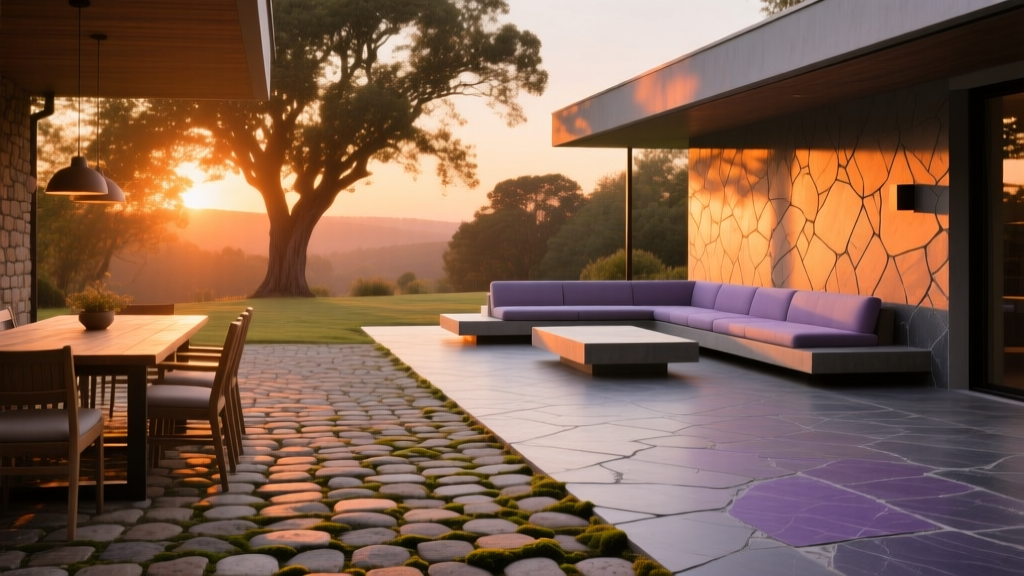
Pavers are a flexible pavement system. When the ground heaves or settles, the individual units shift independently. In the spring, a settled paver can be lifted out, the base re-leveled with coarse sand, and the paver replaced. This modularity makes pavers vastly superior in regions with heavy clay soils or deep frost lines, where rigid slabs are almost guaranteed to crack over a 20-year period.
Maintenance Realities: Sealing, Weeds, and Crack Repair
Neither material is truly "maintenance-free," but the type of labor required differs drastically.
- Stamped Concrete Maintenance: Requires resealing every 2 to 3 years with a solvent-based or water-based acrylic sealer (e.g., SuperSeal 25 or SureCrete XS-32). Without resealing, UV radiation will fade the color hardener, and water intrusion will lead to efflorescence and freeze-thaw spalling. Cracks that occur outside control joints must be routed and filled with a color-matched polyurethane sealant like Sikaflex.
- Paver Patio Maintenance: Does not strictly require sealing, though a silane/siloxane penetrating sealer can be applied to prevent staining and color fading. The primary maintenance involves monitoring the joints. Over time, polymeric sand can erode or wash out, leading to weed growth and ant infestations. Re-sanding joints every 5 to 7 years is necessary. Additionally, plastic or aluminum edge restraints must be inspected; if the spikes loosen, the perimeter pavers will spread and fail.
Long-Term ROI and Lifespan Projections
When evaluating the return on investment, it is vital to separate the material lifespan from the real estate value it adds.
"Hardscaping projects consistently yield high returns at resale. According to the National Association of Realtors' Remodeling Impact Report, landscaping and hardscaping upgrades can recover up to 100% of their cost at the time of sale. However, buyers increasingly view cracked stamped concrete as a 'red flag' deferred maintenance item, whereas a well-laid paver patio carries a perception of premium, permanent masonry."
Lifespan Expectancy:
A properly poured and maintained stamped concrete patio will last 25 to 30 years before the surface becomes too degraded or cracked to maintain aesthetically. A paver patio, utilizing high-density concrete units (minimum 8,000 PSI compressive strength), will easily last 50 to 75 years. The base may require re-leveling once or twice in that half-century, but the pavers themselves will outlast the home's roof.
Final Verdict: Which Should You Choose?
The choice between a paver patio and stamped concrete ultimately hinges on your site conditions and your tolerance for future maintenance.
- Opt for Stamped Concrete if you are working with a tighter initial budget, your site has excellent natural drainage, and you prefer the seamless, uniform look of a continuous stone slab. It is ideal for covered patios or regions with mild winters where the risk of subgrade heaving is minimal.
- Opt for a Paver Patio if you are building in a freeze-thaw climate, dealing with expansive clay soils, or want a lifelong installation that can be easily repaired. The higher upfront cost is offset by the elimination of mandatory bi-annual resealing and the guarantee that a localized failure will not compromise the entire patio.
Written by
Priya KapoorPriya Kapoor is a real estate market analyst and construction economics researcher with expertise in housing affordability, development feasibility, and infrastructure investment. She holds a Master of Regional Planning from Cornell University and previously worked as a senior analyst at CBRE's Investment Properties group, where she modeled returns for $4B in mixed-use development pipelines. Priya now runs an independent research practice advising developers, municipalities, and REITs on construction cost forecasting and market timing. She publishes the quarterly "BuildMat Market Pulse" report tracking material price indices across 12 commodity categories. Based in Austin, TX, Priya serves on the board of Habitat for Humanity Austin and is a marathon runner.
More from Priya Kapoor
View all
Construction Cost
Cost to Build a 1600 Sq Ft Home in 2026: Full Breakdown
Accurate 2026 cost to build a 1600 sq ft home—material, labor, and regional pricing breakdowns included. Plan your budget with real-time estimates.
Aug 11, 2026

Wood & Lumber
Name the Types of Wood for Pressure Treatment and Preservation
Learn how to name the types of wood best suited for pressure treatment. Compare species treatability, chemical retention levels, and 2026 preservation costs.
Aug 4, 2026

Stone & Masonry
Stone Veneer Suppliers Lindenhurst: 2026 Cost Analysis
Analyze 2026 stone veneer costs in Lindenhurst, NY. Compare local supplier pricing, delivery fees, and Suffolk County installation labor rates.
Aug 4, 2026