Concrete vs Asphalt Paving: Technical Specs and Load Capacities
Compare concrete vs asphalt paving with technical specs, load capacities, mix designs, and subgrade requirements for structural engineering decisions.

Material Composition and Binding Mechanics
The fundamental engineering distinction between concrete and asphalt lies in their structural classification: concrete is a rigid pavement, while asphalt is a flexible pavement. This dichotomy dictates how each material distributes vehicular loads to the underlying subgrade.
Binder Chemistry Snapshot
Concrete (Portland Cement): Relies on the chemical hydration of Portland cement (typically Type I/II) mixed with water, fine aggregates, and coarse aggregates. The structural integrity is defined by the water-cement (w/c) ratio, which must be strictly maintained between 0.40 and 0.45 for paving applications to ensure high compressive strength and low permeability.
Asphalt (Bitumen): Utilizes a petroleum-derived bitumen binder mixed with graded aggregates to form Hot Mix Asphalt (HMA). The binder's performance is classified using the Performance Grade (PG) system. A standard PG 64-22 binder is engineered to resist rutting at a maximum 7-day average pavement temperature of 64°C and thermal cracking at a minimum temperature of -22°C.
Structural Load-Bearing Specifications
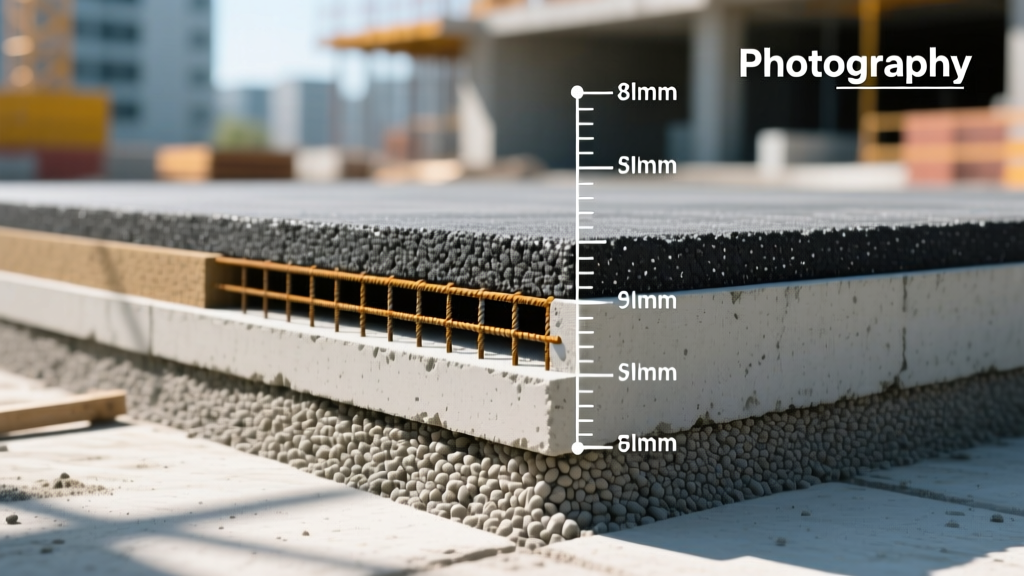
Load distribution mechanics require entirely different thickness profiles and reinforcement strategies for each material. Rigid concrete pavements distribute loads over a wide area via slab action, whereas flexible asphalt pavements transfer loads through a cone of stress via grain-to-grain contact within the aggregate matrix.
| Technical Parameter | Concrete (Rigid Pavement) | Asphalt (Flexible Pavement) |
|---|---|---|
| Design Compressive Strength | 4,000 PSI minimum (28-day cure) | N/A (Measured by Marshall Stability / Flow) |
| Standard Thickness (Passenger Vehicles) | 4 to 5 inches | 3 to 4 inches (Total HMA depth) |
| Standard Thickness (Heavy RVs / Dump Trucks) | 6 to 8 inches | 6 to 9 inches (Requires structural base) |
| Reinforcement | 5/8-inch rebar at 2-foot centers or 6x6 WWM | None (Relies on aggregate interlock) |
| In-Place Density Requirement | N/A (Air entrainment 5-7% for freeze-thaw) | 92% to 96% of Theoretical Maximum Specific Gravity (Gmm) |
| Traffic Readiness Timeframe | 7 days for passenger vehicles; 28 days for heavy loads | 24 to 48 hours (Once mat cools below 120°F) |
Subgrade Preparation and Base Course Engineering
A common failure point in both materials is improper subgrade engineering. According to the Portland Cement Association (PCA), concrete slabs require a uniform, unyielding subgrade. Because concrete acts as a bridge over soft spots, differential settlement leads directly to slab cracking. The California Bearing Ratio (CBR) of the subgrade should exceed 10, and a 4-inch layer of compacted, open-graded aggregate base is recommended for drainage and capillary break purposes.
Conversely, the Federal Highway Administration (FHWA) specifies that asphalt requires a robust structural base. Because asphalt yields to the subgrade, any weakness in the underlying soil will telegraph through to the surface as alligator cracking. Heavy-duty asphalt installations require 4 to 8 inches of crushed aggregate base over a subgrade with a minimum CBR of 5.
Thermal Dynamics and Environmental Tolerances
Temperature fluctuations dictate the jointing and mix design requirements for both materials.
Concrete: Jointing and Air Entrainment
Concrete expands and contracts with thermal shifts and shrinks during the hydration process. To control cracking, contraction joints must be saw-cut within 6 to 18 hours of placement. The saw-cut depth must be exactly one-quarter (1/4) of the slab thickness, and joints should be spaced at intervals of 10 to 15 feet, maintaining a length-to-width ratio not exceeding 1.5:1. Furthermore, in climates subject to freeze-thaw cycles, the mix must include air-entraining admixtures to create 5% to 7% microscopic air voids, providing chambers for expanding ice to occupy without spalling the surface.
Asphalt: Viscoelastic Yielding
Asphalt does not require control joints because its bitumen binder is viscoelastic; it flexes and yields to thermal contraction. However, this same property makes it vulnerable to high-temperature rutting. To mitigate this, the FHWA pavement guidelines and asphalt institutes mandate strict compaction temperatures. The HMA mat must be delivered to the paver at 275°F to 300°F and rolled to achieve target density before the mat temperature drops below 175°F. If compacted at too low a temperature, the aggregate matrix fails to lock, resulting in premature raveling and moisture infiltration.
Surface Friction and Skid Resistance Coefficients
Surface safety is governed by macrotexture (large-scale aggregate roughness) and microtexture (fine aggregate surface friction).
- Concrete Macrotexture: Achieved via coarse burlap drag or synthetic turf tining applied while the concrete is in a plastic state. Transverse tining at 1/8-inch depth and 1/4-inch spacing is the standard specification for high-speed vehicular traffic to prevent hydroplaning.
- Asphalt Macrotexture: Inherent in the mix design. Open-graded friction courses (OGFC) or Stone Matrix Asphalt (SMA) utilize a gap-graded aggregate structure with high coarse aggregate content to create surface voids that drain water laterally, significantly increasing wet-weather skid resistance.
Decision Framework: Specifying Concrete vs. Asphalt
Use this engineering logic tree to determine the optimal material for your specific site conditions and load requirements:
- Assess Heavy Static Loads: If the pavement will support heavy static loads (e.g., RVs parked for months, commercial dumpsters, or forklift traffic), specify Concrete. Asphalt will deform and rut under prolonged static point-loads, especially in high ambient temperatures.
- Evaluate Chemical Exposure: If the surface will be exposed to petroleum distillates, hydraulic fluid leaks, or de-icing salts, specify Concrete. Bitumen binders are soluble in petroleum products and will soften and degrade upon contact with fuel spills.
- Analyze Subgrade Conditions: If the site has poor, highly expansive clay soils and the budget does not allow for deep subgrade excavation and replacement, specify Asphalt with a thick structural aggregate base. Asphalt's flexibility allows it to tolerate minor differential settlement without catastrophic failure.
- Calculate Lifecycle and Maintenance Budgets: If the project requires a 30+ year lifecycle with minimal routine maintenance and high initial capital is available, specify Concrete. If the project requires immediate traffic use, lower initial capital expenditure, and accepts a 15-20 year lifecycle with periodic sealcoating, specify Asphalt.
Written by
Sarah WhitfieldSarah Whitfield is a chartered quantity surveyor (MRICS) and construction cost analyst with 15 years of experience in material pricing, procurement strategy, and project budgeting. She earned her degree in Construction Management from the University of Reading (UK) and has worked on projects ranging from $2M custom homes to $180M mixed-use developments across North America and Europe. Sarah currently leads cost estimating for BuildMat Insight, maintaining a proprietary database of 4,000+ material price points updated quarterly. She is a frequent contributor to RSMeans cost data panels and has presented at the International Cost Engineering Council (ICEC) congress. Based in Denver, CO, Sarah is an avid trail runner and volunteer mentor for Women in Construction.
More from Sarah Whitfield
View all
Wood & Lumber
What Are the Different Types of Wood? A Builder's Guide
Compare structural softwoods, finish hardwoods, and engineered lumber. Analyze Janka ratings, MOE values, and 2026 pricing for construction.
Aug 4, 2026

Walls & Panels
Steel Framing vs Wood Framing: Corrosion and Moisture Defense
Compare steel framing vs wood framing for moisture resistance. Learn about galvanized coatings, condensation risks, and corrosion protection strategies.
Jul 21, 2026

Stone & Masonry
How to Cut Stone Veneer: Wet Saw vs Grinder Comparison
Compare the best tools for cutting stone veneer. We review wet saws, angle grinders, and chop saws to help you achieve clean, chip-free cuts.
Jul 21, 2026