Types of Concrete Floor Slabs: Crack Troubleshooting & Repair
Learn how to diagnose and repair structural cracks, settlement, and moisture issues based on the specific types of concrete floor slabs in your building.
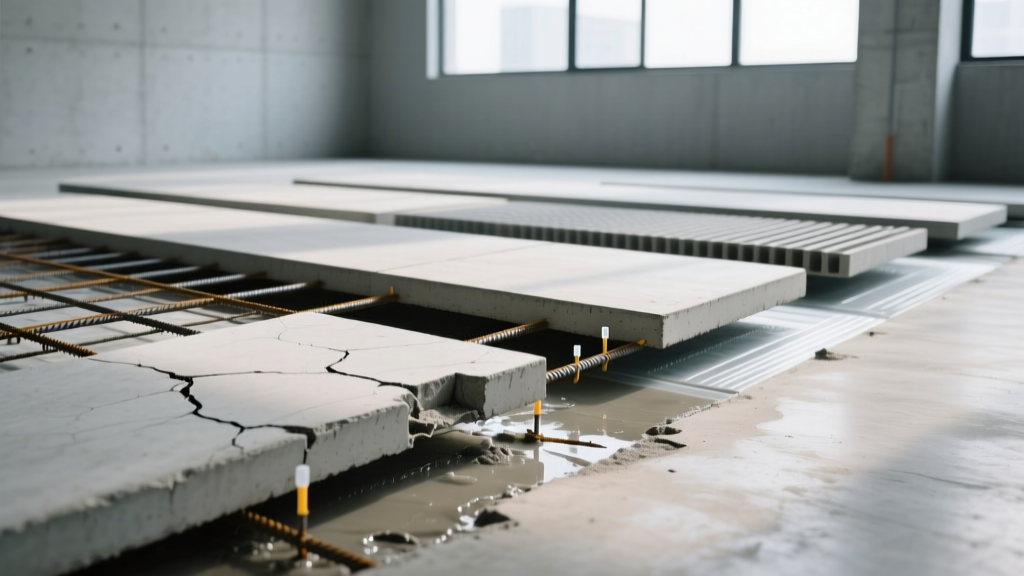
The Critical Link Between Slab Design and Failure Mechanics
Troubleshooting concrete floor failures requires more than a superficial patch; it demands an understanding of the structural typology. The types of concrete floor slabs deployed in modern construction—slab-on-grade, suspended, post-tensioned, and waffle—each distribute loads and react to environmental stresses differently. Applying a rigid epoxy to a dynamic joint in a slab-on-grade, or core-drilling blindly into a post-tensioned slab, leads to catastrophic secondary failures. This guide provides a forensic approach to diagnosing and repairing specific slab types using current 2026 material science and structural protocols.
Slab-on-Grade: Subgrade Interaction and Shrinkage
Slab-on-grade systems rely entirely on the underlying subgrade for support. When troubleshooting these slabs, failures almost always stem from subgrade consolidation, inadequate vapor retardation, or improper saw-cut timing during initial curing.
Symptom: Differential Settlement and Corner Breaks
If a slab corner breaks under forklift traffic (typically defined as loading exceeding 8,000 lbs per axle), the root cause is a void beneath the slab caused by subgrade washout or poor compaction. The repair requires void filling before surface patching.
- Diagnostic Tool: Ground Penetrating Radar (GPR) or sounding with a heavy chain drag to map subsurface voids.
- Repair Protocol: High-density polyurethane foam slab jacking. Inject two-part closed-cell polyurethane (e.g., Alchemy-Spetec Deep Lift) through 5/8-inch drilled ports on a 3-foot grid.
- Cost & Timing: $10 to $15 per square foot in 2026. The slab is ready for heavy traffic in 15 minutes post-injection.
Symptom: Mid-Panel Random Cracking
Random cracking indicates that initial shrinkage stresses exceeded the concrete's tensile strength, usually because control joints were cut too late or too shallow. According to the Portland Cement Association, joint depth must be at least 25% of the slab thickness.
- Repair Protocol: Route the crack to a minimum 1/4-inch wide by 1/2-inch deep V-groove. Clean with compressed air and fill with a flexible, high-movement polyurea joint sealant (e.g., Metzger/McGuire Spal-Pro RS 88) rather than rigid epoxy, which will simply crack again adjacent to the repair.
Suspended Slabs: Deflection and Flexural Cracking
Suspended slabs span between beams or walls and are highly susceptible to long-term deflection and flexural cracking on the tension face (the underside of the slab). Troubleshooting requires measuring live-load deflection against ACI 318 limits (typically L/240 for roofs and L/360 for floors supporting brittle partitions).
Symptom: Transverse Cracking at Mid-Span
Cracks running perpendicular to the span direction on the soffit (underside) indicate flexural overstress. If the crack width exceeds 0.012 inches, structural intervention is required.
| Deflection Severity | Measured Crack Width | Repair & Strengthening Method | Estimated Cost (per sq ft) |
|---|---|---|---|
| Moderate (Serviceability) | 0.005" - 0.012" | Low-viscosity epoxy injection (Sikadur 52) to restore monolithic behavior. | $18 - $25 |
| Severe (Structural) | > 0.012" | Externally bonded Carbon Fiber Reinforced Polymer (CFRP) laminates (SikaWrap Hex-230C). | $45 - $70 |
| Critical (Failure Imminent) | > 0.025" + spalling | Steel plate bonding or supplemental steel beam shoring. | $120+ |
When applying CFRP laminates, the concrete soffit must be mechanically abraded to expose the aggregate profile, and the tensile strength of the concrete substrate must be verified via a pull-off test (ASTM D4541) to ensure it exceeds 200 psi before bonding.
Post-Tensioned Slabs: The Hidden Cable Hazard
Post-tensioned (PT) slabs utilize high-strength steel tendons stressed after the concrete cures to put the slab into compression. This eliminates many shrinkage cracks but introduces severe risks during the repair phase.
Symptom: Anchorage Zone Spalling and Tendon Corrosion
In parking garages or marine environments, de-icing salts migrate through the concrete, corroding the anchorage hardware at the slab edges. This leads to delamination and spalling at the dead and live ends.
- Diagnostic Tool: Half-cell potentiometer testing (ASTM C876) to map the electrochemical corrosion potential of the embedded steel.
- Repair Protocol: Remove spalled concrete via hydro-demolition (high-pressure water at 10,000+ PSI) to avoid micro-fracturing the surrounding concrete. Clean the exposed tendon and anchor hardware, apply a zinc-rich primer, and encapsulate with a high-modulus, shrinkage-compensated repair mortar like MasterEmaco S 488 CI, which contains a migrating corrosion inhibitor.
Waffle and Ribbed Slabs: Punching Shear Failures
Waffle slabs utilize a grid of deep ribs to reduce weight while spanning long distances. The most critical vulnerability in these types of concrete floor slabs is punching shear at the column intersections, where the solid drop panel meets the waffle voids.
Symptom: Concentric Cracking Around Columns
Circular or polygonal cracking patterns radiating outward from a column capital indicate punching shear distress. This is often exacerbated by heavy point loads added post-construction (e.g., installing dense server racks or vaults).
- Immediate Action: Install temporary Acrow props or hydraulic shoring beneath the affected bay immediately.
- Repair Protocol: The structural fix requires increasing the shear perimeter. This is achieved by drilling through the slab and installing post-installed shear studs (e.g., Hilti HZA-P) or thickening the drop panel using formed micro-concrete.
Moisture Vapor Transmission (MVT) Across All Slab Types
Regardless of whether the slab is on-grade or suspended, excessive moisture vapor transmission destroys floor finishes and causes adhesive failure. Surface calcium chloride tests (ASTM F1869) are outdated and inaccurate for thick slabs.
Current 2026 industry standards mandate in-situ relative humidity (RH) testing per ASTM F2170 testing protocols. Probes must be inserted at 40% of the slab depth (if drying from one side) or 20% depth (if drying from two sides).
- If RH exceeds 75%: Do not install impermeable floor coverings (VCT, epoxy, urethane).
- Mitigation Strategy: Apply a 100% solids, moisture-mitigating epoxy primer (e.g., Mapei Primer MF) capable of blocking up to 100% RH and 25 lbs of hydrostatic pressure, followed by a self-leveling underlayment.

Summary Decision Matrix for Slab Repair
| Concrete Slab Type | Common Distress | Primary Diagnostic | Optimal 2026 Repair Material |
|---|---|---|---|
| Slab-on-Grade | Differential Settlement | GPR / Chain Drag | High-density polyurethane foam |
| Slab-on-Grade | Dynamic Joint Spalling | Visual / Joint Gauge | Polyurea joint sealant (Shore A 85) |
| Suspended Slab | Flexural Overstress | Deflection Survey | Carbon Fiber (CFRP) laminates |
| Post-Tensioned | Anchor Corrosion | Half-Cell Potentiometer | Hydro-demolition + CI Repair Mortar |
| Waffle / Ribbed | Punching Shear | Load / Crack Mapping | Post-installed shear studs |
Successfully repairing concrete requires matching the intervention to the structural behavior of the specific slab typology. Misdiagnosing a post-tensioned slab as a standard reinforced slab, or treating a dynamic slab-on-grade joint with rigid epoxy, guarantees premature failure and compounded repair costs.
Written by
Priya KapoorPriya Kapoor is a real estate market analyst and construction economics researcher with expertise in housing affordability, development feasibility, and infrastructure investment. She holds a Master of Regional Planning from Cornell University and previously worked as a senior analyst at CBRE's Investment Properties group, where she modeled returns for $4B in mixed-use development pipelines. Priya now runs an independent research practice advising developers, municipalities, and REITs on construction cost forecasting and market timing. She publishes the quarterly "BuildMat Market Pulse" report tracking material price indices across 12 commodity categories. Based in Austin, TX, Priya serves on the board of Habitat for Humanity Austin and is a marathon runner.
More from Priya Kapoor
View all
Construction Cost
Cost to Build a 1600 Sq Ft Home in 2026: Full Breakdown
Accurate 2026 cost to build a 1600 sq ft home—material, labor, and regional pricing breakdowns included. Plan your budget with real-time estimates.
Aug 11, 2026

Wood & Lumber
Name the Types of Wood for Pressure Treatment and Preservation
Learn how to name the types of wood best suited for pressure treatment. Compare species treatability, chemical retention levels, and 2026 preservation costs.
Aug 4, 2026

Stone & Masonry
Stone Veneer Suppliers Lindenhurst: 2026 Cost Analysis
Analyze 2026 stone veneer costs in Lindenhurst, NY. Compare local supplier pricing, delivery fees, and Suffolk County installation labor rates.
Aug 4, 2026