Pavers vs Concrete Patio: 2026 Cost Breakdown and ROI Analysis
Compare pavers vs concrete patio costs in 2026. Detailed breakdown of materials, labor, maintenance, and long-term ROI to help you choose the right hardscape.
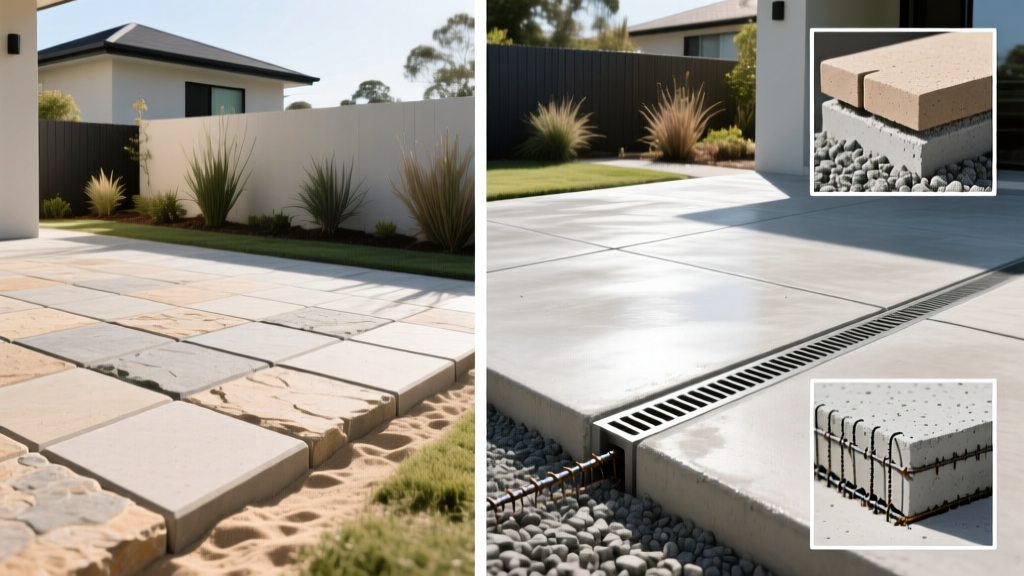
Choosing between interlocking pavers and poured concrete for a patio hinges on more than just the initial contractor quote. While basic poured concrete often presents a lower upfront cost, the 20-year lifecycle expenses, structural failure modes, and repair complexities drastically alter the true financial picture. This analysis breaks down the exact material, labor, and maintenance costs for both systems in 2026, providing the technical data needed to make a mathematically sound hardscaping decision.
The True Cost of Hardscaping: Upfront vs. Lifecycle
The most common mistake homeowners make when evaluating a pavers vs concrete patio is comparing the Day 1 installation cost while ignoring the Day 3,650 repair reality. Poured concrete is a monolithic slab; when it fails, it fails structurally. Pavers are a flexible, modular system; when they fail, the issue is typically localized to the base or jointing sand. The table below outlines the 2026 national average costs per square foot, factoring in professional installation, base preparation, and projected 20-year maintenance.
| Cost Metric (Per Sq. Ft.) | Poured Concrete (Broom Finish) | Poured Concrete (Stamped/Stained) | Concrete Pavers (Standard) | Clay/Cobblestone Pavers (Premium) |
|---|---|---|---|---|
| Material Cost | $2.50 - $4.00 | $4.00 - $8.00 | $3.50 - $6.00 | $8.00 - $14.00 |
| Labor & Base Prep | $4.00 - $7.00 | $8.00 - $12.00 | $7.00 - $11.00 | $12.00 - $18.00 |
| Total Installed Cost | $6.50 - $11.00 | $12.00 - $20.00 | $10.50 - $17.00 | $20.00 - $32.00 |
| 20-Year Maintenance | $4.50 - $8.00 | $9.00 - $14.00 | $6.00 - $10.00 | $8.00 - $12.00 |
| 20-Year Lifecycle Total | $11.00 - $19.00 | $21.00 - $34.00 | $16.50 - $27.00 | $28.00 - $44.00 |
Poured Concrete Patio: Deep Dive Cost Analysis
The affordability of a basic concrete patio comes from the speed of installation and the low cost of raw materials. However, achieving a slab that survives two decades without severe cracking requires strict adherence to engineering specifications. According to the Portland Cement Association (PCA) Durability Guidelines, a residential patio slab must be a minimum of 4 inches thick, utilizing a 3,000 to 4,000 PSI mix design.
Base Material & Reinforcement Costs
A concrete slab is only as stable as its subgrade. Contractors must excavate and install a 4-inch to 6-inch compacted crushed stone subbase. Skipping this step saves roughly $1.50 per square foot upfront but guarantees differential settlement and catastrophic cracking in expansive clay soils. For reinforcement, 6x6 W1.4xW1.4 welded wire mesh (WWF) costs about $0.45 per square foot, while upgrading to #3 rebar tied in an 18-inch grid adds approximately $0.85 per square foot. In freeze-thaw climates, the concrete mix must be air-entrained (5% to 7% air content) to prevent surface spalling, which adds a marginal $15 to $25 per cubic yard to the ready-mix delivery.
Finishing Options & Price Multipliers
- Broom Finish: The baseline standard. Adds no additional labor cost beyond standard troweling and brushing.
- Exposed Aggregate: Requires a surface retarder and power washing. Adds $2.00 - $3.50 per square foot.
- Stamped Concrete: Requires color hardeners, release agents, and specialized polyurethane mats. Adds $6.00 - $10.00 per square foot and increases the resealing maintenance burden significantly.
Paver Patio: Deep Dive Cost Analysis
The Interlocking Concrete Pavement Institute (ICPI) Technical Specifications dictate that a paver patio is not just a surface layer, but a flexible, multi-tiered structural system. The higher upfront labor cost is driven by the meticulous base preparation required to prevent settling and frost heave.
Base Preparation & Edge Restraints
A proper paver base requires excavating 8 to 10 inches. The subgrade should be lined with a non-woven geotextile fabric ($0.30 per square foot) to separate the soil from the aggregate. This is followed by 6 inches of ASTM D2940 graded aggregate base (GAB), compacted in 2-inch lifts to 98% Proctor density. This base preparation alone accounts for 40% of the total labor cost. Furthermore, pavers require rigid edge restraints—such as SnapEdge or poured concrete curbs—secured with 10-inch landscape spikes. Edge restraint installation costs $3.50 to $5.00 per linear foot, a hidden cost rarely itemized in initial estimates.
Paver Types & Sand Jointing
Standard concrete pavers (e.g., Belgard, Unilock) range from $3.50 to $6.00 per square foot for the material. Premium kiln-fired clay pavers or natural stone cobblestones push this to $8.00 to $14.00+ per square foot. The joints must be swept with polymeric sand rather than standard masonry sand to prevent weed growth and ant excavation. High-quality polymeric sand costs $35 to $45 per 50-pound bag, covering roughly 60 to 80 square feet depending on joint width, adding $0.50 to $0.75 per square foot to the material total.
Warning: The Base Prep Shortcut
Many low-bid contractors install pavers directly over a 2-inch sand bed without a compacted aggregate base. This violates ICPI standards and will result in severe undulation, pooling water, and edge failure within 24 to 36 months. Always require a written specification detailing the depth and compaction of the aggregate base before signing a contract.
Hidden Costs and Edge Cases
When analyzing the pavers vs concrete patio debate, you must account for site-specific variables that inflate costs for both materials.
- Tree Root Intrusion: If building within 15 feet of mature trees, roots will eventually lift a monolithic concrete slab, causing it to snap. Repairing a root-lifted slab requires demolition and repouring ($15+ per square foot). Pavers can simply be unzipped, the root pruned or bridged, the base re-leveled, and the pavers reinstalled for a fraction of the cost.
- Utility Access: If your patio sits over main water lines or sewer cleanouts, a concrete patio requires expensive core drilling and patching if access is needed. Pavers offer 100% utility access by simply lifting the stones.
- Drainage and Slope: Both systems require a minimum 1/8-inch per foot slope away from the foundation. If your yard requires extensive cut-and-fill grading or the installation of French drains to manage runoff, expect to add $2,500 to $5,000 to the total project cost, regardless of the surface material chosen.
Maintenance, Repair, and 20-Year ROI
The long-term financial divergence between the two materials becomes obvious in years 5 through 20.
Concrete Maintenance: Poured concrete must be sealed every 2 to 3 years to protect against water penetration and UV degradation, especially if stamped or colored. Professional sealing costs $1.50 to $2.50 per square foot. If the slab cracks due to soil subsidence, epoxy or polyurethane crack injection costs $10 to $15 per linear foot, and the repair will remain visible. If a section fails entirely, partial replacement will never perfectly match the faded color of the existing slab.
Paver Maintenance: Pavers require re-sanding and sealing every 3 to 4 years, costing $2.00 to $3.00 per square foot. However, their repair cost is effectively zero. If a paver cracks or stains, you pry it out with two screwdrivers and drop in a replacement stone. The National Association of Landscape Professionals (NALP) frequently notes that the modular nature of pavers preserves property value better than aging, cracked concrete, yielding a higher return on investment at the time of home resale.
Decision Framework: Which Should You Choose?
Use this framework to finalize your material selection based on your specific site conditions and financial priorities:
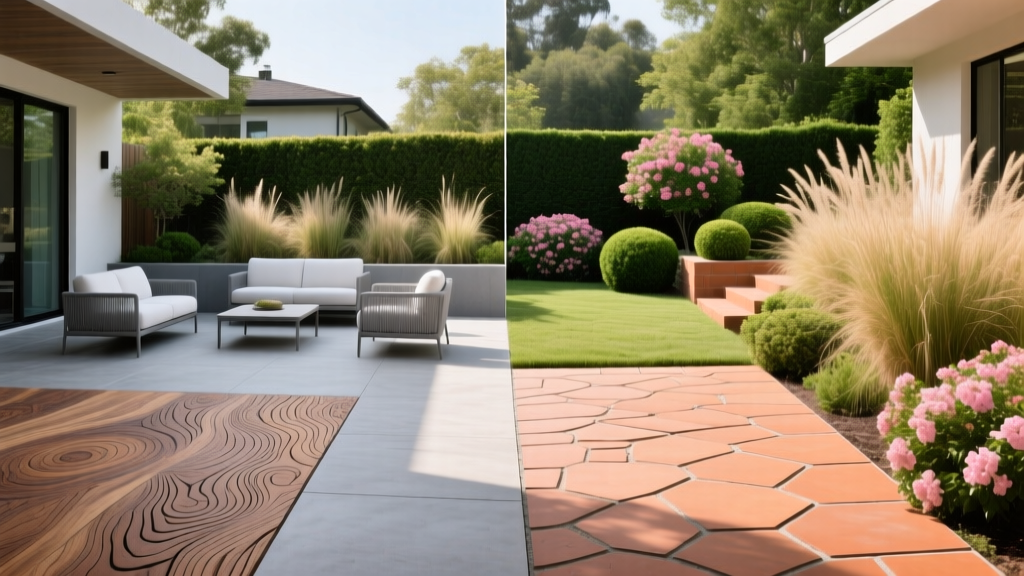
- Choose Poured Concrete If: You are on a strict upfront budget, the patio is a simple geometric shape (square or rectangle), the soil is highly stable with zero tree root interference, and you prefer a seamless, modern aesthetic with fewer joints for patio furniture to wobble on.
- Choose Pavers If: You are building in a region with severe freeze-thaw cycles, the site has expansive clay soil or mature trees, you anticipate needing utility access beneath the hardscape, or you want a system that can be repaired invisibly and relocated if you expand the patio in the future.
Ultimately, while basic concrete wins the Day 1 price war, high-quality stamped concrete and premium pavers cost nearly the same to install. In that mid-to-high tier, pavers offer a superior lifecycle value due to their modularity, invisible repair capabilities, and resistance to catastrophic structural failure.
Written by
Marcus ChenMarcus Chen is a licensed structural engineer (PE) and building materials analyst with over 12 years of experience across residential, commercial, and industrial construction. He holds a Master of Science in Civil Engineering from UC Berkeley and spent six years at Thornton Tomasetti before transitioning to independent consulting and technical writing. Marcus specializes in material selection for seismic-prone regions, concrete reinforcement strategies, and lifecycle cost analysis. His work has been cited by the American Concrete Institute (ACI) and the Structural Engineers Association of California (SEAOC). When he is not on a job site or at his desk, you will find him hiking the Sierra Nevada or restoring a 1920s craftsman bungalow in Oakland, CA.
More from Marcus Chen
View all
Construction Cost
How Much Did the Eiffel Tower Cost to Build?
How much did the Eiffel Tower cost to build in 1889? We adjust for inflation and compare its budget to modern skyscraper construction.
Aug 4, 2026

Fire Resistance
What Is a Fire Resistant Material? Testing & Certification Guide
Discover what is a fire resistant material through ASTM and UL testing. Learn how fire ratings, certifications, and assemblies work in construction.
Aug 4, 2026

Construction Cost
How Much Did the Burj Khalifa Cost to Build?
How much did the Burj Khalifa cost to build? We break down the $1.5B project and extract 5 money-saving strategies for your next build.
Jul 30, 2026