Paving Stones vs Concrete: Driveway Cost & Lifespan Guide
Compare paving stones vs concrete for driveways and patios. Expert analysis of installation costs, PSI ratings, failure modes, and lifespan.

The Structural Divide: Poured Slabs vs. Interlocking Pavers
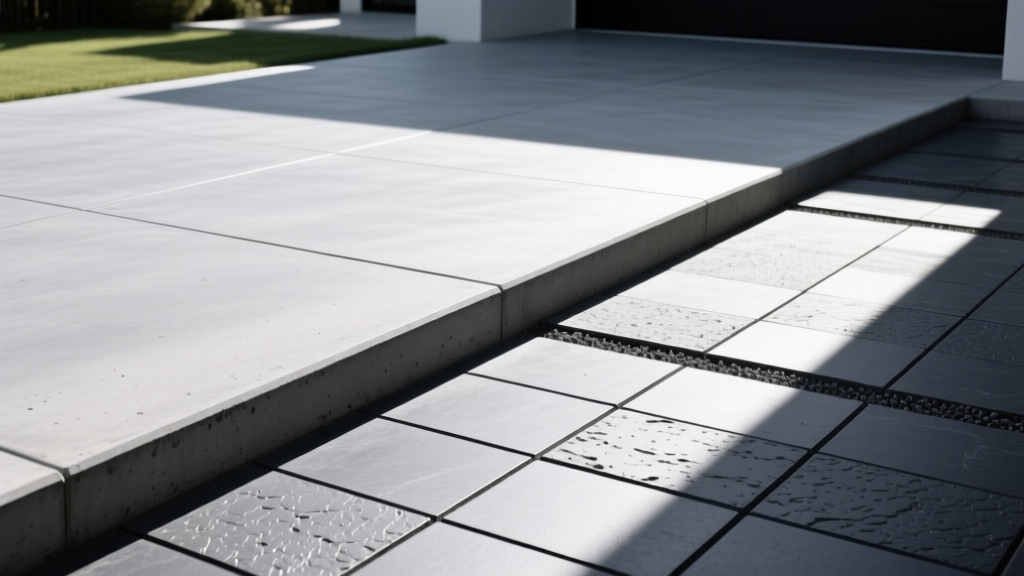
When evaluating paving stones vs concrete for exterior hardscaping, the fundamental difference lies in structural behavior. Poured concrete is a rigid, monolithic surface governed by American Concrete Institute (ACI) standards. A standard residential driveway requires a 4,000 PSI mix design, a 6-inch thickness, and air-entrainment of 4% to 6% to survive freeze-thaw cycles. Because it moves as a single unit, any subgrade shifting transfers directly to the slab, resulting in tensile stress and cracking.
Conversely, interlocking concrete pavers are flexible, segmental units manufactured to ASTM C936 standards. They boast a minimum compressive strength of 8,000 PSI and water absorption rates below 5%. Instead of resisting ground movement through sheer mass, pavers dissipate kinetic loads and accommodate minor soil deflection through their jointing system. This flexibility makes them highly resilient in expansive clay soils where rigid slabs routinely fail.
Quick Decision Matrix: Which Material Fits Your Site?
- Choose Poured Concrete If: You have a stable, well-draining sandy subgrade, a strict upfront budget, and prefer a minimalist, modern aesthetic with fewer joints.
- Choose Paving Stones If: Your site features expansive clay, heavy tree root networks, or poor drainage. Pavers are also the mandatory choice if you require permeable stormwater management or anticipate future utility trenching.
Subgrade Preparation: The Hidden Cost Driver
The most common point of failure for both materials is inadequate base preparation, yet the requirements differ significantly. Poured concrete typically requires a 4-inch base of compacted granular fill. If the subgrade is stable, contractors may even pour directly on graded earth, though this risks frost heave in northern climates.
Paving stones demand a far more rigorous foundation. According to the Interlocking Concrete Pavement Institute (ICPI), a vehicular paver driveway requires 6 to 8 inches of compacted, crushed angular aggregate (ASTM D2940) topped with a 1-inch bedding layer of coarse, sharp concrete sand (ASTM C33). This base must be compacted in 2-inch lifts using a vibratory plate compactor to achieve 95% Proctor density. Skipping this step guarantees base washout and paver settling within the first three years.
Upfront Installation Costs and Labor Breakdown
While poured concrete is generally less expensive initially, the gap narrows when decorative finishes are applied to the slab. The following table outlines average 2026 pricing for a standard 500-square-foot residential driveway, assuming moderate site accessibility and standard soil conditions.
| Cost Factor | Poured Concrete (Standard Broom Finish) | Interlocking Paving Stones (Standard Driveway Grade) |
|---|---|---|
| Excavation & Base Prep | $2.00 - $3.50 / sq ft | $4.00 - $6.00 / sq ft |
| Material Costs | $4.00 - $6.00 / sq ft | $3.50 - $7.00 / sq ft |
| Labor & Installation | $4.00 - $6.00 / sq ft | $8.00 - $14.00 / sq ft |
| Total Estimated Cost | $10.00 - $15.50 / sq ft | $15.50 - $27.00 / sq ft |
Note that upgrading poured concrete to a stamped or exposed aggregate finish will push the concrete cost to $18 - $25 per square foot, effectively matching or exceeding the cost of mid-tier paving stones.
Long-Term Durability and Specific Failure Modes
Concrete: Uncontrolled Cracking and Spalling
Concrete's primary vulnerability is tensile weakness. Even with control joints cut every 10 feet to诱导 (induce) straight-line cracking, thermal expansion and subgrade settling often cause random, jagged fractures. Furthermore, the use of sodium chloride (rock salt) for winter de-icing triggers a chemical reaction that causes surface spalling—the flaking and peeling of the top cement paste layer. To mitigate this, contractors must apply a silane/siloxane penetrating sealer every 3 to 5 years, which chemically repels water and chlorides without altering surface traction.
Paving Stones: Edge Restraint Failure and Creep
Pavers do not crack, but they can migrate. The most frequent failure mode in paver installations is inadequate edge restraint. Without a rigid perimeter, vehicular turning forces push the outer pavers outward, opening joints and allowing the bedding sand to escape. Professional installations must utilize heavy-duty plastic or aluminum edge restraints (such as SnapEdge or Perma-Edge) secured with 10-inch galvanized spikes driven every 12 inches into the base aggregate, not just the soil.
Maintenance Realities: Jointing and Weed Intrusion
The maintenance profiles of paving stones vs concrete diverge sharply at the joints. Poured concrete requires periodic sealing and joint caulking with self-leveling polyurethane (like Sikaflex) to prevent water infiltration beneath the slab. Pavers, however, rely on jointing sand to maintain interlock and prevent weed growth.
Standard masonry sand washes out easily and invites ants and weeds. The modern standard is polymeric sand, which contains water-activated polymers that bind the sand grains together into a flexible, mortar-like matrix. Products like Alliance Gator Maxx G2 or Techniseal Polymeric Sand are engineered to resist washout and weed germination while retaining enough flexibility to accommodate minor paver movement. Re-applying polymeric sand is typically required every 7 to 10 years, whereas concrete joint caulking may be needed every 3 to 5 years.
Permeability and Stormwater Management
As municipal stormwater regulations tighten, permeability has become a critical factor in hardscape design. Standard poured concrete is entirely impervious, generating high volumes of surface runoff that can overwhelm local drainage systems and carry pollutants into waterways.
While pervious concrete exists, it is highly susceptible to clogging from fine sediments and requires specialized vacuum maintenance. In contrast, Permeable Interlocking Concrete Pavement (PICP) utilizes wider joints filled with clean, crushed open-graded stone (ASTM No. 8 or No. 89). According to EPA Green Infrastructure guidelines, PICP systems can infiltrate rainfall rates exceeding 10 inches per hour, effectively mimicking natural ground absorption. For properties with strict lot-coverage limits or poor natural drainage, permeable pavers offer a functional and regulatory advantage that standard concrete simply cannot match.
Final Verdict: Matching Material to Project Scope
The choice between paving stones and concrete ultimately hinges on site conditions, budget flexibility, and long-term maintenance tolerance. Poured concrete remains the most cost-effective solution for large, straightforward driveways with stable subgrades, provided the owner is willing to maintain a strict sealing schedule to prevent spalling. Paving stones command a higher initial investment and require meticulous base preparation, but they offer superior structural resilience in problematic soils, effortless localized repairs, and unmatched versatility in permeable stormwater design. For high-end patios or driveways subject to heavy tree root intrusion, the segmental flexibility of pavers will almost always outlast a rigid concrete slab.
Written by
David NakamuraDavid Nakamura is a licensed architect (AIA) and construction technology writer focused on sustainable building methods, mass timber engineering, and high-performance building envelopes. He holds a Master of Architecture from the University of Washington and is a certified Passive House Consultant (CPHC). David spent eight years at the Seattle firm Mithun, where he led the design of three LEED Platinum projects, before founding his own practice specializing in net-zero residential design. He serves on the editorial advisory board of GreenBuilder Magazine and has authored peer-reviewed papers on cross-laminated timber (CLT) connections for the Journal of Structural Engineering. In his spare time, David teaches woodworking at Pratt Fine Arts Center and kayaks the Puget Sound.
More from David Nakamura
View all
Construction Cost
Labor Cost to Build a Deck Per Sq Ft: 2026 Installation Guide
Discover the exact labor cost to build a deck per sq ft in 2026. This installation guide breaks down contractor rates, complexity factors, and hidden fees.
Aug 4, 2026

Construction Cost
How Much Does It Cost to Build a 3 Bedroom House? Financing Guide
Learn exactly how much it costs to build a 3 bedroom house and explore 2026 financing options, construction loan types, and budget frameworks for your build.
Aug 4, 2026

Construction Cost
Cost to Build a Tennis Court: 2026 Guide
How much does it cost to build a tennis court in 2026? Breakdowns for asphalt, concrete, and synthetic surfaces plus fencing and lighting.
Jul 30, 2026