Evaluate CertainTeed Fiber Cement Products: Cost & Market Reality
Analyze the true cost of CertainTeed fiber cement products in 2026, including legacy repair expenses, market availability, and top alternative comparisons.

The 2026 Market Reality: CertainTeed’s Fiber Cement Exit
To accurately evaluate the building materials company CertainTeed on fiber cement products in 2026, one must first address a critical industry shift: CertainTeed has largely exited the manufacturing of traditional cementitious siding. Once a major competitor to James Hardie with its WeatherBoards line, CertainTeed pivoted away from fiber cement due to escalating manufacturing overhead, legacy asbestos litigation impacts, and a strategic shift toward advanced polymers and composite claddings.
Consequently, a traditional cost breakdown for new CertainTeed fiber cement installation is no longer applicable. Instead, a rigorous 2026 cost analysis must focus on three realities: the premium cost of sourcing legacy WeatherBoards for repairs, the structural costs of removing failing cementitious siding, and the comparative pricing of transitioning to active market leaders or CertainTeed’s own modern composite alternatives.
Legacy Repair Costs: Sourcing Discontinued WeatherBoards
For homeowners and contractors maintaining existing CertainTeed fiber cement exteriors, replacing damaged boards is the primary cost driver. Because the product is no longer in active production, standard distribution channels (like ABC Supply or Beacon) do not stock it. Sourcing requires tapping into architectural salvage, liquidation yards, or custom milling, which drastically inflates the price per square foot.
| Sourcing Method | Estimated Cost (Per Sq. Ft.) | Availability & Lead Time | Color Match Viability |
|---|---|---|---|
| Architectural Salvage Yards | $2.50 - $4.00 | Highly variable; requires local hunting | Poor (fading and discontinued palettes) |
| Online Liquidation/Overstock | $4.50 - $7.00 | 1-3 weeks; high shipping freight costs | Moderate (if original SKU is found) |
| Custom Fiber Cement Milling | $9.00 - $14.00 | 4-6 weeks; minimum order quantities apply | Excellent (custom profiles and priming) |
Full Replacement: Transitioning Away from Fiber Cement
When legacy CertainTeed fiber cement reaches the end of its lifecycle—often characterized by edge spalling, efflorescence, or fastener rust-bleeding—the most cost-effective long-term decision is a full tear-off. Below is a 2026 cost matrix comparing the transition to James Hardie (the fiber cement standard) versus CertainTeed Everlast Advanced Composite Siding (the company's modern spiritual successor).
Material and Labor Cost Matrix (Per Square Foot)
| Material Type | Material Cost | Installation Labor | Total Installed Cost | Key Cost Drivers |
|---|---|---|---|---|
| James Hardie Fiber Cement | $3.50 - $5.50 | $4.50 - $7.50 | $8.00 - $13.00 | Silica dust mitigation, heavy material handling, specialized cutting tools. |
| CertainTeed Everlast Composite | $6.00 - $9.00 | $3.50 - $5.50 | $9.50 - $14.50 | Higher material cost offset by faster installation; no silica abatement required. |
| Premium Vinyl (CertainTeed Cedar Impressions) | $2.50 - $4.50 | $3.00 - $5.00 | $5.50 - $9.50 | Lowest labor cost; lightweight; lacks the rigid impact resistance of cement/composite. |
Hidden Costs in Fiber Cement Removal and Replacement
Evaluating the true cost of a siding project requires looking beyond the cladding itself. Fiber cement removal introduces specific hidden expenses that contractors must account for in their bids.
1. Silica Dust Mitigation and OSHA Compliance
While removing old fiber cement does not generate as much dust as cutting new boards, any on-site trimming of replacement cementitious boards triggers strict OSHA regulations regarding respirable crystalline silica. According to OSHA's silica standards for construction, contractors must use water-delivery systems or HEPA-filtered dust collection vacuums attached to specialized shears. This equipment overhead, combined with the slower cutting speed, adds approximately $0.50 to $0.85 per square foot to the labor cost of fiber cement projects compared to composite or vinyl.
2. Substrate Degradation and WRB Replacement
Fiber cement is highly porous. If the previous installers failed to maintain a minimum 6-inch ground clearance or neglected to flash horizontal trim properly, water wicking is almost guaranteed. When tearing off old CertainTeed WeatherBoards, contractors frequently discover rotted OSB sheathing or degraded weather-resistant barriers (WRB).
- Minor Sheathing Repair: $15 - $25 per square foot (localized patching).
- Full WRB Replacement (e.g., ZIP System or Tyvek HomeWrap): $1.25 - $2.50 per square foot.
- Flashing and Drip Edge Upgrades: $400 - $800 per project (essential for preventing repeat wicking).
"The shift from cementitious siding to advanced polymer composites in the mid-2020s was driven as much by labor shortages and silica regulations as it was by material science. Contractors simply prefer materials that do not require specialized respiratory protection and heavy-duty scoring tools."
— Industry Analysis on Cladding Trends, Building Material Supply Reports
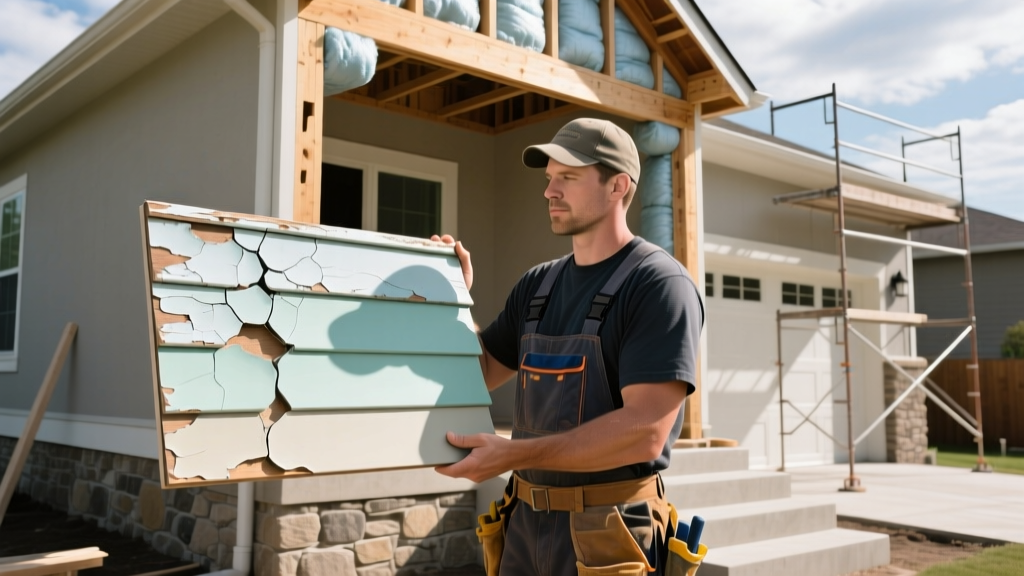
Technical Failure Modes: Why CertainTeed Fiber Cement Failed Prematurely
To understand the lifecycle costs, it is vital to recognize the specific failure modes that plagued older fiber cement installations. If you are evaluating a home with existing CertainTeed fiber cement, inspect for the following edge cases:
Fiber cement absorbs moisture. If the factory-applied primer was compromised during installation, or if the boards were installed in high-humidity zones without proper back-priming, water enters the substrate. In freezing climates, this water expands, causing the bottom edges of the siding to delaminate and spall. Once spalling begins, the structural integrity of the board is compromised, and localized repair is impossible; full replacement is required.
Fastener Corrosion and Wind Uplift
CertainTeed’s original installation manuals specified hot-dipped galvanized or stainless steel nails. However, cost-cutting contractors frequently used electro-galvanized roofing nails. In 2026, homes built 15 years ago with improper fasteners are now showing severe rust bleeding through the paint film. Furthermore, if the boards were face-nailed too close to the edge (less than 3/4" from the top edge), the brittle nature of fiber cement leads to micro-fractures, severely reducing the wind-uplift resistance of the exterior envelope.
Final Decision Framework: Repair, Replace, or Pivot?
When evaluating the building materials company CertainTeed on fiber cement products today, your decision should be dictated by the current state of the existing exterior and your long-term holding strategy for the property.
- Scenario A: Isolated Impact Damage (Less than 5% of exterior).
Action: Source legacy boards from architectural salvage. Do not invest in custom milling unless the property is a high-value historic restoration. Budget $500-$800 for a specialized contractor to execute the patch and blend the paint. - Scenario B: Widespread Edge Spalling or Moisture Intrusion.
Action: Execute a full tear-off. Do not attempt to install new fiber cement over the existing layer. Pivot to CertainTeed Everlast Composite if you want to maintain a relationship with the CertainTeed ecosystem and avoid future silica/moisture issues, or choose James Hardie if you require the absolute highest fire-rating (ASTM E84 Class A) and rigid impact resistance. - Scenario C: Preparing for a Near-Term Sale (Under 3 Years).
Action: Power wash, caulk all horizontal seams with a high-grade polyurethane sealant (like OSI QUAD Max), and apply a premium elastomeric exterior coating to bind minor micro-fractures. This cosmetic stabilization costs roughly $2.50 per square foot and delays full replacement for the next buyer.
For comprehensive guidelines on maintaining and evaluating exterior cladding systems, refer to the University of Minnesota Extension's siding maintenance resources, which provide excellent baseline data on moisture management and material longevity across different climate zones.
Written by
Elena RodriguezElena Rodriguez is a civil engineer and technical writer specializing in concrete technology, masonry systems, and ASTM/ACI compliance. She earned her B.S. in Civil Engineering from Texas A&M University and spent a decade at a materials testing laboratory, performing over 2,000 concrete compressive strength tests and masonry prism evaluations. Elena is an ACI-certified Field Testing Technician (Grade I) and a member of ASTM Committee C12 on Natural Building Stone. She currently consults on forensic engineering cases involving concrete failures and moisture intrusion. Based in San Antonio, TX, Elena is a proud member of the Society of Women Engineers (SWE) and coaches her daughter's FIRST Robotics team.
More from Elena Rodriguez
View all
Walls & Panels
Cost Analysis: Light Gauge Steel Framing Advantages and Disadvantages
Evaluate light gauge steel framing advantages and disadvantages through a strict cost analysis lens, comparing material, labor, and lifecycle expenses.
Aug 4, 2026

Walls & Panels
Gypsum Board Types: Exact Specifications, Thickness & Dimensions
Compare standard, Type X, and moisture-resistant gypsum board types. Get exact specifications, thicknesses, dimensions, and ASTM standards for your project.
Aug 4, 2026

Fire Resistance
Best Fire-Resistant Outdoor Decking Materials: 2026 Buyer Guide
Discover the best fire-resistant outdoor decking materials for 2026. Compare Class A PVC, aluminum, and hardwood options for WUI compliance and safety.
Aug 4, 2026