Concrete vs Liner Pool: Cost, Durability, and Build Comparison
Compare concrete vs liner pool construction, costs, and lifespans. Expert data on gunite durability, vinyl maintenance, and long-term ROI.

The Core Structural Difference: Pneumatic Concrete vs. Non-Structural Membranes
When evaluating a concrete vs liner pool, the fundamental divergence lies in structural engineering. Concrete pools (specifically gunite and shotcrete) are monolithic, structural shells. Builders excavate the site, tie a grid of #4 or #5 steel rebar on 10-inch to 12-inch centers, and pneumatically spray a mixture of cement, sand, and aggregate at high velocity. This cures into a 6-inch to 8-inch thick shell with a compressive strength typically exceeding 4,000 psi. The concrete itself is the structural vessel holding the water.
Vinyl liner pools, conversely, are non-structural. The water is held by a custom-cut, flexible membrane—typically a 27-mil to 30-mil virgin vinyl sheet. This liner relies entirely on a supporting framework of galvanized steel, polymer, or extruded aluminum panels, backed by compacted soil or a vermiculite/cement floor base. If the structural frame fails or the surrounding soil shifts, the liner has no independent load-bearing capacity.
Quick Verdict: Structural Integrity
Choose concrete (gunite/shotcrete) if you require a highly durable, permanent structural asset capable of withstanding aggressive soil conditions, high water tables, and custom freeform geometries. Choose a vinyl liner if you prioritize a lower initial capital outlay, a non-porous surface that resists algae, and a standardized rectangular footprint.
Upfront Capital Costs and Installation Timelines
The initial financial outlay and construction schedule represent the most immediate differences between these two methodologies. According to industry data tracked by the Pool & Hot Tub Alliance (PHTA), concrete pools command a significant premium due to labor intensity, material costs, and extended curing times.
| Metric | Concrete (Gunite/Shotcrete) | Vinyl Liner |
|---|---|---|
| Average Base Cost (15x30 ft) | $90,000 - $140,000+ | $55,000 - $85,000 |
| Construction Timeline | 10 to 16 weeks | 4 to 8 weeks |
| Excavation & Soil Removal | Extensive (over-dig for gravel base) | Standard (precise to panel dimensions) |
| Interior Finish Application | Wet-cast plaster, quartz, or pebble | Pre-manufactured vinyl drop-in |
The higher cost of concrete is driven by the multi-trade coordination required: steel tying, plumbing rough-ins, gunite application, and final interior finishing. Vinyl liner kits arrive pre-engineered, drastically reducing on-site labor hours and allowing the pool to be filled and operational within days of panel assembly.
Long-Term Maintenance and Lifecycle Expenses
The true cost of ownership emerges in years 5 through 15. The porosity of the interior surface dictates chemical consumption, while the structural material dictates major renovation intervals.
Concrete Pool Lifecycle
Standard white marcite plaster is highly porous, providing microscopic footholds for algae. This necessitates rigorous brushing and higher chlorine residuals (3.0 - 5.0 ppm). Upgrading to a PebbleTec or quartz aggregate finish increases the upfront cost by $5,000 to $12,000 but extends the surface lifespan from 7 years to 15+ years. Eventually, the concrete shell will require complete drainage, acid washing, and resurfacing—a major renovation costing $12,000 to $20,000 depending on the finish selected.
Vinyl Liner Lifecycle
Vinyl is completely non-porous, allowing for lower chlorine levels (1.0 - 3.0 ppm) and virtually eliminating the need for aggressive algae brushing. However, the liner is subject to UV degradation, chemical bleaching, and physical punctures. A high-quality 30-mil liner typically lasts 7 to 10 years. Replacement requires draining the pool, unseating the coping, and installing a new custom-cut membrane, costing between $4,500 and $7,000 per cycle.
Expert Insight: While a vinyl liner replacement is cheaper than a concrete resurfacing job, a homeowner will likely replace a vinyl liner two or three times over a 30-year period. When calculating 30-year ROI, the lifecycle costs of both pool types often converge, making the initial aesthetic and structural preferences the true deciding factors.
Structural Vulnerabilities and Failure Modes
Every building material has specific environmental vulnerabilities. Understanding these failure modes is critical for site-specific decision making.
- Hydrostatic Pressure (Concrete): In areas with high water tables, groundwater pressure pushing up against the empty concrete shell can cause structural cracking or even 'float' the pool out of the ground during a drain. Builders must install hydrostatic relief valves in the main drain sump and deep gravel sumps beneath the shell to mitigate this.
- Liner Floating (Vinyl): Vinyl pools are equally susceptible to high water tables. If groundwater seeps behind the liner panels, the liner will bubble, stretch, and float. Unlike concrete, vinyl pools cannot easily integrate sub-shell relief valves, requiring perimeter French drains to manage the water table.
- Rebar Oxidation (Concrete): If the gunite shell is applied too thin (less than 6 inches) or if the rebar grid is not properly elevated on dobies (concrete chairs) to ensure full encapsulation, moisture can reach the steel. The resulting oxidation expands the rebar, spalling the concrete from the inside out.
- Panel Corrosion (Vinyl): Steel wall panels in vinyl pools are prone to rust at the seams and screw lines, especially in coastal or high-salinity soil environments. Polymer panels eliminate rust but lack the rigidity of steel, requiring more extensive external bracing during the backfill process.
Design Flexibility and Aesthetics
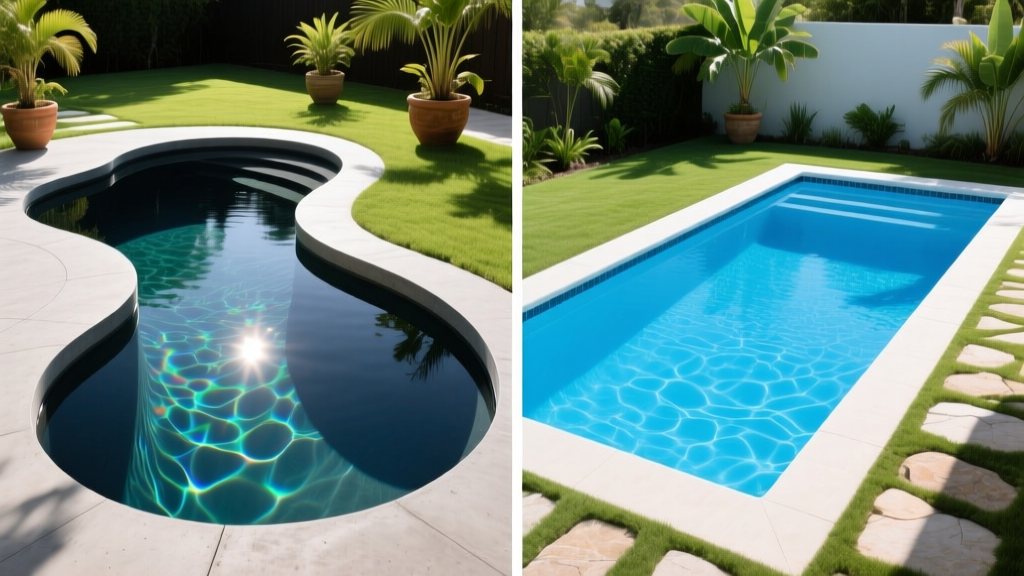
According to manufacturing guidelines from major suppliers like Latham Pools, vinyl liners are constrained by the bending radii of the supporting wall panels. While modern CNC manufacturing allows for some custom curves, vinyl pools are predominantly restricted to geometric shapes: rectangles, true-L shapes, and Grecian outlines. The interior aesthetic is limited to printed patterns that mimic tile or stone, which can look artificial upon close inspection.
Concrete is entirely formless until sprayed. Builders can create zero-edge infinity profiles, naturalistic lagoons with integrated boulders, and shallow sun shelves (Baja shelves) with complex radii. Furthermore, the interior finish of a concrete pool can utilize real materials—colored glass beads, natural river pebbles, and polished marble—providing a tactile and visual depth that printed vinyl cannot replicate.
Decision Matrix: Which Pool Type Fits Your Project?
Use the following framework to align your site conditions, budget, and long-term goals with the correct material.
| Project Parameter | Choose Concrete | Choose Vinyl Liner |
|---|---|---|
| Budget is strictly capped under $70k | ❌ | ✅ |
| Custom freeform or infinity edge design | ✅ | ❌ |
| High soil salinity or coastal environment | ✅ | ❌ (Steel panels rust) |
| Desire for lowest weekly chemical costs | ❌ | ✅ |
| Need pool operational in under 6 weeks | ❌ | ✅ |
| Integrating heavy natural stone coping/boulders | ✅ | ❌ |
Frequently Asked Technical Questions
Can a vinyl liner pool be converted to concrete later?
No. The structural frameworks are entirely incompatible. A vinyl pool relies on thin, flexible panels and a sand/vermiculite base that cannot support the immense weight and hydrostatic pressure of a gunite shell. If you want a concrete pool, the vinyl structure must be completely demolished and removed, and the site re-excavated to accommodate the thicker concrete shell and extensive steel rebar grid.
Does a concrete pool add more resale value to a home than a vinyl pool?
Generally, yes. Real estate appraisers and buyers typically view concrete pools as permanent, high-end architectural features, particularly when finished with premium aggregates like PebbleTec and paired with natural stone coping. Vinyl pools are often viewed as semi-permanent structures with a depreciating asset (the liner) that the buyer may immediately need to replace, which can result in a lower appraised value addition relative to the initial build cost.
How does ground freezing affect both pool types?
In freeze-thaw climates, both pools require winterization, but the failure modes differ. Concrete pools are highly susceptible to frost heave if the surrounding deck and coping are not properly isolated with expansion joints; the expanding ice can crack the rigid shell. Vinyl pools are more forgiving of minor ground movement due to the flexibility of the liner, but ice expansion inside the pool can damage the skimmer faceplates and return lines if ice compensators (air pillows) are not utilized correctly.
Written by
Elena RodriguezElena Rodriguez is a civil engineer and technical writer specializing in concrete technology, masonry systems, and ASTM/ACI compliance. She earned her B.S. in Civil Engineering from Texas A&M University and spent a decade at a materials testing laboratory, performing over 2,000 concrete compressive strength tests and masonry prism evaluations. Elena is an ACI-certified Field Testing Technician (Grade I) and a member of ASTM Committee C12 on Natural Building Stone. She currently consults on forensic engineering cases involving concrete failures and moisture intrusion. Based in San Antonio, TX, Elena is a proud member of the Society of Women Engineers (SWE) and coaches her daughter's FIRST Robotics team.
More from Elena Rodriguez
View all
Walls & Panels
Cost Analysis: Light Gauge Steel Framing Advantages and Disadvantages
Evaluate light gauge steel framing advantages and disadvantages through a strict cost analysis lens, comparing material, labor, and lifecycle expenses.
Aug 4, 2026

Walls & Panels
Gypsum Board Types: Exact Specifications, Thickness & Dimensions
Compare standard, Type X, and moisture-resistant gypsum board types. Get exact specifications, thicknesses, dimensions, and ASTM standards for your project.
Aug 4, 2026

Fire Resistance
Best Fire-Resistant Outdoor Decking Materials: 2026 Buyer Guide
Discover the best fire-resistant outdoor decking materials for 2026. Compare Class A PVC, aluminum, and hardwood options for WUI compliance and safety.
Aug 4, 2026