Selecting Sikaflex Self-Leveling Sealant for Concrete Joints
Master material taxonomy for concrete joints. Learn when and how to specify Sikaflex self-leveling sealant for horizontal expansions and cracks.
The Taxonomy of Concrete Joint Sealants: Where Polyurethane Fits
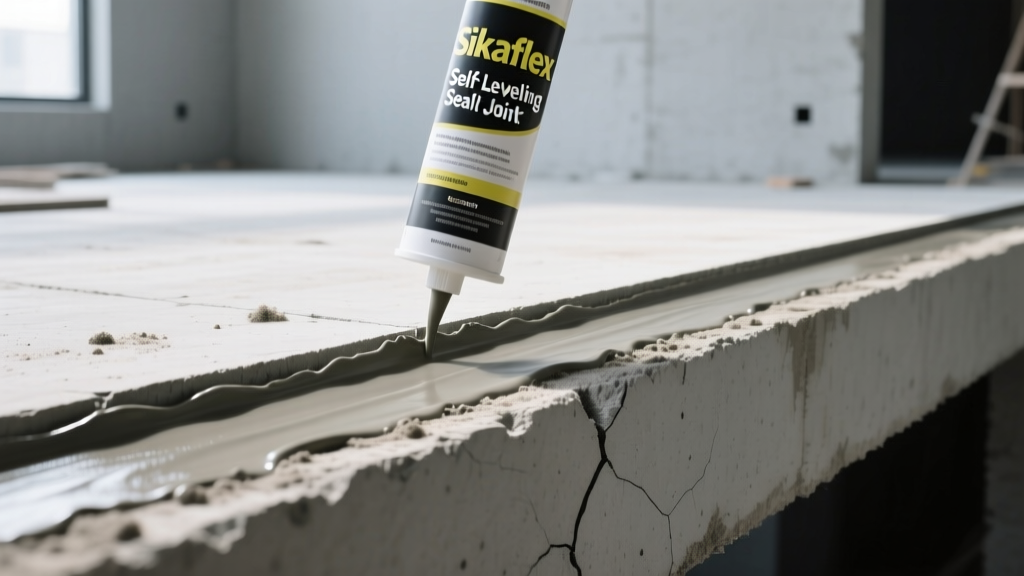
Designing durable concrete flatwork requires more than just specifying the correct compressive strength or slump; it demands a rigorous approach to joint sealing. Concrete expands, contracts, and deflects. Without an elastomeric barrier, horizontal control joints and expansion joints rapidly fill with incompressible debris, leading to spalling and structural degradation. When navigating the material taxonomy of joint sealants, specifiers generally choose between three primary chemistries: silicone, polysulfide, and polyurethane. Within the polyurethane category, specifying a Sikaflex self-leveling sealant (such as the Sikaflex-11+ Purform line) represents the industry benchmark for horizontal applications ranging from commercial warehouse floors to residential driveways.
Unlike gun-grade sealants that require extensive tooling and smoothing, self-leveling polyurethane formulations possess a specific rheology. They are highly thixotropic yet pourable, allowing gravity to naturally flatten the material within the joint cavity, creating a seamless, flush finish that withstands forklift traffic and pedestrian wear without catching or tearing.
Comparative Matrix: Polyurethane vs. Silicone vs. Polysulfide
To understand why a Sikaflex self-leveling sealant is frequently selected over alternatives, we must evaluate the chemical trade-offs. While silicones offer superior UV resistance and polysulfides provide exceptional chemical resistance in wastewater facilities, polyurethanes dominate the general construction and paving sectors due to their mechanical toughness.
| Property | Polyurethane (Sikaflex) | Silicone | Polysulfide |
|---|---|---|---|
| Traffic Durability | Excellent (High Tear Resistance) | Poor (Easily Punctured) | Good |
| UV Resistance | Moderate (May Chalk/Chalk) | Excellent | Moderate |
| Paintability | Yes (After Full Cure) | No | Yes |
| Application Ease | High (Self-Leveling) | Moderate (Requires Tooling) | Low (Messy, Odorous) |
| Cost per Linear Foot | $2.00 - $3.50 | $3.50 - $5.50 | $4.00 - $6.00 |
According to guidelines published by the American Concrete Institute (ACI), polyurethane sealants are the preferred choice for driveways, sidewalks, and warehouse floors because their high tear strength prevents the sealant from ripping when subjected to the shear forces of turning vehicle tires.
Technical Specifications and Rheology Dynamics
When specifying a Sikaflex self-leveling sealant for horizontal joints, understanding the exact curing mechanics is critical for project scheduling. These single-component polyurethanes cure by reacting with ambient moisture. The 'self-leveling' characteristic is a carefully engineered balance: the material must flow just enough to eliminate ridges and tooling marks, but possess enough yield stress to remain suspended on the backer rod without leaking through microscopic voids in the concrete substrate.
- Shore A Hardness: Typically 35 to 40 (provides a firm, rubber-like surface that resists dirt pickup and indentation).
- Elongation at Break: 400% to 600% (allows the sealant to stretch significantly during winter thermal contraction).
- Tack-Free Time: 2 to 4 hours at 73°F (23°C) and 50% relative humidity.
- Full Cure Rate: Approximately 1/16 inch (1.5 mm) per 24 hours. A standard 1/2-inch deep joint will require 7 to 10 days to cure entirely to the bottom.
The Non-Negotiable Role of Sika Primer-3 N
The most common cause of sealant failure in concrete joints is not the elastomer itself, but the bond line. Concrete is a highly porous, alkaline, and often dusty substrate. Applying a self-leveling sealant directly to unprepared concrete will inevitably result in adhesive failure. Sika Corporation mandates the use of a dedicated primer, such as Sika Primer-3 N, for porous mineral substrates.
If concrete is poured and sealed on the same day, or if the substrate retains high moisture content, the moisture will react with the polyurethane and release carbon dioxide gas. Because the self-leveling sealant skins over rapidly, this gas becomes trapped, creating unsightly blisters and voids within the joint. Always verify that the concrete has cured for a minimum of 7 days and that the moisture content is below 4% before priming and sealing.
Step-by-Step Surface Preparation Protocol
- Mechanical Routing: Use a concrete saw or router to ensure the joint is exactly 1/2-inch wide and 1/2-inch deep. The optimal shape factor for self-leveling sealants is 2:1 (width to depth).
- Debris Removal: Blow out the joint with oil-free compressed air (minimum 90 psi). Wire brushing is insufficient for removing latent dust from the sidewalls.
- Backer Rod Insertion: Press a closed-cell polyethylene backer rod into the joint. The rod should be 25% larger than the joint width to ensure a tight friction fit, controlling the depth of the sealant and preventing three-sided adhesion.
- Priming: Apply Sika Primer-3 N using a small brush or dauber, coating only the vertical sidewalls. Avoid pooling primer on the backer rod. Allow 30 to 60 minutes for the primer to flash off before pouring the sealant.
Cost Analysis and Yield Calculations for 2026 Budgeting
Accurate budgeting requires moving beyond the per-cartridge price and calculating the true installed cost per linear foot. In 2026, a standard 10.1 oz (300 ml) cartridge of high-grade self-leveling polyurethane retails between $13.00 and $16.00, while 20 oz (600 ml) foil sausages range from $22.00 to $28.00.
Yield Calculation for a 1/2' x 1/2' Joint:
- Volume of 10.1 oz cartridge = ~18.4 cubic inches.
- Joint cross-section area (1/2' x 1/2') = 0.25 square inches.
- Linear yield per cartridge = 18.4 / (0.25 * 12 inches) = 6.13 linear feet.
Material Cost Breakdown (Per Linear Foot):
- Sealant (at $15.00/cartridge): $2.45 / lf
- Sika Primer-3 N (at $45.00/quart, covering ~150 lf): $0.30 / lf
- 1/2' Closed-Cell Backer Rod: $0.15 / lf
- Total Material Cost: ~$2.90 per linear foot.
When factoring in labor (joint routing, cleaning, priming, and pouring), contractors typically bid horizontal joint sealing at $6.50 to $9.00 per linear foot for commercial projects, depending on site accessibility and linear footage economies of scale.
Identifying and Troubleshooting Failure Modes
Even with premium materials, improper execution leads to distinct failure modes. Recognizing these early allows for targeted remediation.
Adhesive Failure (Peeling from Sidewalls)
Symptom: The sealant pulls away cleanly from the concrete edge, leaving the concrete exposed.
Root Cause: Failure to use Sika Primer-3 N, application over dusty substrates, or applying sealant before the primer has fully flashed off.
Remediation: Cut out the failed sections, re-route the concrete edges to expose fresh aggregate, re-prime, and repour.
Cohesive Failure (Tearing in the Center)
Symptom: The sealant remains bonded to the concrete but splits down the middle when the joint expands.
Root Cause: Three-sided adhesion. If the sealant bonds to the backer rod or the bottom of the joint, it cannot stretch freely and will tear under tension.
Remediation: Ensure the backer rod is properly sized and undamaged during insertion. Never use a liquid bond-breaker over a damaged backer rod; replace it entirely.
Chalking and UV Degradation
Symptom: The surface of the sealant turns white, powdery, and begins to micro-crack after 3 to 5 years of direct sunlight exposure.
Root Cause: Polyurethanes are inherently susceptible to ultraviolet degradation. While this chalking is primarily aesthetic and does not immediately compromise the waterproof seal, it is a known limitation.
Remediation: For highly visible architectural concrete where UV stability is paramount, consider a self-leveling silicone alternative, or specify a UV-stable polyurethane topcoat over the Sikaflex product once fully cured.
Proper joint design is the unsung hero of concrete flatwork. By matching the correct elastomeric taxonomy to the specific mechanical and environmental demands of the site, specifiers can extend the service life of concrete pavements and slabs by decades, preventing water infiltration and subgrade erosion.