Stamped Concrete vs Non-Slip Surfaces: Slip Resistance Comparison
Compare stamped concrete vs non-slip surfaces for slip resistance. Explore DCOF metrics, anti-slip additives, costs, and ADA compliance for 2026 projects.

The Slip Resistance Problem with Stamped Concrete
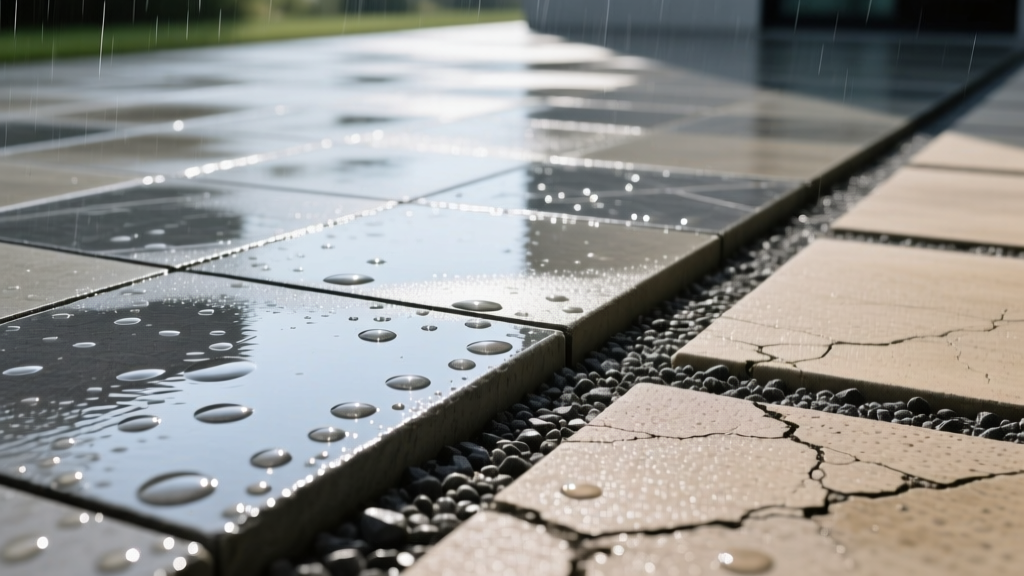
Stamped concrete remains one of the most popular decorative finishes for patios, pool decks, and commercial walkways due to its ability to mimic high-end materials like slate, flagstone, and cobblestone at a fraction of the cost. However, the very processes that give stamped concrete its aesthetic appeal also create a significant safety hazard. The stamping mats compress the surface paste, creating a dense, smooth layer. When this layer is sealed with standard film-forming acrylics to enhance color and protect against UV degradation, the microscopic pores are filled, resulting in a continuous plastic film. When wet, this film drastically reduces traction, turning an attractive patio into a severe slip-and-fall liability.
Understanding Slip Resistance Metrics: DCOF and ADA Standards
To accurately compare stamped concrete against alternative non-slip surfaces, contractors and architects must rely on standardized friction metrics rather than subjective assessments. The industry standard for measuring slip resistance is the Dynamic Coefficient of Friction (DCOF), which measures the friction of a surface while an object is already in motion. This has largely replaced the older Static Coefficient of Friction (SCOF) metric.
- ANSI A326.3 Standard: Requires a minimum wet DCOF of 0.42 for level interior spaces, though exterior wet areas demand much higher thresholds.
- ADA Compliance: According to the U.S. Access Board ADA Guidelines, accessible routes require a slip-resistant surface. While the ADA does not specify an exact numeric DCOF in its current enforceable text, the widely accepted standard derived from the ADA Accessibility Guidelines (ADAAG) is a minimum of 0.60 for flat surfaces and 0.80 for ramps.
- OSHA Regulations: OSHA Standard 1910.22 mandates that employers ensure walking-working surfaces are free of hazards and possess adequate traction, heavily scrutinizing surfaces that fall below the 0.50 DCOF mark in wet conditions.
Stamped Concrete vs. Alternative Non-Slip Surfaces
When evaluating stamped concrete vs non-slip surfaces, the comparison extends beyond the concrete itself to the finishing techniques and alternative materials available. The matrix below outlines the performance, cost, and aesthetic trade-offs for 2026 installations.
| Surface Type | Wet DCOF Range | Avg. Installed Cost (per sq ft) | Aesthetic Versatility | Maintenance Level |
|---|---|---|---|---|
| Stamped Concrete (No Additive) | 0.25 - 0.40 | $12 - $18 | High | High (Reseal 1-2 yrs) |
| Stamped Concrete + Anti-Slip Additive | 0.55 - 0.65 | $12.50 - $18.50 | High | High (Reseal 1-2 yrs) |
| Exposed Aggregate Concrete | 0.65 - 0.80 | $10 - $15 | Medium | Low |
| Heavy Broom Finish Concrete | 0.70 - 0.85 | $6 - $10 | Low | Very Low |
| Interlocking Concrete Pavers | 0.60 - 0.75 | $16 - $26 | High | Medium (Joint Sand) |
1. Stamped Concrete with Anti-Slip Additives
If the aesthetic of stamped concrete is non-negotiable, integrating an anti-slip additive into the sealer is the only viable path to compliance. Products like SureCrete SureGrip or Increte Systems Anti-Slip utilize micronized polypropylene beads or aluminum oxide. Aluminum oxide is generally preferred for exterior applications due to its Mohs hardness of 9, which prevents the grit from breaking down under foot traffic.
Application Protocol: The additive must be mixed directly into the sealer at a ratio of roughly 1 pound per 5 gallons of sealer, and kept in constant suspension using a drill and paddle mixer. Broadcasting the grit onto the surface after rolling the sealer results in uneven clumping, poor adhesion, and premature wash-off. Expect to add $0.15 to $0.30 per square foot to the total project cost for high-grade aluminum oxide additives.
2. Exposed Aggregate Concrete
Exposed aggregate achieves slip resistance mechanically rather than chemically. By applying a surface retarder immediately after the pour and subsequently washing away the top layer of cement paste, the underlying gravel and crushed stone are revealed. This creates a highly textured, three-dimensional surface with deep voids that channel water away from the contact point of a shoe. Exposed aggregate routinely achieves a wet DCOF above 0.65 without the need for film-forming sealers. Penetrating silane/siloxane sealers can be applied to prevent freeze-thaw spalling without altering the surface friction.
3. Broom Finish Concrete
The traditional broom finish remains the undisputed king of pure slip resistance. Dragging a coarse-bristled concrete broom across the leveling slab creates continuous, perpendicular striations that act as micro-channels for water displacement. While it lacks the decorative appeal of stamped patterns, a heavy broom finish is the mandatory standard for commercial loading docks, municipal ramps, and steep residential driveways where liability outweighs aesthetics.
4. Interlocking Concrete Pavers
Pavers offer a unique advantage in the stamped concrete vs non-slip surfaces comparison: micro-drainage. The joints between the pavers are filled with coarse polymeric sand or crushed stone dust. These joints allow surface water to drain laterally and provide physical edges that disrupt the hydroplaning effect. Furthermore, if a paver settles or cracks, it can be individually replaced without destroying the entire slab, an edge it holds over monolithic stamped concrete.
Maintenance and the Degradation of Slip Resistance
A critical, often overlooked factor in this comparison is how slip resistance degrades over time. Stamped concrete relies entirely on the sealer for its color vibrancy and protection. As foot traffic wears down the acrylic sealer, the anti-slip additives embedded within it are also stripped away. A stamped patio that tested at a 0.60 DCOF upon installation in 2024 may drop to a hazardous 0.35 DCOF by 2026 if not properly maintained.
Conversely, exposed aggregate and broom finishes derive their friction from the physical concrete matrix itself. While the concrete may slowly erode over decades, the slip resistance remains remarkably stable throughout the lifespan of the slab, requiring virtually zero friction-related maintenance.
Decision Framework: Which Surface Should You Choose?
Selecting the right surface requires balancing budget, aesthetics, and acceptable liability thresholds. Use this framework to guide your specification:
- Commercial Ramps & ADA Routes: Mandate heavy broom finish or exposed aggregate. Stamped concrete, even with additives, introduces unnecessary liability and maintenance burdens in high-traffic public access zones.
- Residential Pool Decks: Exposed aggregate or textured pavers. Avoid stamped concrete due to the rapid degradation of sealers in wet, chlorinated environments.
- High-End Residential Patios & Walkways: Stamped concrete with aluminum oxide additives. The aesthetic demand justifies the strict biennial resealing maintenance schedule required to maintain the DCOF.
- Steep Driveways (Gradient > 12%): Exposed aggregate or transverse broom finish. Stamped patterns do not provide the directional water channeling required for steep vehicular and pedestrian inclines.
Frequently Asked Questions
Can I apply anti-slip grip tape to stamped concrete instead of using additives?
While grip tape (like 3M Safety-Walk) adheres to sealed concrete, it is highly recommended against for decorative applications. The tape disrupts the visual continuity of the stamp pattern, creates a tripping hazard at the tape edges, and the adhesive often fails when exposed to UV radiation and freeze-thaw cycles, leaving a difficult-to-remove residue.
Does adding sand to the sealer work as a DIY anti-slip solution?
Standard masonry sand is not recommended. The silica particles are often too large and irregular, causing them to settle at the bottom of the sealer bucket before application, or clump on the surface, creating an unsightly, uneven texture. Always use commercially manufactured, micronized anti-slip additives specifically engineered to remain suspended in acrylic or polyurethane sealers.
How often must stamped concrete with anti-slip additives be resealed?
In high-traffic or high-UV environments, the sealer and the embedded additive must be reapplied every 12 to 24 months. Before resealing, the surface must be thoroughly cleaned with a trisodium phosphate (TSP) solution to remove dirt and oxidized acrylic, ensuring the new coat bonds properly and the new additive layer performs to its tested DCOF specifications.
Written by
Priya KapoorPriya Kapoor is a real estate market analyst and construction economics researcher with expertise in housing affordability, development feasibility, and infrastructure investment. She holds a Master of Regional Planning from Cornell University and previously worked as a senior analyst at CBRE's Investment Properties group, where she modeled returns for $4B in mixed-use development pipelines. Priya now runs an independent research practice advising developers, municipalities, and REITs on construction cost forecasting and market timing. She publishes the quarterly "BuildMat Market Pulse" report tracking material price indices across 12 commodity categories. Based in Austin, TX, Priya serves on the board of Habitat for Humanity Austin and is a marathon runner.
More from Priya Kapoor
View all
Construction Cost
Cost to Build a 1600 Sq Ft Home in 2026: Full Breakdown
Accurate 2026 cost to build a 1600 sq ft home—material, labor, and regional pricing breakdowns included. Plan your budget with real-time estimates.
Aug 11, 2026

Wood & Lumber
Name the Types of Wood for Pressure Treatment and Preservation
Learn how to name the types of wood best suited for pressure treatment. Compare species treatability, chemical retention levels, and 2026 preservation costs.
Aug 4, 2026

Stone & Masonry
Stone Veneer Suppliers Lindenhurst: 2026 Cost Analysis
Analyze 2026 stone veneer costs in Lindenhurst, NY. Compare local supplier pricing, delivery fees, and Suffolk County installation labor rates.
Aug 4, 2026