Technical Specs for Different Types of Concrete Sealer
Analyze technical specs for all types of concrete sealer, including silanes, epoxies, and polyurethanes, with exact coverage rates and MVT limits.

Chemical Classification and Substrate Interaction
Selecting the correct protection for a cementitious substrate requires a precise understanding of pore structure, alkalinity, and environmental exposure. The various types of concrete sealer operate on fundamentally different chemical mechanisms. Broadly, these products are categorized into penetrating (pore-lining or pore-blocking) and film-forming (surface-bonding) systems. According to the Portland Cement Association, matching the sealer's molecular weight and viscosity to the concrete's capillary network is the primary determinant of long-term performance.
Penetrating Sealers: Silanes, Siloxanes, and Silicates
Penetrating systems rely on capillary action to draw reactive chemicals into the concrete matrix. They do not build a measurable dry film thickness (DFT) on the surface.
Silane and Siloxane Water Repellents
Silanes possess the lowest molecular weight and smallest particle size among the types of concrete sealer designed for water repellency. This allows them to penetrate deeply (up to 1/4 inch in high-density mixes) and react with the free alkalis (calcium hydroxide) to form a hydrophobic silicone resin within the pores. Siloxanes, having a larger molecular structure, penetrate less deeply (typically 1/8 to 3/16 inch) but offer superior surface coverage and are better suited for porous, broom-finished, or exposed aggregate surfaces.
- Silane Coverage Rate: 300 to 450 square feet per gallon (highly dependent on substrate porosity).
- Siloxane Coverage Rate: 200 to 300 square feet per gallon.
- Active Solids Content: Specify a minimum of 40% active solids for vertical applications and 20% for horizontal decks to ensure adequate pore-lining.
- Water Absorption Reduction: High-quality formulations must demonstrate a >85% reduction in water absorption when tested per ASTM C1583.
Lithium and Sodium Silicate Densifiers
Unlike water repellents, silicate sealers react with unhydrated calcium hydroxide (free lime) to form additional calcium silicate hydrate (C-S-H) gel. This permanently densifies the surface, reducing dusting and increasing surface abrasion resistance. Lithium silicates are preferred over sodium silicates because they do not require scrubbing or rinsing after application and are less prone to triggering efflorescence or alkali-silica reaction (ASR).
Film-Forming Sealers: Acrylics, Epoxies, and Polyurethanes
Film-forming types of concrete sealer sit on top of the substrate, providing a physical wear layer. Their performance is dictated by polymer chemistry, cross-link density, and dry film thickness (DFT).
Acrylic Resins
Acrylics are single-component, solvent- or water-based polymers that dry through solvent evaporation. They are UV-stable and commonly used for exterior decorative concrete to enhance color (the 'wet look'). However, they offer minimal chemical resistance and low abrasion tolerance. Expect a DFT of 1 to 2 mils per coat, with a functional lifespan of 1 to 3 years in high-traffic zones before requiring a recoat.
Epoxy Coatings
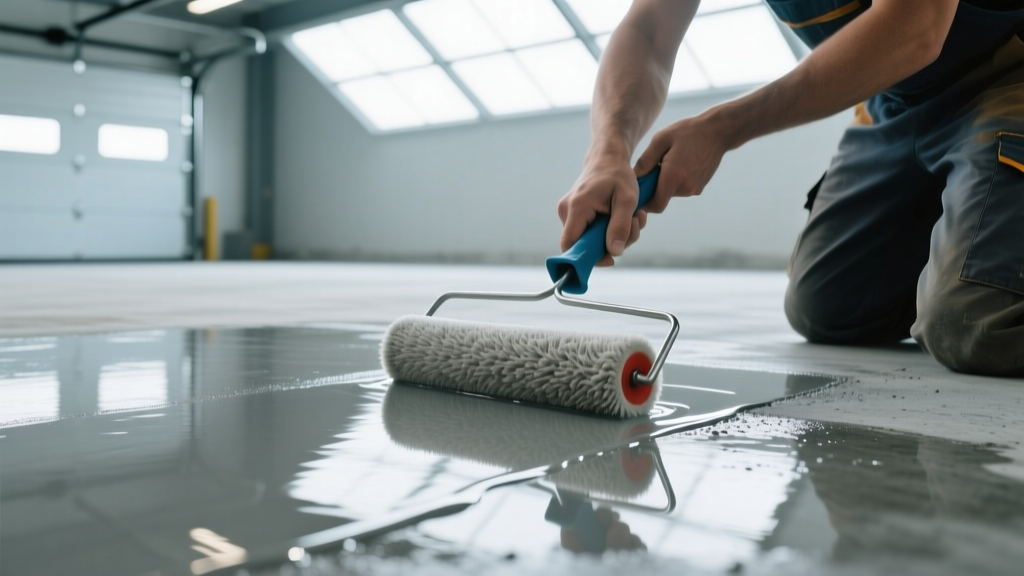
Two-component, 100% solids epoxies provide exceptional compressive strength (often exceeding 10,000 psi) and chemical resistance. They chemically cross-link to form a rigid, high-build film (10 to 20 mils DFT). However, standard aromatic epoxies are not UV-stable and will chalk or yellow when exposed to direct sunlight. They are strictly specified for interior industrial floors, warehouses, and garages.
Aliphatic Polyurethanes and Polyaspartics
Polyurethanes serve as the premier topcoat for exterior and UV-exposed interior applications. Aliphatic polyurethanes maintain color stability and offer superior abrasion resistance compared to epoxies, typically measured via the Taber Abrasion test (ASTM D4060). Polyaspartic esters represent the latest evolution in this category, offering rapid cure times (return to service in 2-4 hours), high DFT capabilities (up to 12 mils in a single pass), and extreme UV stability.
Technical Comparison Matrix
| Sealer Type | DFT / Penetration | Taber Abrasion (mg loss) | VOC Limit (SCAQMD) | Cost per Sq. Ft. |
|---|---|---|---|---|
| Silane/Siloxane | 1/8' - 1/4' Penetration | N/A (No surface film) | < 100 g/L (Water-based) | $0.15 - $0.35 |
| 100% Solids Epoxy | 10 - 20 mils | 20 - 40 mg (CS-17 wheel) | 0 g/L (No VOCs) | $0.60 - $1.20 |
| Aliphatic Polyurethane | 2 - 3 mils | 10 - 25 mg (CS-17 wheel) | < 250 g/L | $0.40 - $0.80 |
| Polyaspartic Ester | 6 - 12 mils | 5 - 15 mg (CS-17 wheel) | < 250 g/L | $1.00 - $2.50 |
Moisture Vapor Transmission (MVT) and Substrate Limits
The most frequent cause of catastrophic failure in film-forming types of concrete sealer is the mismanagement of hydrostatic pressure and moisture vapor transmission. The Environmental Protection Agency (EPA) and industry bodies mandate strict adherence to VOC and indoor air quality standards, which has driven the market toward water-based and 100% solids systems. However, these systems are highly sensitive to subsurface moisture.
Quantitative Testing Requirements
Before specifying an epoxy or polyurethane system, contractors must verify the slab's moisture content using standardized quantitative tests:
- ASTM F2170 (Relative Humidity Probe Test): Probes are inserted into holes drilled to 40% of the slab's depth. For standard epoxies, the RH must not exceed 75%. For specialized moisture-mitigating epoxies, thresholds can reach 90% to 95%.
- ASTM F1869 (Calcium Chloride Test): Measures the pounds of moisture emitted per 1,000 square feet over 24 hours. Standard film-forming sealers require a reading of 3.0 lbs or less. High-performance moisture vapor barriers can tolerate up to 10.0 to 15.0 lbs.
Surface Preparation and Concrete Surface Profile (CSP)
Film-forming sealers rely on mechanical interlock for adhesion. Acid etching is no longer considered an acceptable preparation method for high-performance epoxies or polyurethanes due to the unpredictability of the etch profile and the risk of residual neutralization salts.
Diagnostic Troubleshooting for Sealer Failures
When a sealer system fails, the morphology of the failure provides direct evidence of the root cause. Use this diagnostic framework to identify specification errors:
- Symptom: Blistering and Bubbles in Epoxy/Polyurethane.
Cause: MVT exceeds the coating's perm rating, or outgassing occurred due to a drop in barometric pressure or rising substrate temperatures during the curing window. Fix: Install a moisture-mitigating epoxy primer before the wear course. - Symptom: Whitening or Hazing in Acrylics.
Cause: Solvent-based acrylics were applied over a damp substrate, or water-based acrylics were exposed to rain/high humidity before complete coalescence. The trapped moisture scatters light. Fix: Apply a solvent bath (like xylene) to re-emulsify the acrylic and release the trapped moisture, or strip and reapply. - Symptom: Peeling and Flaking at Joint Lines.
Cause: The rigid film-forming sealer was applied continuously over dynamic control joints without honoring the joint. The tensile stress of slab movement exceeds the coating's elongation capacity (typically 2-5% for epoxies). Fix: Saw-cut the coating at all control joints and fill with a flexible polyurea joint filler.
Specifying the correct types of concrete sealer requires moving beyond basic product categories and evaluating the exact chemical properties, environmental constraints, and substrate conditions of the project. By adhering to ASTM testing protocols and matching the sealer's mechanical properties to the anticipated service loads, engineers and contractors can ensure decades of substrate protection.
Written by
Sarah WhitfieldSarah Whitfield is a chartered quantity surveyor (MRICS) and construction cost analyst with 15 years of experience in material pricing, procurement strategy, and project budgeting. She earned her degree in Construction Management from the University of Reading (UK) and has worked on projects ranging from $2M custom homes to $180M mixed-use developments across North America and Europe. Sarah currently leads cost estimating for BuildMat Insight, maintaining a proprietary database of 4,000+ material price points updated quarterly. She is a frequent contributor to RSMeans cost data panels and has presented at the International Cost Engineering Council (ICEC) congress. Based in Denver, CO, Sarah is an avid trail runner and volunteer mentor for Women in Construction.
More from Sarah Whitfield
View all
Wood & Lumber
What Are the Different Types of Wood? A Builder's Guide
Compare structural softwoods, finish hardwoods, and engineered lumber. Analyze Janka ratings, MOE values, and 2026 pricing for construction.
Aug 4, 2026

Walls & Panels
Steel Framing vs Wood Framing: Corrosion and Moisture Defense
Compare steel framing vs wood framing for moisture resistance. Learn about galvanized coatings, condensation risks, and corrosion protection strategies.
Jul 21, 2026

Stone & Masonry
How to Cut Stone Veneer: Wet Saw vs Grinder Comparison
Compare the best tools for cutting stone veneer. We review wet saws, angle grinders, and chop saws to help you achieve clean, chip-free cuts.
Jul 21, 2026