Type S Mortar Applications: When to Use It Over Type N
Discover exact scenarios for Type S mortar, from retaining walls to stone veneer. Learn ASTM C270 specs, mix ratios, and when to avoid it.
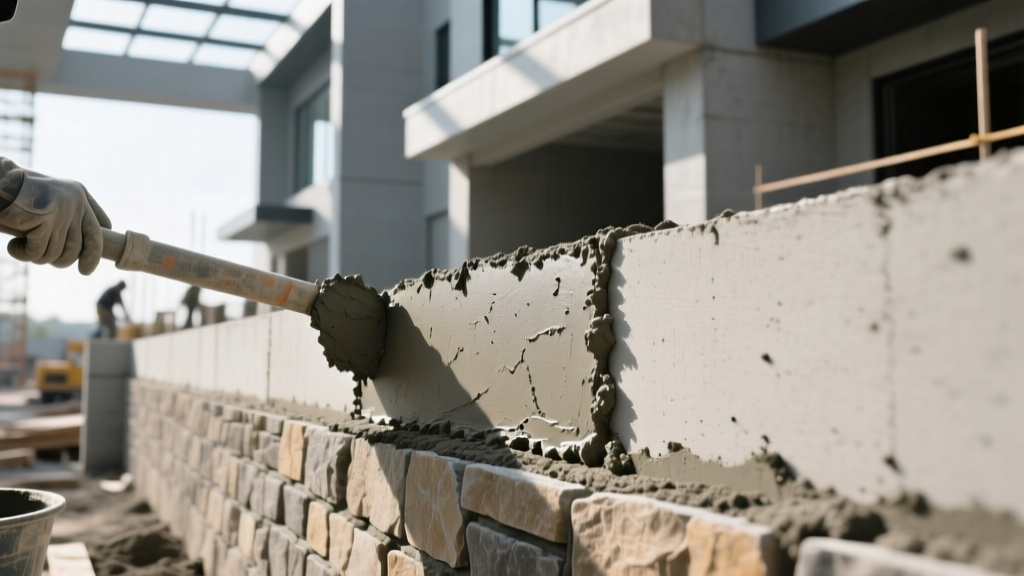
The Engineering Profile of Type S Mortar
Choosing the correct mortar is not a matter of generic preference; it is a structural calculation. Under ASTM C270, Type S mortar is engineered for high tensile bond strength and moderate compressive strength. While masons often default to Type N for general above-grade work, Type S is the mandatory specification for applications subjected to lateral earth pressure, high wind loads, or severe gravity shear.
ASTM C270 Type S Specifications
- Minimum Compressive Strength: 1,800 PSI (at 28 days)
- Minimum Flexural Bond Strength: 180 PSI
- Proportion Mix (by Volume): 1 part Portland cement, 1/2 part hydrated lime, 4.5 parts damp loose sand
- Water Retention: Minimum 12%
Scenario Matching Matrix: Type S vs. Alternatives
Not every project requires the 1,800 PSI compressive strength of Type S. Over-engineering a mortar joint can be just as destructive as under-engineering it. Use this decision matrix to match your specific scenario to the correct ASTM classification.
| Application Scenario | Optimal Mortar | Why Type S is/isn't the Fit |
|---|---|---|
| Below-Grade Foundation Walls | Type S | Resists lateral soil pressure and moisture penetration via high flexural bond. |
| Retaining Walls (Over 3 ft) | Type S or Type M | Type S provides necessary shear strength; Type M (2,500 PSI) used if extreme surcharge loads exist. |
| Above-Grade Brick Veneer | Type N | Type S is too rigid. Type N (750 PSI) allows for thermal expansion/contraction without cracking brick. |
| Manufactured Stone Veneer (MSV) | Type S | High bond strength (180 PSI) prevents heavy cladding from delaminating under gravity. |
| Pre-1930s Historic Masonry | Type O or Lime | Type S will cause catastrophic spalling. Historic brick is softer than 1,800 PSI mortar. |
Deep Dive: 4 Ideal Scenarios for Type S Mortar
1. Retaining Walls and Landscape Edging
Retaining walls must resist the lateral earth pressure of saturated soil. When soil becomes waterlogged, hydrostatic pressure pushes horizontally against the masonry units. Type N mortar (750 PSI compressive, 75 PSI flexural bond) often fails in these conditions, resulting in stepped cracking along the bed joints. Type S delivers 180 PSI of flexural bond strength, effectively locking the units together to act as a monolithic mass. For retaining walls exceeding 4 feet in height, engineers often pair Type S mortar with vertical rebar and grouted cells to handle the increased moment forces.
2. Below-Grade Foundation Construction
Concrete masonry units (CMUs) used in basement and crawlspace foundations are subjected to constant soil moisture and lateral loading. Type S mortar's lower water-to-cement ratio (when mixed to a 12% water retention rate) creates a denser joint profile that resists water migration. Furthermore, the high Portland cement content (compared to Type N) accelerates the early-stage cure, allowing foundation walls to be backfilled sooner without compromising joint integrity.
3. Heavy Cladding and Manufactured Stone Veneer (MSV)
When installing heavy natural stone or dense manufactured stone veneer on vertical surfaces, gravity is the primary enemy. The Belden Brick Technical Notes and general masonry guidelines emphasize that veneer mortars must possess high tensile bond strength to prevent delamination. Type S is the industry standard for the scratch and brown coats in veneer applications because its 180 PSI flexural bond strength provides a mechanical grip that exceeds the dead load of the stone. Always pair Type S mortar with a corrosion-resistant metal lath and a weather-resistive barrier (WRB).
4. Seismic and High-Wind Coastal Zones
In regions governed by strict seismic codes or high-velocity hurricane zones (HVHZ), masonry structures must absorb and dissipate kinetic energy without catastrophic brittle failure. The increased lime content in Type S (compared to Type M) provides a slight degree of flexibility and autogenous healing. When micro-cracks form during a seismic event or wind deflection, the unhydrated lime particles react with moisture and carbon dioxide to seal the cracks, maintaining the structural envelope's weather-tightness.
The Danger Zone: When Type S Causes Structural Damage
CRITICAL WARNING: Historic and Soft Masonry
Never use Type S mortar on historic brick (typically pre-1930s) or soft, low-fired clay masonry. The fundamental rule of masonry is that the mortar must always be softer and more permeable than the masonry unit.
If you point a soft brick wall (compressive strength of 800 PSI) with Type S mortar (1,800 PSI), the mortar will not yield during thermal expansion or moisture absorption. Instead, the stress will transfer to the brick, causing the faces to pop off—a failure mode known as spalling. For historic restoration, specify Type O (350 PSI) or a pure NHL (Natural Hydraulic Lime) mortar to ensure the joints act as the sacrificial element.
Managing Efflorescence in Type S Applications
Because Type S mortar contains a high proportion of Portland cement, it is inherently more susceptible to efflorescence—the white, powdery salt deposits that appear on masonry surfaces when water-soluble salts migrate to the surface and evaporate. In below-grade and retaining wall applications, this is a common aesthetic complaint.
To mitigate this, specify a low-alkali Portland cement (meeting ASTM C150) and ensure your sand source is washed and free of soluble salts. Furthermore, implement strict moisture management: install weep holes at the base of retaining walls, use a breathable silane/siloxane sealer on the exposed masonry faces, and ensure proper grading to direct surface water away from the mortar joints. Never use muriatic acid to clean fresh Type S mortar; the acid reacts with the Portland cement, permanently etching the joint and accelerating future degradation.
Procurement & Mixing: Pre-Blended vs. Site-Mixed
For commercial applications and consistent residential results, pre-blended mortars are vastly superior to site-mixed proportions due to the elimination of human error in sand-to-cement ratios. When sourcing Type S mortar, consider these industry-standard formulations:
- QUIKRETE® Mortar Mix (No. 1102): A pre-blended Type S mortar requiring only the addition of water. Ideal for small to mid-sized veneer and retaining wall projects. Yield: 0.6 cubic feet per 60 lb bag.
- SPEC MIX® Type S Mortar: Available in bulk silos for commercial sites. Includes pre-measured sand, cement, and lime, ensuring exact ASTM C270 compliance across hundreds of batches.
- Sakrete® Type S Mortar Mix: Formulated with masonry cement and graded sand. Requires approximately 1.25 gallons of water per 80 lb bag to achieve the standard 3/4-inch slump.
Expert Mixing Protocol
When mixing pre-blended Type S, add 3/4 of the required water to the mixer first, then add the dry mix, followed by the remaining water. Mix for a minimum of 5 minutes. Crucial: Type S mortar has a usable pot life of approximately 90 minutes. If the mortar begins to stiffen in the tub, do not add more water (retempering weakens the tensile bond). Instead, discard the batch and mix a fresh load.
Summary Decision Framework
Select Type S mortar when your project involves below-grade foundations, retaining walls, heavy stone veneer, or lateral earth pressure. Rely on its 1,800 PSI compressive and 180 PSI flexural bond strengths to provide structural rigidity. Avoid Type S entirely for above-grade soft brick, historic restoration, or non-load-bearing partition walls where Type N or Type O will provide the necessary flexibility and vapor permeability. Always verify local building codes, as municipal engineering requirements in seismic zones may dictate specific mortar types and reinforcement schedules.