Selecting the Right Types of Concrete Form Ties for Wall Mixes
Compare the primary types of concrete form ties, from snap ties to threaded bars, and learn how to match them to your specific wall mix design.
The Physics of Formwork: Lateral Pressure and Mix Design
Formwork failure is rarely a hardware defect; it is almost always a miscalculation of lateral pressure. When fluid concrete is placed in a vertical wall form, it exerts outward hydrostatic pressure. The selection of form ties—the tension elements that hold the opposing form faces together—must be directly correlated to the concrete mix design, placement rate, and temperature. According to the American Concrete Institute (ACI) 347 Guide to Formwork, standard vibrated concrete pressure is limited by the rate of hydration and internal friction. However, modern mix designs utilizing high-range water reducers (HRWR) or Self-Consolidating Concrete (SCC) behave as pure fluids, exerting full hydrostatic pressure (typically 145 to 150 pounds per cubic foot) from the top of the pour to the bottom.
Understanding the specific types of concrete form ties is critical for structural engineers and formwork superintendents. A mismatch between the tie's Safe Working Load (SWL) and the mix's lateral pressure profile results in catastrophic blowouts, endangering crews and ruining structural tolerances.
Primary Types of Concrete Form Ties Explained
1. Snap Ties (Standard and Heavy-Duty)
Snap ties are the most ubiquitous tie system in commercial and residential wall construction. They consist of a central steel rod with flattened, notched ends that protrude through the plywood formwork. Once the concrete cures, the exposed ends are snapped off using a specialized lever tool, leaving the central rod embedded in the wall.
- Standard Snap Ties: Typically feature a Safe Working Load (SWL) of 2,250 lbs. They are ideal for standard 3,000 to 4,000 psi mixes with a moderate slump (4 to 6 inches) placed at conventional rates (under 5 feet per hour).
- Heavy-Duty Snap Ties: Engineered with a thicker central rod and deeper breakback notches, offering an SWL of 3,000 to 3,500 lbs. Required for stiffer mixes with large aggregate or faster placement rates.
Breakback Depth: Standard breakback is 1 inch from the concrete face. For architectural finishes or water-retaining structures, a 1.5-inch or 2-inch breakback is specified to prevent surface rusting (rust-jacking) from the exposed steel nub.
2. Coil Ties
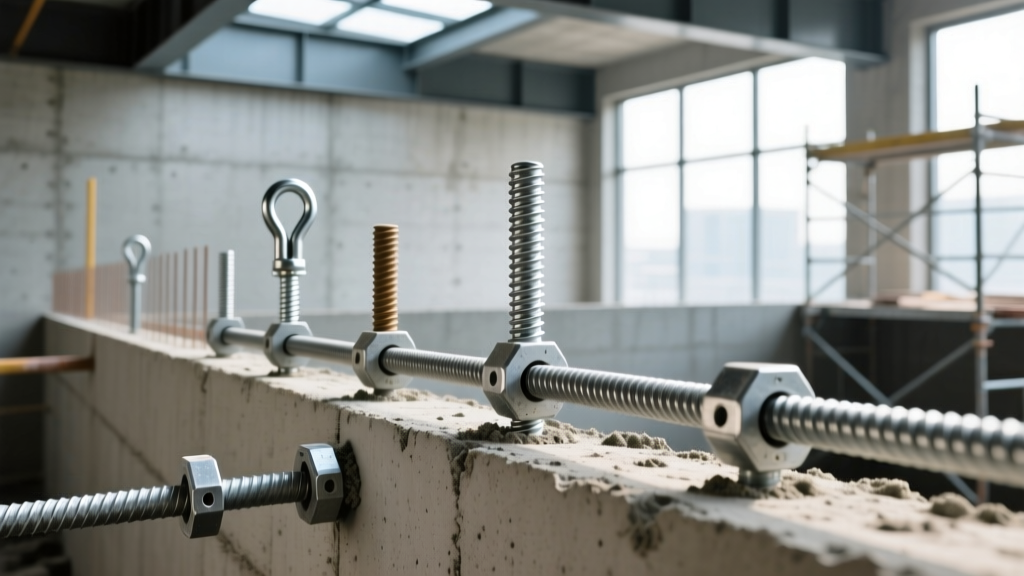
Coil ties utilize a continuous helical thread rolled into the steel rod. Unlike snap ties, the entire tie is sacrificial and remains in the wall, but the external hardware (coil bolts and washers) is reusable. Coil ties are heavily favored in heavy civil and infrastructure projects where forms are stripped and reset rapidly.
- 1/2-Inch Coil Ties: SWL of approximately 3,500 lbs.
- 3/4-Inch Coil Ties: SWL ranging from 6,000 to 8,500 lbs, used for high-strength, high-density mixes or rapid pour rates.
Because coil ties require a threaded coil bolt to secure the form waler, they allow for precise tensioning. However, the hole left in the concrete is larger than a snap tie hole, requiring a more robust patching compound for watertight structures.
3. Taper Ties
Taper ties feature a rod that tapers from a larger diameter at the center to a smaller diameter at the ends. They are secured with hex nuts and bearing plates. The primary advantage of the taper tie is the clean, conical hole it leaves upon removal. The entire tie is extracted from the wall after stripping, making it highly cost-effective for repetitive gang form systems. Taper ties generally offer SWLs between 5,000 and 10,000 lbs, bridging the gap between light commercial and heavy civil applications.
4. Threaded Ties (Dywidag / High-Strength Bars)
For massive pours, nuclear containment structures, or heavily reinforced shear walls utilizing SCC, standard ties are insufficient. Threaded tie systems (often referred to by the prominent brand Dywidag) use high-strength alloy steel bars with coarse, cold-rolled threads. These bars are sleeved in PVC or cardboard tubes so they can be entirely recovered and reused. SWLs for these systems range from 15,000 lbs to over 40,000 lbs per tie. They are essential when mix designs incorporate heavyweight aggregates (up to 200 pcf) for radiation shielding.
⚠️ Critical Warning: SCC and Hydrostatic Blowouts
When transitioning from a standard vibrated mix to Self-Consolidating Concrete (SCC), the lateral pressure formula changes entirely. SCC does not build internal friction during placement. If your formwork is tied with 2,250 lb snap ties spaced at 24 inches on center, an SCC pour will likely exceed the tie capacity before reaching a height of 6 feet. Always recalculate tie spacing assuming 100% hydrostatic head (150 pcf x total wall height) when using SCC, regardless of the placement rate.
Matrix: Matching Tie Systems to Concrete Mix Profiles
The following matrix provides a decision framework for selecting the appropriate tie system based on the specific characteristics of your concrete mix design and structural requirements.
| Tie System | Safe Working Load (SWL) | Ideal Mix Profile | Finish / Breakback | Approx. Unit Cost (2026) |
|---|---|---|---|---|
| Standard Snap Tie | 2,250 lbs | Standard 4,000 psi, 4-5" slump, vibrated | 1" snap break; small rust risk | $0.45 - $0.75 |
| Heavy-Duty Snap Tie | 3,000 - 3,500 lbs | High early strength, 6-8" slump, fast pour | 1.5" snap break; moderate patch | $0.85 - $1.20 |
| 3/4" Coil Tie | 6,000 - 8,500 lbs | Mass concrete, high density, rapid cycling | Large void; requires grout plug | $2.50 - $4.00 |
| Taper Tie | 5,000 - 10,000 lbs | Architectural walls, repetitive gang forms | Clean conical hole; excellent finish | $5.00 - $8.50 |
| Threaded Bar (Sleeved) | 15,000 - 40,000+ lbs | SCC, heavyweight shielding mixes, massive pours | Large sleeved void; structural patch | $18.00 - $35.00+ |
Calculating Tie Spacing Based on Mix Design Variables
To determine the exact spacing for your chosen tie type, you must calculate the maximum lateral pressure. For standard concrete, the ACI 347 formula incorporates the temperature of the concrete mix (T) and the rate of placement (R). However, mix design admixtures drastically alter these variables.
Consider a 12-foot retaining wall poured with a mix containing a retarder to extend workability in high heat. The retarder slows the initial set, meaning the fluid concrete retains its hydrostatic properties for a longer duration. If you use standard 2,250 lb snap ties, and the maximum calculated pressure at the base of the form is 1,500 pounds per square foot (psf), the ties must be spaced no further apart than 1.5 square feet (e.g., 12 inches horizontally by 18 inches vertically) near the base of the wall. As the pour height increases and the pressure at the bottom remains constant, the tie grid must remain dense at the bottom and can gradually widen toward the top of the form.
OSHA Compliance and Safety Factors
Formwork design is heavily regulated due to the severe risks associated with blowouts. OSHA Standard 1926.703 mandates that formwork must be capable of supporting all vertical and lateral loads that might be applied. Crucially, the hardware—including form ties, waler brackets, and form panels—must be designed with a minimum safety factor of 4 to 1 against ultimate failure for tension elements. When reviewing tie manufacturer technical data sheets, always ensure you are reading the Safe Working Load (SWL), which already incorporates this safety factor, rather than the Ultimate Tensile Strength (UTS). Designing forms based on UTS is a critical engineering error that violates safety codes and risks structural collapse.

Surface Finish and Patching Protocols
The choice of tie directly impacts the post-pour labor budget. Snap ties leave a small, jagged depression. For standard foundation walls below grade, this is often left untreated or lightly parged. However, for architectural concrete or water-retaining structures (like water treatment basins), the exposed steel of a broken snap tie will oxidize, expand, and spall the surrounding concrete face within 3 to 5 years.
For these critical applications, specify ties with integral plastic spreader cones. The cone creates a uniform, 1-inch diameter dimple on the concrete surface. After the tie is snapped or removed, the dimple is routed out and filled with a high-modulus, non-shrink epoxy patching compound. This seals the steel entirely from moisture ingress. Coil and taper ties leave larger voids that require mechanical plugging or deep cementitious grout injections to maintain the structural integrity and watertightness of the wall.
Written by
David NakamuraDavid Nakamura is a licensed architect (AIA) and construction technology writer focused on sustainable building methods, mass timber engineering, and high-performance building envelopes. He holds a Master of Architecture from the University of Washington and is a certified Passive House Consultant (CPHC). David spent eight years at the Seattle firm Mithun, where he led the design of three LEED Platinum projects, before founding his own practice specializing in net-zero residential design. He serves on the editorial advisory board of GreenBuilder Magazine and has authored peer-reviewed papers on cross-laminated timber (CLT) connections for the Journal of Structural Engineering. In his spare time, David teaches woodworking at Pratt Fine Arts Center and kayaks the Puget Sound.
More from David Nakamura
View all
Construction Cost
Labor Cost to Build a Deck Per Sq Ft: 2026 Installation Guide
Discover the exact labor cost to build a deck per sq ft in 2026. This installation guide breaks down contractor rates, complexity factors, and hidden fees.
Aug 4, 2026

Construction Cost
How Much Does It Cost to Build a 3 Bedroom House? Financing Guide
Learn exactly how much it costs to build a 3 bedroom house and explore 2026 financing options, construction loan types, and budget frameworks for your build.
Aug 4, 2026

Construction Cost
Cost to Build a Tennis Court: 2026 Guide
How much does it cost to build a tennis court in 2026? Breakdowns for asphalt, concrete, and synthetic surfaces plus fencing and lighting.
Jul 30, 2026