Types of Cracking in Concrete: Diagnosis and Repair Cost Guide
Analyze repair costs for various types of cracking in concrete. Get current pricing for epoxy injection, routing, and structural stabilization.

The Financial Reality of Concrete Degradation
Concrete is engineered for compressive strength, but its inherent weakness in tension makes it susceptible to fracturing under thermal, environmental, and structural stresses. Understanding the specific types of cracking in concrete is not merely an academic exercise; it is a critical financial imperative. Misdiagnosing a structural shear crack as benign drying shrinkage can lead to catastrophic foundation failure, while over-engineering a repair for superficial craze cracking wastes thousands of dollars in unnecessary structural epoxies.
This analysis breaks down the exact diagnostic, preventative, and remedial costs associated with the primary fracture mechanisms in modern concrete construction, utilizing current material pricing and labor rates.
Diagnostic Costs: Engineering and Assessment
Before deploying repair materials, accurate classification of the crack's etiology is required. Visual inspection is insufficient for determining whether a crack is active (still moving) or dormant.
- Visual Inspection & Mapping: $150 - $300 (Typically performed by a certified concrete inspector).
- Ultrasonic Pulse Velocity (UPV) Testing: $400 - $800 per day. Used to determine crack depth and internal voids without destructive coring.
- Structural Engineer Assessment: $350 - $900 flat fee. Mandatory for diagonal shear cracks, cracks wider than 1/4 inch (6mm), or cracks exhibiting vertical displacement (differential settlement).
- Crack Monitoring (Tell-tales): $25 - $50 per gauge. Installed over 30-90 days to measure seasonal thermal expansion or ongoing settlement.
Non-Structural Cracks: Cosmetic and Surface Repairs
Non-structural cracks do not compromise the load-bearing capacity of the element but can allow moisture ingress, leading to freeze-thaw damage or reinforcement corrosion.
Plastic Shrinkage and Craze Cracks
Plastic shrinkage occurs when the surface evaporation rate exceeds the bleed water rise rate during the first few hours of placement, resulting in shallow, parallel fissures. Craze cracks are a network of fine, shallow hexagonal fractures caused by surface carbonation or improper finishing techniques (e.g., troweling bleed water back into the surface).
Repair Strategy: Because these cracks are typically less than 0.1mm wide and extremely shallow, routing is ineffective. The standard protocol is the application of a high-solids, low-viscosity penetrating sealer or a cementitious slurry grout.
- Sodium Silicate Densifiers (e.g., Prosoco Consolideck LS): $0.25 - $0.50 per sq. ft. (Material only).
- Micro-topping Overlay (1/8 inch polymer-modified cement): $4.00 - $7.00 per sq. ft. (Installed).
Drying Shrinkage and Map Cracking
As the cement paste hydrates and loses moisture over months or years, it shrinks. If the concrete is restrained by the subgrade or adjacent structures, tensile stresses exceed the concrete's modulus of rupture, causing map cracking or distinct transverse shrinkage cracks.
| Repair Method | Best Application | Material Cost (per LF) | Installed Cost (per LF) |
|---|---|---|---|
| Routing & Sealing (Polyurethane) | Dormant cracks 1/16" to 1/4" wide | $1.50 - $3.00 | $4.00 - $8.00 |
| Routing & Sealing (Polysulfide) | Horizontal slabs with high UV exposure | $2.00 - $4.50 | $5.50 - $10.00 |
| Gravity Feed (Low-Viscosity Epoxy) | Hairline cracks (< 1/16") in flatwork | $3.00 - $5.00 | $6.00 - $12.00 |
Structural and Subgrade Cracks: High-Stakes Interventions
When the types of cracking in concrete indicate load-path disruption or foundational failure, cosmetic sealants are insufficient. Structural repairs must restore or exceed the original tensile and shear capacity of the cross-section.
Settlement and Void-Induced Cracking
Differential settlement occurs when the subgrade compaction is uneven or when hydrostatic pressure washes away supporting soils. This manifests as wide, tapering cracks or significant vertical faulting across a slab. Repairing the crack without addressing the void guarantees immediate re-fracture.
- Traditional Mudjacking (Cementitious Slurry): $3.00 - $6.00 per sq. ft. Requires drilling 1.5-inch to 2-inch holes. Heavy material can cause further settlement in weak soils.
- Polyjacking (High-Density Polyurethane Foam): $5.00 - $12.00 per sq. ft. Requires 5/8-inch ports. The foam expands 20-30 times its liquid volume, lifting the slab with pinpoint precision while waterproofing the subgrade. This is the current industry standard for void remediation.
Shear, Overload, and Thermal Cracking
Diagonal cracks near beam supports, deep vertical cracks in retaining walls, and mid-span flexural cracks indicate that the applied loads exceed the structural design, or that thermal gradients in mass concrete caused severe internal tension.
According to guidelines published by the American Concrete Institute (ACI), structural crack injection requires materials with a tensile strength greater than the concrete matrix itself.
| Structural Repair Method | Target Crack Profile | Key Material Examples | Installed Cost (per LF) |
|---|---|---|---|
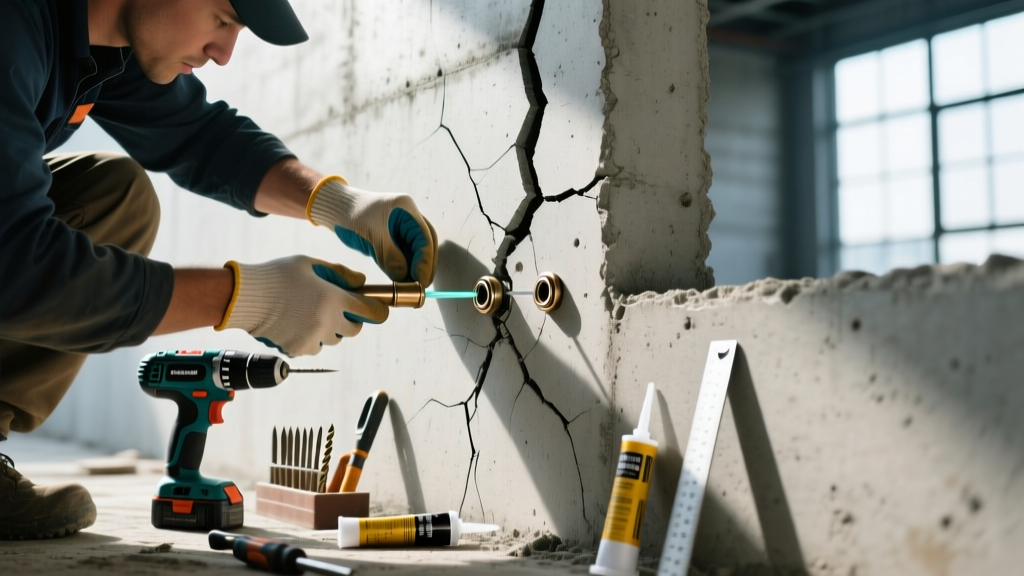
| High-Pressure Epoxy Injection | Dormant structural cracks 0.002" to 1/2" | SikaDur 35 Hi-Mod LV, MasterEmaco | $12.00 - $25.00 |
| Polyurethane Foam Injection | Active, leaking foundation cracks | MasterSeal 750, Sika Waterstop | $15.00 - $30.00 |
| Carbon Fiber Stitching | Cracks requiring shear reinforcement | Simpson Strong-Tie Carbon Fiber | $35.00 - $60.00 |
The Hidden Cost: Alkali-Silica Reaction (ASR)
ASR is a deleterious chemical reaction between the alkaline pore solution in cement and reactive silica in certain aggregates. The reaction produces an expansive gel that absorbs water, creating immense internal pressure and causing severe map cracking, pop-outs, and eventual structural disintegration.
Unlike shrinkage cracks, ASR cannot be simply routed and sealed. The Portland Cement Association (PCA) notes that ASR mitigation in existing structures requires limiting moisture ingress and applying lithium-based chemical treatments.
- Lithium Nitrate Surface Treatment (e.g., AquaConSeal ASR): $2.50 - $4.50 per sq. ft. This penetrates the matrix and halts the expansive gel reaction.
- Total Element Replacement: When ASR expansion exceeds 0.1% strain and rebar is heavily corroded, localized patching fails. Full demolition and replacement using non-reactive aggregates and supplementary cementitious materials (SCMs) like fly ash or slag costs $15 to $35 per sq. ft.
"The most cost-effective repair for concrete cracking happens before the concrete is poured. Proper jointing—cutting control joints to a depth of one-quarter the slab thickness within 6 to 18 hours of placement—forces the concrete to crack in a straight, hidden line rather than randomly across the surface."
Decision Matrix: When to Repair vs. Replace
Determining the financial threshold between repairing a cracked element and demolishing it requires a strict cost-benefit analysis. Use the following framework to guide capital allocation:
1. The 30% Rule of Thumb
If the estimated cost of structural stabilization, crack injection, and surface resurfacing exceeds 30% of the total replacement cost of the concrete element, replacement is the superior long-term investment. Repair materials have a finite lifecycle (typically 10-15 years for epoxies), whereas a properly placed replacement slab offers a 40+ year lifespan.
2. Active vs. Dormant Crack Evaluation
- Dormant Cracks: Epoxy injection is highly cost-effective. The structural bond restores monolithic behavior.
- Active Cracks (Thermal/Seasonal): Rigid epoxies will fail as the crack cycles. You must route and seal with elastomeric polyurethanes, or install a slip-joint. If the movement exceeds 1/8 inch annually, the structural design is fundamentally flawed, and replacement or massive structural underpinning is required.
3. Environmental Exposure Class
Cracks in interior, climate-controlled warehouse slabs pose minimal risk and can be filled with low-cost cementitious grouts ($2 - $4 per LF). Cracks in marine environments, de-icing salt exposure zones, or wastewater treatment facilities require high-build, chemical-resistant polyurea or methyl methacrylate (MMA) resins ($18 - $35 per LF) to prevent chloride ion penetration and subsequent rebar corrosion.
Accurate diagnosis of the types of cracking in concrete transforms maintenance from a reactive, budget-draining chore into a predictable, optimized asset management strategy. Always pair visual assessments with non-destructive testing to ensure the selected repair methodology addresses the root mechanical or chemical cause, rather than merely masking the symptom.
Written by
David NakamuraDavid Nakamura is a licensed architect (AIA) and construction technology writer focused on sustainable building methods, mass timber engineering, and high-performance building envelopes. He holds a Master of Architecture from the University of Washington and is a certified Passive House Consultant (CPHC). David spent eight years at the Seattle firm Mithun, where he led the design of three LEED Platinum projects, before founding his own practice specializing in net-zero residential design. He serves on the editorial advisory board of GreenBuilder Magazine and has authored peer-reviewed papers on cross-laminated timber (CLT) connections for the Journal of Structural Engineering. In his spare time, David teaches woodworking at Pratt Fine Arts Center and kayaks the Puget Sound.
More from David Nakamura
View all
Construction Cost
Labor Cost to Build a Deck Per Sq Ft: 2026 Installation Guide
Discover the exact labor cost to build a deck per sq ft in 2026. This installation guide breaks down contractor rates, complexity factors, and hidden fees.
Aug 4, 2026

Construction Cost
How Much Does It Cost to Build a 3 Bedroom House? Financing Guide
Learn exactly how much it costs to build a 3 bedroom house and explore 2026 financing options, construction loan types, and budget frameworks for your build.
Aug 4, 2026

Construction Cost
Cost to Build a Tennis Court: 2026 Guide
How much does it cost to build a tennis court in 2026? Breakdowns for asphalt, concrete, and synthetic surfaces plus fencing and lighting.
Jul 30, 2026