Comparing Types of Concrete Barriers: Technical Specs & MASH Standards
Explore technical specs, MASH test levels, and geometric profiles for types of concrete barriers to optimize highway containment design.
The Physics of Containment: Working Width and Dynamic Deflection
When evaluating types of concrete barriers for highway and infrastructure projects, engineers must look beyond basic mass and focus on dynamic impact mechanics. The primary metric for barrier performance is not just whether it stops a vehicle, but how it manages kinetic energy transfer. Under the FHWA MASH 2020 Guidelines (Manual for Assessing Safety Hardware), barrier performance is quantified by three critical spatial dimensions:
- Dynamic Deflection (D): The maximum lateral distance the barrier moves during impact. Rigid concrete barriers typically exhibit near-zero deflection (D = 0), making them mandatory for work zones with zero rear clearance.
- Working Width (W): The lateral distance from the traffic-side face of the barrier to the maximum dynamic position of any part of the vehicle or barrier. For rigid concrete, W is largely dictated by vehicle intrusion.
- Vehicle Intrusion (VI): The maximum lateral distance any part of the test vehicle extends beyond the traffic-side face of the barrier. Concrete profiles are specifically sloped to minimize VI by redirecting the vehicle's tires rather than allowing the chassis to override the top rail.
Geometric Profiles: Types of Concrete Barriers Analyzed
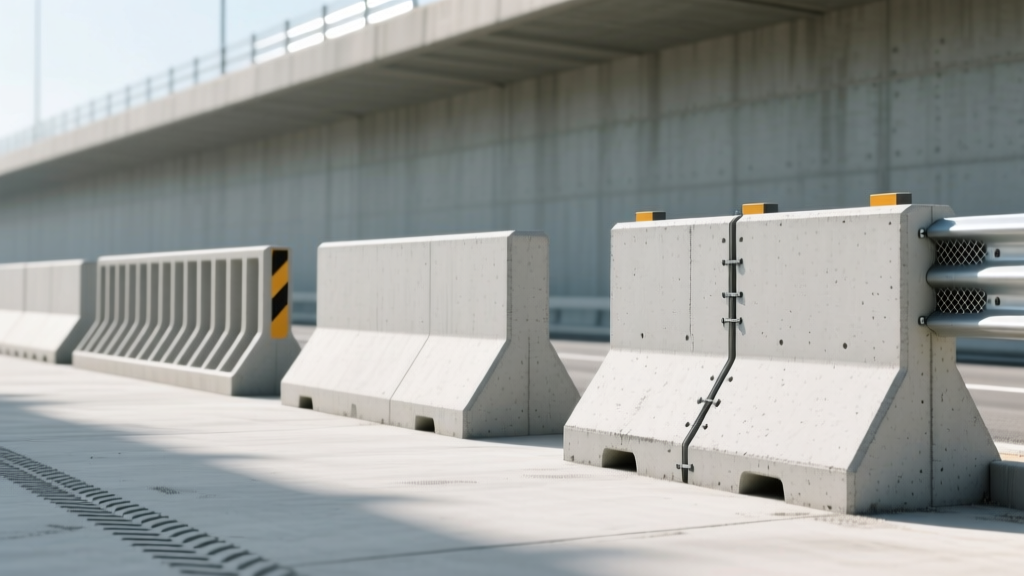
The cross-sectional geometry of a concrete barrier dictates its interaction with varying vehicle bumper heights and center-of-gravity profiles. The slope break points (where the angle of the barrier face changes) are the most critical technical specifications in the design.
F-Shape Barrier (The Modern Standard)
The F-shape is currently the preferred profile for most high-speed highway applications. Its defining technical feature is a lower slope break point located exactly 10 inches (254 mm) above the pavement surface. This specific height was engineered to engage the bumper and front axle of modern small passenger vehicles (which sit lower to the ground than 1980s models) before the tires can climb the face. The upper break point sits at 30 inches, providing a vertical upper face that prevents heavy trucks from rolling over the top. The F-shape significantly reduces the 'ride-up' and subsequent rollover risk for compact cars compared to legacy designs.
Jersey Shape Barrier (Legacy and High-Speed)
Originally developed in the 1950s, the Jersey barrier features a lower slope break point at 13 inches (330 mm) and an upper break point at 30 inches. While highly effective at redirecting heavy trucks and preventing cross-median crossovers, the 13-inch lower break point is less optimal for modern low-profile sedans. Under high-speed, high-angle impacts, small cars can experience wheel climb, leading to higher lateral G-forces on occupants and an increased risk of vehicle vaulting. It remains in use primarily where existing infrastructure is being maintained to original spec or in low-speed work zones.
Constant Slope Barrier (10.8-Degree Profile)
The constant slope barrier eliminates the dual break points entirely, featuring a single, continuous face sloped at 10.8 degrees from vertical. This geometry was developed to provide consistent redirection performance regardless of the impact angle or vehicle type. Because there is no horizontal 'shelf' for a tire to catch and climb, the constant slope profile offers superior stability for SUVs and light trucks. It is heavily specified in TL-4 and TL-5 applications where right-of-way constraints allow for a slightly wider base footprint (typically 32 to 36 inches wide at the base compared to the 24-inch base of a standard Jersey).
Vertical Barrier (Maximum Containment)
Vertical concrete barriers (0-degree slope) are utilized almost exclusively in high-consequence containment scenarios, such as bridge medians, toll plazas, and hazardous material routing corridors. Designed to meet MASH TL-5 and TL-6 standards, these barriers are often 42 to 54 inches tall. The vertical face prevents any vehicle ride-up, forcing the truck's chassis to absorb the impact energy through structural deformation rather than kinetic redirection. Due to the massive lateral forces transferred to the foundation, vertical barriers require continuous moment-slab foundations or deep pinned connections rather than standard gravity-based placement.
MASH Test Level (TL) Selection Matrix
Selecting the correct barrier type requires matching the geometric profile to the required MASH Test Level. The matrix below outlines the design vehicle specifications for the most common highway test levels.
| Test Level | Design Vehicle (Weight) | Impact Speed | Impact Angle | Recommended Concrete Profile |
|---|---|---|---|---|
| TL-3 | 2,425 lb (1100 kg) Small Car | 62 mph (100 km/h) | 25° | F-Shape (32" height) |
| TL-4 | 5,000 lb (2270 kg) Pickup Truck | 62 mph (100 km/h) | 25° | F-Shape or Constant Slope (32" - 36") |
| TL-5 | 80,000 lb (36,000 kg) Tractor-Van | 50 mph (80 km/h) | 15° | Constant Slope or Vertical (42"+ height) |
| TL-6 | 80,000 lb (36,000 kg) Tank Trailer | 50 mph (80 km/h) | 15° | Vertical (54" height with moment slab) |
Material Specifications: Mix Design and Reinforcement
Precast concrete barriers subjected to MASH TL-4 and higher impacts require stringent material specifications to prevent brittle shear failure upon impact. Standard Department of Transportation (DOT) specifications mandate the following:
- Compressive Strength: Minimum 5,000 psi (34.5 MPa) at 28 days. High-early strength mixes achieving 4,000 psi in 24 hours are often used for rapid-deployment work zone barriers.
- Water-Cement Ratio: Strictly limited to 0.40 or lower to ensure low permeability and high freeze-thaw durability (ASTM C666 compliance).
- Reinforcement Steel: Grade 60 (420 MPa) rebar. For barriers exposed to de-icing salts, epoxy-coated reinforcing steel conforming to ASTM A775 Standard for Epoxy-Coated Reinforcing Steel is mandatory to prevent subsurface rust jacking and concrete spalling.
- Aggregate: ASTM C33 graded aggregates with a maximum nominal size of 1 inch to ensure dense consolidation around tight rebar spacing near the connection pockets.
Connection Hardware and Subgrade Tolerances
A concrete barrier is only as rigid as its connections. For permanent installations, adjacent segments are joined using either loop-and-pin systems or steel splice sleeves.
When using steel splice sleeves, the void must be filled with a non-shrink, high-strength grout conforming to ASTM C1107 for Non-Shrink Grout. Standard sand-cement mortar will shrink as it cures, leaving a micro-gap between the rebar and the grout. Under a TL-4 impact, this gap allows the rebar to slip, leading to catastrophic joint separation and vehicle penetration. Always specify Grade C (non-shrink, high-early) grout and verify flowability during the pour.
Subgrade preparation is equally critical. Precast barriers must be placed on a compacted aggregate base or a leveled asphalt pad. The maximum allowable subgrade tolerance is typically 1/4 inch over a 10-foot span. If the subgrade is uneven, the barrier will rock, creating point-loads that can snap the bottom longitudinal rebar during a heavy truck impact. Shimming with steel plates is permitted, but shimming with wood or composite materials is strictly prohibited due to compression and rot over time.
Decision Framework: Matching Barrier Geometry to Site Constraints
Use this technical decision tree to specify the correct barrier type for your project:
- If the site is a high-speed interstate median with a high volume of compact cars: Specify the F-Shape profile. The 10-inch break point minimizes small-car trip-overs and reduces occupant risk metrics (ORM).
- If the site features a high percentage of SUVs/Light Trucks and right-of-way is unconstrained: Specify the Constant Slope (10.8°) profile. It offers the most stable redirection for high-center-of-gravity vehicles without the risk of tire snagging.
- If the site is a bridge median or cliff-edge with zero allowable working width: Specify a Vertical Barrier (TL-5/TL-6) pinned directly to the structural deck. Ensure the deck structural engineer verifies the moment capacity of the anchor bolts (typically 1.25-inch diameter Grade 105 threaded rods spaced at 24 inches on center).
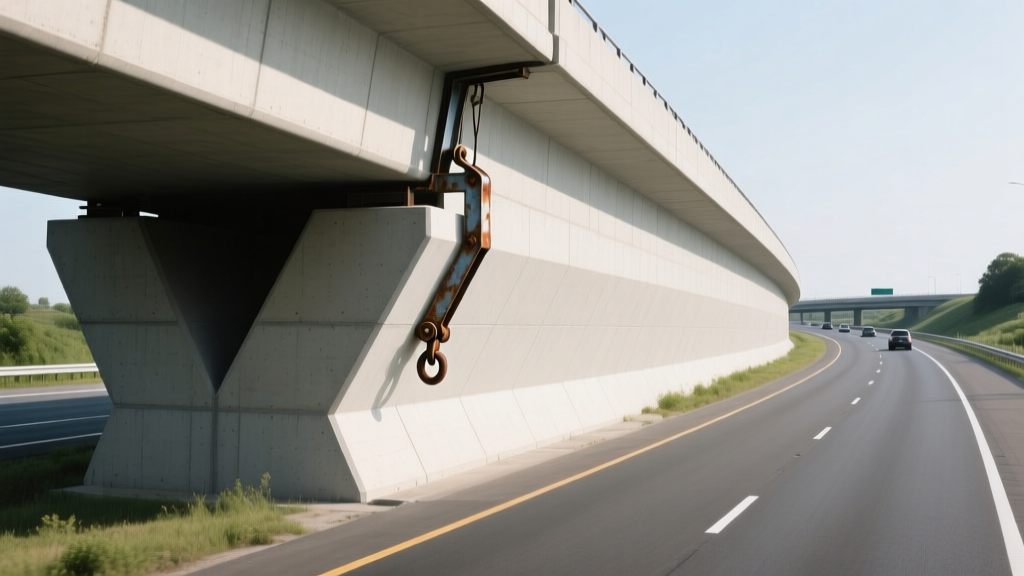
- If the application is a temporary work zone requiring daily relocation: Specify standard Jersey Shape barriers with loop-and-pin connections. The Jersey shape's wider base and integrated forklift pockets/steel lifting loops make it the most efficient profile for rapid deployment and retrieval.
Written by
Sarah WhitfieldSarah Whitfield is a chartered quantity surveyor (MRICS) and construction cost analyst with 15 years of experience in material pricing, procurement strategy, and project budgeting. She earned her degree in Construction Management from the University of Reading (UK) and has worked on projects ranging from $2M custom homes to $180M mixed-use developments across North America and Europe. Sarah currently leads cost estimating for BuildMat Insight, maintaining a proprietary database of 4,000+ material price points updated quarterly. She is a frequent contributor to RSMeans cost data panels and has presented at the International Cost Engineering Council (ICEC) congress. Based in Denver, CO, Sarah is an avid trail runner and volunteer mentor for Women in Construction.
More from Sarah Whitfield
View all
Wood & Lumber
What Are the Different Types of Wood? A Builder's Guide
Compare structural softwoods, finish hardwoods, and engineered lumber. Analyze Janka ratings, MOE values, and 2026 pricing for construction.
Aug 4, 2026

Walls & Panels
Steel Framing vs Wood Framing: Corrosion and Moisture Defense
Compare steel framing vs wood framing for moisture resistance. Learn about galvanized coatings, condensation risks, and corrosion protection strategies.
Jul 21, 2026

Stone & Masonry
How to Cut Stone Veneer: Wet Saw vs Grinder Comparison
Compare the best tools for cutting stone veneer. We review wet saws, angle grinders, and chop saws to help you achieve clean, chip-free cuts.
Jul 21, 2026