Types of Concrete Flooring: 2026 Cost Breakdown & Installation Analysis
Discover the detailed cost breakdown of various types of concrete flooring. Compare polished, stamped, epoxy, and stained concrete prices for 2026.

The True Cost of Concrete Flooring: Beyond the Base Pour
When evaluating types of concrete flooring, the initial material cost of the raw slab is only a fraction of the final investment. The financial reality of concrete flooring lies in the surface preparation, chemical treatments, and finishing techniques applied after the cure. In 2026, supply chain stabilization has normalized cement prices, but specialized labor for decorative and high-performance finishes continues to drive cost variations. This analysis breaks down the exact material, labor, and hidden lifecycle costs of the most common concrete flooring systems, providing a precise framework for budgeting your project.
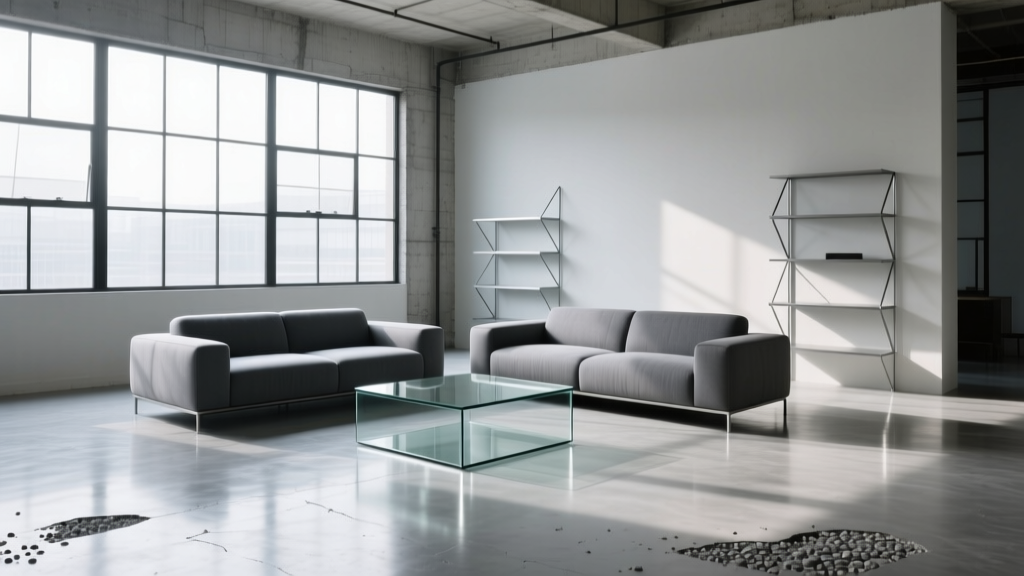
Comprehensive Cost Matrix: Types of Concrete Flooring
The following matrix outlines the current installed costs per square foot for residential and light-commercial applications. These figures assume a standard 4-inch thick slab with a baseline compressive strength of 3,000 to 4,000 PSI.
| Flooring Type | Material Cost ($/sq.ft) | Labor Cost ($/sq.ft) | Total Installed ($/sq.ft) | Primary Application |
|---|---|---|---|---|
| Basic Broom Finish | $2.50 - $4.00 | $3.00 - $5.00 | $5.50 - $9.00 | Garages, utility patios |
| Acid-Stained Concrete | $2.00 - $5.00 | $5.00 - $10.00 | $7.00 - $15.00 | Interior residential, retail |
| Polished Concrete | $3.00 - $6.00 | $5.00 - $12.00 | $8.00 - $18.00 | Commercial, modern homes |
| Stamped Concrete | $5.00 - $12.00 | $8.00 - $15.00 | $13.00 - $27.00 | Patios, pool decks, driveways |
| 100% Solids Epoxy | $3.00 - $7.00 | $4.00 - $8.00 | $7.00 - $15.00 | Garages, basements, labs |
| Radiant Heated Slab | $8.00 - $15.00 | $10.00 - $20.00 | $18.00 - $35.00 | High-end bathrooms, living areas |
Deep Dive: Finish-Specific Cost Drivers
Polished Concrete: The Grit Progression Premium
Polished concrete pricing is directly tied to the diamond abrasive grit progression. A basic 'honed' finish stopping at 400-grit costs between $4 and $7 per square foot. However, achieving a true mechanical polish requires progressing through 800-grit, 1500-grit, and finally 3000-grit resin pads. Each additional step increases labor time by 15% to 20%. Furthermore, the application of a lithium silicate densifier (such as Prosoco Consolideck LS) is mandatory after the 100-grit metal bond step to harden the surface. Skipping the densifier to save $0.50 per square foot will result in a soft floor that degrades within two years under foot traffic.
Stamped Concrete: Pattern Complexity and Color Hardening
The cost gap in stamped concrete is dictated by the pattern depth and color methodology. A basic seamless texture mat requires less labor and material than an interlocking ashlar slate or cobblestone pattern, which demands meticulous hand-detailing at edges and joints. Additionally, using a dry-shake color hardener (like those from Butterfield Color or Brickform) broadcast across the surface before stamping adds $1.50 to $3.00 per square foot compared to integral color mixed into the truck, but it yields a significantly more durable, UV-stable surface that resists wear in high-traffic zones.
Epoxy and Polyaspartic Coatings: Mil Thickness Matters
Big-box store epoxy kits typically yield a 3 to 5 mil dry film thickness (DFT) and cost around $2.00 per square foot DIY. Professional-grade 100% solids epoxy systems, applied at 10 to 15 mils DFT with a polyurethane topcoat for UV and scratch resistance, cost $7 to $15 per square foot. For exterior or sun-exposed applications, polyaspartic topcoats are mandatory to prevent yellowing and chalking, adding roughly $2.50 per square foot to the total project cost but extending the lifecycle by a decade.
Never install epoxy, polyurethane, or moisture-sensitive adhesives over a concrete slab without conducting an ASTM F2170 Relative Humidity (RH) test. If in-situ RH probes read above 75% (or 80% for some specific manufacturer warranties), the alkaline moisture will blister and delaminate the coating. Mitigating this requires a two-part epoxy moisture vapor barrier (e.g., Mapei Primer EP), adding $2.50 to $4.50 per square foot to your budget.
Hidden Cost Drivers and Site-Specific Edge Cases
Budget overruns in concrete flooring rarely stem from the finish itself; they originate in the subgrade and preparation phases. Factor these variables into your financial model:
- Surface Preparation (CSP Profiling): The International Concrete Repair Institute (ICRI) mandates specific Concrete Surface Profiles (CSP) for different coatings. Epoxy requires a CSP 2 or 3, achieved via diamond grinding ($1.50 - $2.50/sq.ft). Thicker coatings require shot blasting to achieve a CSP 4 or 5 ($2.50 - $4.00/sq.ft).
- Slab Thickness and Reinforcement: Standard residential slabs are 4 inches thick. If the floor will support heavy machinery, RVs, or concentrated point loads, upgrading to a 5-inch or 6-inch slab with fiber-mesh reinforcement or #4 rebar on 2-foot centers will increase the raw pour cost by 25% to 40%.
- Joint Sawing and Filling: Control joints are necessary to manage shrinkage cracking. Sawing joints costs $0.50 to $1.00 per linear foot. If you are polishing or coating the floor, filling these joints with a polyurea or epoxy joint filler (like Metzger/McGuire Spal-Pro) to prevent edge chipping adds $1.00 to $2.00 per linear foot.
Lifecycle Cost Analysis: Concrete vs. Traditional Materials
While the upfront cost of high-end polished or stamped concrete ($15-$25/sq.ft) rivals premium hardwood or natural stone, the 50-year lifecycle cost tells a different story. Hardwood requires sanding and refinishing every 10 to 15 years at $4 to $7 per square foot. Carpet requires complete replacement every 7 to 10 years. Polished concrete, conversely, requires only daily dust mopping and a burnishing with a high-speed floor machine every 3 to 5 years at roughly $0.50 per square foot to restore the gloss. According to data compiled by HomeGuide's flooring cost analysis, concrete consistently yields the lowest cost-per-year of service among all hard-surface flooring options when maintenance is factored in.
Decision Framework: Selecting the Right System
Use this practical framework to align your budget with the correct concrete flooring type:
- Budget under $8/sq.ft & Interior: Acid-stained concrete with a basic acrylic sealer. Accept that the color will be mottled and translucent.
- Budget $8 - $15/sq.ft & High Traffic: Mechanically polished concrete (800-grit minimum). Ideal for retail, modern homes, and commercial spaces where zero-VOC and low maintenance are priorities.
- Budget $10 - $18/sq.ft & Garage/Industrial: 100% solids epoxy with a quartz sand broadcast for slip resistance and heavy impact tolerance. Ensure proper ASTM F2170 moisture testing first.
- Budget $15+/sq.ft & Exterior/Curb Appeal: Stamped concrete with dry-shake color hardener and a solvent-based acrylic sealer. Requires resealing every 2 to 3 years to maintain color vibrancy and water repellency.
Expert Insight: The most common mistake in concrete flooring budgeting is treating the concrete contractor and the flooring finisher as the same entity. For polished, epoxy, or stained interiors, hire a specialty decorative concrete contractor. General flatwork contractors excel at pouring flat, level slabs, but rarely possess the specialized planetary grinders and chemical knowledge required for high-end interior finishes. As noted in Angi's concrete flooring cost guide, hiring specialized finishers prevents costly remediation of poorly prepared surfaces.
Accurate budgeting for types of concrete flooring requires looking past the initial pour and scrutinizing the chemical, mechanical, and labor inputs required to transform raw cement into a finished architectural surface. By accounting for surface profiling, moisture mitigation, and long-term maintenance, you can select a concrete flooring system that delivers both aesthetic superiority and uncompromising financial value.
Written by
Priya KapoorPriya Kapoor is a real estate market analyst and construction economics researcher with expertise in housing affordability, development feasibility, and infrastructure investment. She holds a Master of Regional Planning from Cornell University and previously worked as a senior analyst at CBRE's Investment Properties group, where she modeled returns for $4B in mixed-use development pipelines. Priya now runs an independent research practice advising developers, municipalities, and REITs on construction cost forecasting and market timing. She publishes the quarterly "BuildMat Market Pulse" report tracking material price indices across 12 commodity categories. Based in Austin, TX, Priya serves on the board of Habitat for Humanity Austin and is a marathon runner.
More from Priya Kapoor
View all
Construction Cost
Cost to Build a 1600 Sq Ft Home in 2026: Full Breakdown
Accurate 2026 cost to build a 1600 sq ft home—material, labor, and regional pricing breakdowns included. Plan your budget with real-time estimates.
Aug 11, 2026

Wood & Lumber
Name the Types of Wood for Pressure Treatment and Preservation
Learn how to name the types of wood best suited for pressure treatment. Compare species treatability, chemical retention levels, and 2026 preservation costs.
Aug 4, 2026

Stone & Masonry
Stone Veneer Suppliers Lindenhurst: 2026 Cost Analysis
Analyze 2026 stone veneer costs in Lindenhurst, NY. Compare local supplier pricing, delivery fees, and Suffolk County installation labor rates.
Aug 4, 2026