Crushed Concrete vs Limestone: Best Base Material Guide
Compare crushed concrete vs limestone for driveway and slab bases. Analyze costs, drainage, compaction, and pH to choose the right aggregate.

The Core Debate: Recycled Aggregate vs. Natural Stone
Selecting the correct sub-base material dictates the structural lifespan of any hardscape, driveway, or concrete slab. The debate between crushed concrete (Recycled Concrete Aggregate, or RCA) and natural crushed limestone centers on mechanical interlock, drainage characteristics, and long-term chemical stability. While both materials meet ASTM D2940 standards for dense-graded aggregate when properly processed, their physical behaviors under load and moisture diverge significantly.
According to the EPA Sustainable Management of Construction and Demolition Debris guidelines, RCA diverts millions of tons of waste from landfills annually, making it a staple in modern sustainable construction. However, sustainable sourcing does not automatically equate to structural superiority in every application. Understanding the mechanical and chemical differences between these two aggregates is critical for avoiding base failure, frost heave, and slab cracking.
Head-to-Head Material Comparison Matrix
| Property | Crushed Concrete (RCA) | Crushed Limestone |
|---|---|---|
| Material Origin | Recycled demolished structures/pavements | Quarried natural sedimentary rock |
| Specific Gravity | 2.2 to 2.5 (Lower density) | 2.6 to 2.8 (Higher density) |
| Water Absorption Rate | 3% to 10% (Higher due to residual mortar) | 0.5% to 2.5% (Low absorption) |
| Typical Cost (Delivered per Ton) | $12 - $22 | $18 - $35 |
| Primary Base Use | Structural slab sub-bases, heavy-load driveways | French drains, permeable pavers, flexible bases |
| Alkalinity (pH) | 10.5 - 12.0 (Highly alkaline) | 8.0 - 9.5 (Moderately alkaline) |
| LEED v4.1 Credit Eligibility | Yes (Recycled Content & Regional Materials) | Yes (Regional Materials only) |
The 'Fines' Factor: Re-hydration and Cementitious Bonding
The most significant functional difference between the two materials lies in the residual cement paste attached to crushed concrete. When RCA is processed into a dense-graded base mix (like 21A or CR-6), it retains a high percentage of microscopic cementitious fines.
When compacted and exposed to moisture, these residual fines undergo a secondary pozzolanic reaction, essentially re-hydrating. This creates a weak cementitious bond within the base layer, transforming a flexible granular base into a semi-rigid, cement-treated base. This phenomenon drastically increases the California Bearing Ratio (CBR) of crushed concrete compared to limestone. A properly compacted 21A crushed concrete base can achieve a CBR of 40-50%, while an equivalent limestone base typically maxes out at 25-35%. For structural concrete slabs supporting heavy point loads (like pole barns or commercial warehouse floors), this semi-rigid support minimizes differential settlement.
Warning: The Vapor Barrier Puncture Risk
Because crushed concrete is sourced from demolition, it occasionally contains small, protruding fragments of steel rebar or wire mesh. If used directly beneath a polyethylene vapor barrier (e.g., 10-mil poly for interior slabs), these sharp metal edges can puncture the membrane during compaction or under slab loads, compromising the moisture barrier and leading to future floor coating failures. Always specify a layer of clean, fine masonry sand or use a heavy-duty 15-mil puncture-resistant barrier when placing RCA directly under interior slabs.
Drainage, Frost Heave, and Permeability
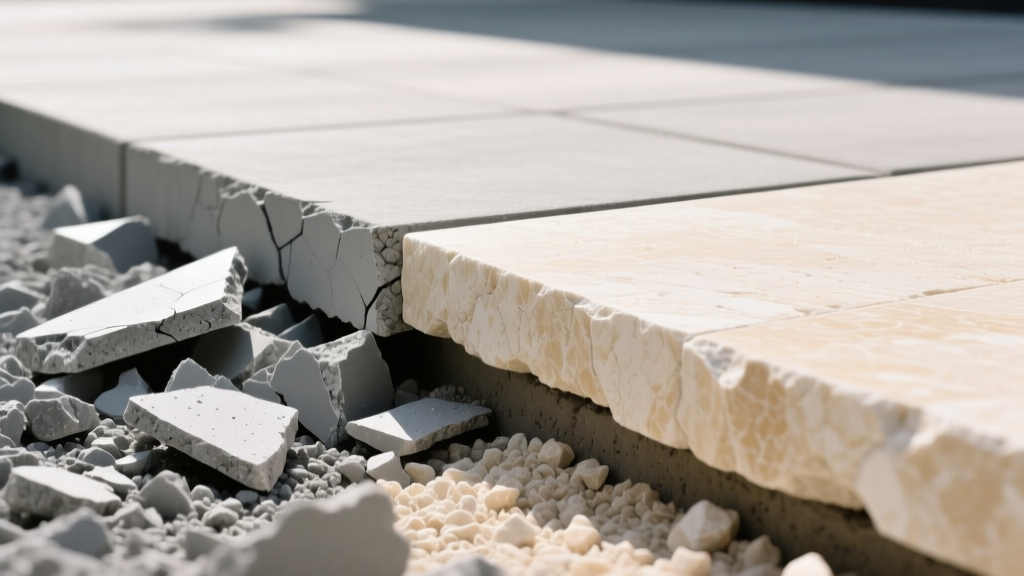
While crushed concrete excels in rigid load-bearing, limestone dominates in water management. Natural limestone, particularly when graded to #57 specifications (3/4-inch to 1-inch clean stone), lacks the cementitious fines found in RCA. This absence of fines ensures that the void spaces between the angular stones remain open indefinitely.
Crushed concrete's high water absorption rate (up to 10% compared to limestone's 2%) means it acts like a sponge during heavy rainfall. In freeze-thaw climates, if a crushed concrete base is not properly sealed or capped with a dense surface layer, the trapped moisture expands upon freezing, causing severe frost heave. Limestone's low absorption rate allows water to pass through rapidly, making it the mandatory choice for French drain envelopes, retaining wall backfill, and permeable paver bases where hydrostatic pressure must be relieved immediately.
Chemical Contamination and Edge Cases
Not all recycled concrete is created equal. The primary failure mode for crushed concrete bases occurs when the recycling facility fails to adequately separate gypsum (drywall) and asphalt from the concrete rubble.
- Gypsum Contamination: If gypsum-rich RCA is used as a sub-base for a new concrete slab, sulfates from the gypsum can react with the tricalcium aluminate in the new concrete. This triggers ettringite formation, a delayed sulfate attack that causes the new slab to expand, crack, and heave from below.
- Asphalt Contamination: Recycled asphalt pavement (RAP) mixed into RCA creates a slippery shear plane under heavy loads. Ensure your supplier certifies the RCA contains less than 1% asphalt and gypsum by weight.
- Alkali-Silica Reaction (ASR): If the original demolished concrete suffered from ASR (reactive silica aggregates), the crushed remnants can continue to react if exposed to high-alkali environments, though this is rarely a concern in unbound base layers.
Data from the USGS Crushed Stone Statistics and Information reports highlights that natural limestone provides a highly predictable, uniform chemical profile, eliminating the risk of hidden demolition contaminants entirely.
Decision Framework: When to Specify Which Material
Specify 21A Crushed Concrete When:
- Pouring Structural Slabs: You are building a driveway, garage pad, or commercial slab that requires a high CBR, semi-rigid sub-base to prevent differential settlement.
- Targeting LEED Certification: The project requires documented recycled content credits for commercial green building compliance.
- Budget is the Primary Constraint: You need to fill deep sub-grade voids (12+ inches) where the 30-40% cost savings per ton on material will significantly reduce overall freight and supply costs.
Specify #57 or 21A Crushed Limestone When:
- Managing Hydrostatic Pressure: You are installing retaining walls, French drains, or foundation perimeter drainage where free-flowing water is critical.
- Building in Severe Freeze-Thaw Zones: The base will be exposed to the elements for extended periods before the final surface layer is applied, requiring low water absorption to prevent frost heave.
- Installing Permeable Hardscapes: You are laying permeable interlocking concrete pavers (PICP) or porous asphalt that rely on an open-graded, fines-free reservoir base.
- Working Near Sensitive Landscaping: The highly alkaline runoff (pH 11+) from fresh crushed concrete can damage adjacent acid-loving plants; limestone's lower pH is safer for immediate landscape integration.
Frequently Asked Questions
Can I mix crushed concrete and limestone in the same base?
Yes, but it is generally unnecessary. Contractors sometimes use a 6-inch base layer of crushed concrete for structural rigidity, topped with a 2-inch layer of clean limestone for final grading and drainage before pouring a slab. However, mixing them in the same lift dilutes the cementitious bonding of the RCA and increases material costs without measurable structural gain.
Does crushed concrete harden like new concrete?
It does not cure to the strength of new structural concrete (3,000+ PSI). The re-hydration of residual fines creates a 'cement-treated' effect that binds the aggregate together tightly, resisting lateral movement and rutting, but it remains a flexible base material that will crack if the underlying subgrade shifts.
How thick should my base layer be for a residential driveway?
For a standard residential concrete driveway (4-inch slab), specify a minimum 4-inch compacted layer of 21A crushed concrete or 21A crushed limestone. For asphalt driveways, increase the base to 6-8 inches of dense-graded aggregate, compacted in 2-inch lifts using a vibratory roller to achieve 95% Proctor density.
Written by
David NakamuraDavid Nakamura is a licensed architect (AIA) and construction technology writer focused on sustainable building methods, mass timber engineering, and high-performance building envelopes. He holds a Master of Architecture from the University of Washington and is a certified Passive House Consultant (CPHC). David spent eight years at the Seattle firm Mithun, where he led the design of three LEED Platinum projects, before founding his own practice specializing in net-zero residential design. He serves on the editorial advisory board of GreenBuilder Magazine and has authored peer-reviewed papers on cross-laminated timber (CLT) connections for the Journal of Structural Engineering. In his spare time, David teaches woodworking at Pratt Fine Arts Center and kayaks the Puget Sound.
More from David Nakamura
View all
Construction Cost
Labor Cost to Build a Deck Per Sq Ft: 2026 Installation Guide
Discover the exact labor cost to build a deck per sq ft in 2026. This installation guide breaks down contractor rates, complexity factors, and hidden fees.
Aug 4, 2026

Construction Cost
How Much Does It Cost to Build a 3 Bedroom House? Financing Guide
Learn exactly how much it costs to build a 3 bedroom house and explore 2026 financing options, construction loan types, and budget frameworks for your build.
Aug 4, 2026

Construction Cost
Cost to Build a Tennis Court: 2026 Guide
How much does it cost to build a tennis court in 2026? Breakdowns for asphalt, concrete, and synthetic surfaces plus fencing and lighting.
Jul 30, 2026