Concrete Blocks vs Cinder Blocks: Technical Specs and Load Limits
Compare concrete blocks vs cinder blocks with exact technical specs, compressive strength data, weight limits, and ASTM standards for structural masonry.

The Core Material Difference: Aggregate Composition
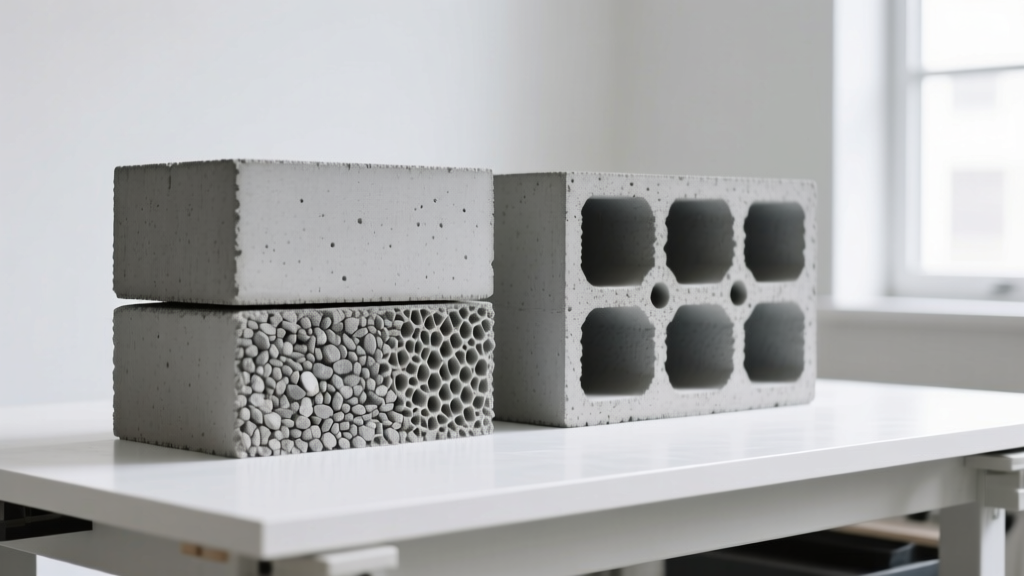
The distinction between concrete blocks and cinder blocks originates in the aggregate used during manufacturing. Standard concrete masonry units (CMUs) utilize dense, crushed natural aggregates such as limestone, granite, quartz, or gravel, combined with Portland cement and sand. This composition yields a high-density matrix capable of withstanding severe compressive and shear forces.
Cinder blocks, historically manufactured using coal cinders, clinkers, and fly ash (byproducts of coal combustion), possess a fundamentally different microstructure. The carbonaceous, highly porous nature of coal cinders creates a lightweight unit with significant void spaces within the cementitious paste. While this reduces the overall dead load of the masonry wall, it critically compromises the tensile and shear capacity of the block, rendering it unsuitable for modern load-bearing applications.
In modern construction supply chains, the term "cinder block" is frequently misused by laypersons and retail staff to describe lightweight concrete blocks. True cinder blocks are virtually extinct in new commercial production due to environmental regulations regarding coal ash and structural code updates. When sourcing lightweight units today, you are purchasing lightweight CMUs (using expanded shale, clay, or slate aggregates), not actual cinder blocks. Always verify the aggregate type on the manufacturer's technical data sheet.
Compressive Strength and ASTM Standards
Structural engineers specify masonry units based on strict ASTM International standards. The governing standard for modern load-bearing masonry is ASTM C90 (Standard Specification for Loadbearing Concrete Masonry Units). This standard mandates minimum compressive strength requirements that true cinder blocks cannot consistently meet.
ASTM C90 vs. Legacy ASTM C129
Historically, non-loadbearing cinder and lightweight blocks were governed by ASTM C129. However, the industry has largely moved away from this distinction. Modern building codes, including the 2024 and upcoming 2026 International Building Code (IBC) cycles, require virtually all structural masonry to meet ASTM C90. Under ASTM C90, the net area compressive strength of the units must average at least 2,000 psi (13.8 MPa), with no individual unit falling below 1,800 psi. High-strength concrete blocks routinely achieve 3,500 to 4,500 psi, whereas legacy cinder blocks typically max out between 800 and 1,200 psi.
Dimensional Tolerances, Shell Thickness, and Weight
The structural viability of a masonry wall relies heavily on the face shell thickness and web dimensions, which dictate mortar bed depth and rebar embedment. Standard concrete blocks feature robust face shells designed to handle concentrated point loads and lateral wind pressures.
| Specification | Normal Weight Concrete Block | Legacy Cinder Block |
|---|---|---|
| Average Unit Weight | 38 - 42 lbs (17.2 - 19.0 kg) | 24 - 28 lbs (10.8 - 12.7 kg) |
| Face Shell Thickness | 1 1/4 inches (31.7 mm) minimum | 3/4 to 7/8 inches (19 - 22 mm) |
| Net Compressive Strength | 2,500 - 4,500+ psi | 800 - 1,200 psi |
| Max Moisture Absorption (ASTM C140) | 13 lbs/ft³ (Normal Weight limit) | 18 - 22 lbs/ft³ (Highly porous) |
| Acoustic STC Rating (Unfilled) | 46 - 50 STC | 40 - 44 STC |
Moisture Absorption and Freeze-Thaw Durability
Moisture management is a critical failure point in masonry design. According to testing protocols outlined by the Portland Cement Association, the porous matrix of cinder blocks acts like a sponge. When subjected to ASTM C140 absorption testing, cinder blocks can absorb upwards of 22 lbs of water per cubic foot. In contrast, normal-weight concrete blocks are strictly capped at 13 lbs/ft³.
In climates experiencing freeze-thaw cycles, this differential is catastrophic for cinder blocks. Water trapped in the large capillary voids of the coal ash aggregate expands upon freezing, causing spalling, micro-cracking, and eventual structural delamination. Modern concrete blocks, utilizing dense crushed stone and optimized water-to-cement ratios, resist water penetration and maintain structural integrity through thousands of freeze-thaw cycles when properly sealed.
Structural Load Limits and Rebar Integration
The transition from unreinforced masonry to reinforced masonry in seismic and high-wind zones necessitates the integration of steel rebar and fluid grout. The physical geometry of concrete blocks vs cinder blocks dictates their performance in reinforced assemblies.
Grout Cell Capacity and Shell Blowout
Standard concrete blocks feature a 1 1/4-inch face shell and robust cross-webs. When masons lay these units with face-shell bedding, the resulting grout cells provide ample clearance for vertical #5 or #6 rebar and allow for deep lap splices. The thick face shells prevent "blowout"—a failure mode where the hydrostatic pressure of wet, high-slump grout fractures the masonry shell during pouring.
Cinder blocks, with their thin 3/4-inch shells and brittle webbing, are highly susceptible to blowout during grouting. Furthermore, the lower compressive strength of the cinder matrix means that the bond strength between the grout and the block interior is significantly weaker, reducing the overall moment capacity of the reinforced wall assembly.
"In seismic retrofitting, we never specify legacy cinder blocks for shear walls. The thin face shells cannot develop the necessary tension-compression couple required to resist lateral racking forces. We exclusively use ASTM C90 normal-weight CMUs with high-slump, pea-gravel grout to ensure complete consolidation around the steel reinforcement."
— Structural Masonry Engineering Guidelines, Seismic Design Category D
Code Compliance and Modern Availability
As of the 2026 construction cycle, true cinder blocks are entirely absent from commercial structural supply chains. The International Building Code (IBC) and International Residential Code (IRC) mandate that all load-bearing masonry units conform to ASTM C90. Because coal cinders cannot reliably meet the 2,000 psi minimum compressive strength threshold or the stringent dimensional tolerances required for modern post-tensioned and reinforced masonry, they have been engineered out of the market.
For non-structural applications—such as interior partition walls, landscaping retaining walls under 3 feet, or temporary site barriers—contractors may occasionally source lightweight CMUs (often mistakenly called cinder blocks). These modern lightweight units use expanded shale or slate, offering reduced dead loads (approx. 28 lbs per block) while still maintaining ASTM C90 compliance for basic structural integrity.
Frequently Asked Technical Questions
Can I use cinder blocks for a residential foundation?
No. Residential foundations require high compressive strength and severe moisture resistance. Building codes universally mandate normal-weight, solid or hollow concrete blocks (ASTM C90) meeting local frost-line and hydrostatic pressure requirements. Cinder blocks will wick ground moisture and fail under the point loads of floor joists.
Why are lightweight blocks sometimes still called cinder blocks?
It is a colloquial holdover from the mid-20th century. Modern lightweight blocks use expanded clay or shale, not coal cinders. Always check the manufacturer's technical data sheet for the specific aggregate type and ASTM compliance before specifying them for load-bearing walls.
How does the fire rating compare between the two?
Both materials offer excellent fire resistance due to their cementitious nature. However, normal-weight concrete blocks typically achieve a 4-hour fire rating for an 8-inch wall, whereas the high porosity and lower mass of legacy cinder blocks may reduce the assembly rating to 2 or 3 hours, depending on the specific aggregate carbon content.
Written by
Priya KapoorPriya Kapoor is a real estate market analyst and construction economics researcher with expertise in housing affordability, development feasibility, and infrastructure investment. She holds a Master of Regional Planning from Cornell University and previously worked as a senior analyst at CBRE's Investment Properties group, where she modeled returns for $4B in mixed-use development pipelines. Priya now runs an independent research practice advising developers, municipalities, and REITs on construction cost forecasting and market timing. She publishes the quarterly "BuildMat Market Pulse" report tracking material price indices across 12 commodity categories. Based in Austin, TX, Priya serves on the board of Habitat for Humanity Austin and is a marathon runner.
More from Priya Kapoor
View all
Construction Cost
Cost to Build a 1600 Sq Ft Home in 2026: Full Breakdown
Accurate 2026 cost to build a 1600 sq ft home—material, labor, and regional pricing breakdowns included. Plan your budget with real-time estimates.
Aug 11, 2026

Wood & Lumber
Name the Types of Wood for Pressure Treatment and Preservation
Learn how to name the types of wood best suited for pressure treatment. Compare species treatability, chemical retention levels, and 2026 preservation costs.
Aug 4, 2026

Stone & Masonry
Stone Veneer Suppliers Lindenhurst: 2026 Cost Analysis
Analyze 2026 stone veneer costs in Lindenhurst, NY. Compare local supplier pricing, delivery fees, and Suffolk County installation labor rates.
Aug 4, 2026