Top Types of Concrete Patios: Cost, Durability and Design Guide
Compare the top types of concrete patios including stamped, exposed aggregate, and broom finishes. Explore 2026 costs, PSI requirements, and durability.
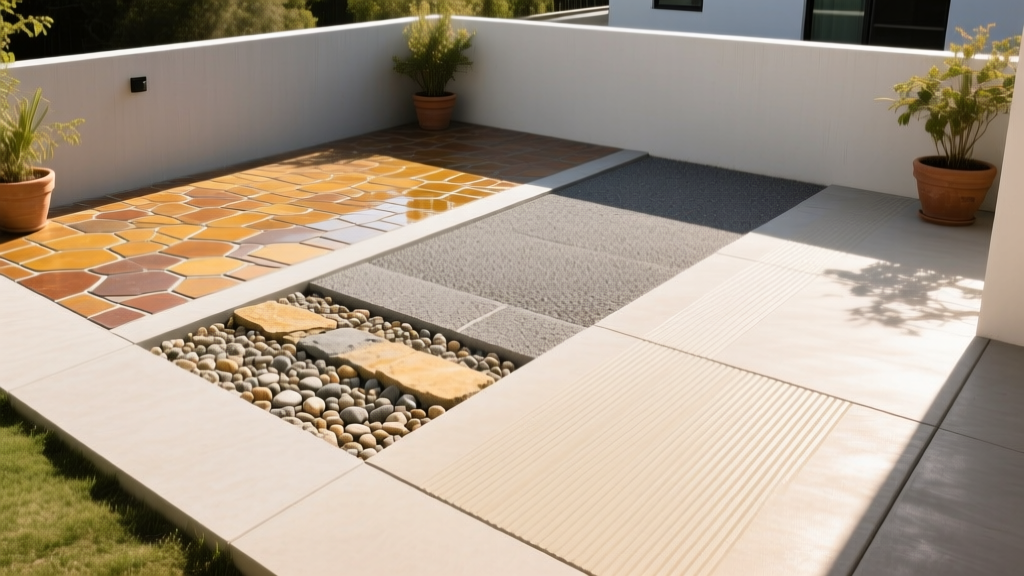
The Structural Foundation: What All Concrete Patios Share
Before evaluating the aesthetic types of concrete patios, it is critical to establish the structural baseline. A decorative surface will fail prematurely if the underlying slab is improperly engineered. For exterior residential patios in 2026, the industry standard dictated by the American Concrete Institute (ACI) requires a minimum compressive strength of 4,000 PSI (pounds per square inch). In regions subject to freeze-thaw cycles, the mix must be air-entrained, containing 4% to 8% microscopic air bubbles per ASTM C260. These voids provide expansion chambers for freezing water, preventing catastrophic internal fracturing.
Slab thickness must be a minimum of 4 inches, though 5 to 6 inches is recommended if the patio will support heavy loads like hot tubs or outdoor kitchens. The subgrade requires compaction to 95% Standard Proctor density to prevent differential settlement. Furthermore, a 10-mil polyethylene vapor barrier should be placed over a 4-inch layer of compacted crushed stone to mitigate moisture migration and reduce the risk of efflorescence.
Matrix: Comparing the Most Popular Types of Concrete Patios
Selecting the right finish involves balancing traction, maintenance, and budget. The following matrix breaks down the core performance metrics for the four primary patio finishes.
| Patio Type | Avg. Cost (per sq. ft.) | Slip Resistance | Maintenance Level | Best Application |
|---|---|---|---|---|
| Standard Broom | $6.00 - $10.00 | Excellent | Low | Pool decks, walkways, utility areas |
| Stamped | $14.00 - $24.00 | Moderate to Poor | High | Entertainment zones, dining areas |
| Exposed Aggregate | $10.00 - $16.00 | Excellent | Moderate | Driveways, high-traffic patios |
| Acid-Stained | $12.00 - $18.00 | Poor (unless textured) | Moderate | Covered patios, modern interiors |
Deep Dive: Surface Finishes and Treatments
Standard Broom Finish
The most economical and practical option, a broom finish is achieved by dragging a stiff-bristled push broom across the concrete just as the bleed water evaporates and the slab begins to set. Using a #3 or #4 synthetic brush creates deep, uniform striations that channel water away and provide superior slip resistance. While it lacks the visual complexity of other types of concrete patios, it can be enhanced with scored control joints or a colored integral pigment added to the ready-mix truck.
Stamped Concrete
Stamped concrete utilizes flexible polyurethane mats to imprint patterns resembling slate, cobblestone, or wood plank. The process requires precise timing. A colored dry-shake hardener is broadcast across the surface and troweled in, followed by an antiquing release agent that prevents the mats from sticking.
A common failure in stamped concrete occurs when contractors stamp too early to beat the weather. If the surface is worked while bleed water is still trapped beneath, a weak, crusted layer forms. This leads to surface scaling within the first winter. Always wait until you can press your thumb into the slab and leave only a 1/4-inch indentation before applying the release agent.
Exposed Aggregate
This finish reveals the natural beauty of the coarse aggregate (pea gravel, crushed granite, or river rock) within the mix. After the concrete is placed and finished, a liquid surface retarder is sprayed on. This chemical delays the setting of the top 1/4-inch of cement paste. The following day, the surface is scrubbed and pressure-washed away, leaving the stones exposed. Exposed aggregate is highly durable and hides surface dirt exceptionally well, making it a top choice for heavily used outdoor spaces.
Acid-Stained and Dyed Concrete
Chemical stains react with the calcium hydroxide in cured concrete to produce translucent, mottled, earth-toned colors. Unlike paints or acrylics, acid stains (typically containing metallic salts and muriatic acid) penetrate the pores and become a permanent part of the matrix. Because the reaction depends on the specific mineral composition of the cement, the results are highly variegated and unpredictable. Water-based acrylic dyes offer more consistent, vibrant colors but require UV-stable sealers to prevent fading in direct sunlight.
Control Joints: The Invisible Lifeline
Concrete will crack; control joints dictate where. According to guidelines published by the Portland Cement Association, control joints should be spaced in feet no more than 2 to 3 times the slab thickness in inches. For a standard 4-inch patio slab, joints must be cut or tooled every 8 to 12 feet. Joints must be cut to a depth of exactly one-quarter the slab thickness (1 inch deep for a 4-inch slab) to create a sufficient plane of weakness. Saw-cutting should occur within 4 to 12 hours of placement, before thermal contraction induces random cracking.
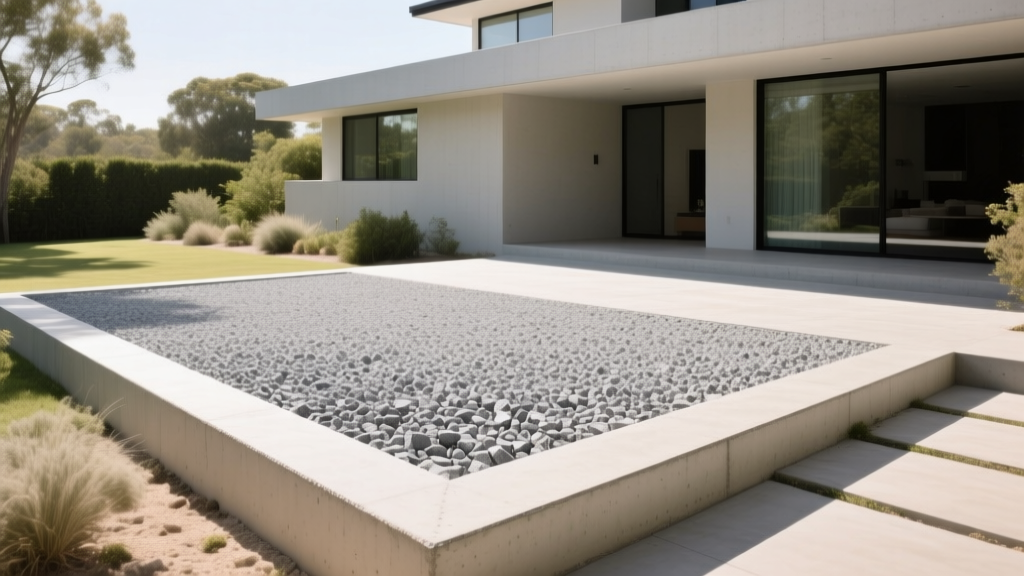
2026 Cost Breakdown and ROI Factors
Pricing for concrete patios has stabilized following the supply chain fluctuations of the early 2020s, though labor costs for specialized finishes continue to rise. The costs below reflect national averages for a 400-square-foot patio, including excavation, 4-inch compacted gravel base, forming, pouring, and finishing.
- Plain Gray (Broom): $2,400 - $4,000 total. Highest ROI for budget-conscious flips.
- Integral Color + Scored: $3,200 - $5,000 total. Adds aesthetic value without the maintenance of stamping.
- Exposed Aggregate: $4,000 - $6,400 total. Excellent longevity justifies the mid-tier investment.
- Multi-Color Stamped: $5,600 - $9,600 total. High visual impact, but requires resealing every 2-3 years, increasing long-term cost of ownership.
Common Failure Modes and Prevention
Understanding why patios fail is essential for evaluating contractor bids and material choices.
D-Cracking
D-Cracking appears as a series of fine cracks parallel to joints and edges, resembling the letter 'D'. It is caused by the use of porous coarse aggregates (like certain limestones or cherts) that absorb water, freeze, and expand. Prevention requires specifying ASTM C33 compliant aggregates with a proven local track record for freeze-thaw durability.
Plastic Shrinkage Cracking
When the rate of surface evaporation exceeds the rate of bleed water rising to the surface, the top layer shrinks and tears. This is prevalent in hot, windy, or low-humidity conditions. Contractors must use evaporation retardants (like Master Builders Confilm) and erect temporary windbreaks during placement. For deeper insights into environmental placement limits, refer to the PCA's durability guidelines.
Maintenance and Sealing Protocols
The longevity of decorative concrete relies heavily on the sealer chemistry. Film-forming acrylic sealers are standard for stamped concrete because they enhance color and provide a wet-look sheen. However, they trap moisture vapor if applied to a damp slab, leading to blushing (a white, cloudy haze). Acrylics also degrade under UV exposure, requiring recoating every 18 to 24 months.
For exposed aggregate and broom finishes, penetrating silane/siloxane sealers are vastly superior. These reactive resins do not form a surface film; instead, they line the capillary pores, rendering the concrete hydrophobic while allowing water vapor to escape. A high-quality 40% silane/siloxane blend will protect against chloride intrusion and freeze-thaw damage for 5 to 7 years without altering the natural slip resistance or appearance of the patio surface.
Written by
Marcus ChenMarcus Chen is a licensed structural engineer (PE) and building materials analyst with over 12 years of experience across residential, commercial, and industrial construction. He holds a Master of Science in Civil Engineering from UC Berkeley and spent six years at Thornton Tomasetti before transitioning to independent consulting and technical writing. Marcus specializes in material selection for seismic-prone regions, concrete reinforcement strategies, and lifecycle cost analysis. His work has been cited by the American Concrete Institute (ACI) and the Structural Engineers Association of California (SEAOC). When he is not on a job site or at his desk, you will find him hiking the Sierra Nevada or restoring a 1920s craftsman bungalow in Oakland, CA.
More from Marcus Chen
View all
Construction Cost
How Much Did the Eiffel Tower Cost to Build?
How much did the Eiffel Tower cost to build in 1889? We adjust for inflation and compare its budget to modern skyscraper construction.
Aug 4, 2026

Fire Resistance
What Is a Fire Resistant Material? Testing & Certification Guide
Discover what is a fire resistant material through ASTM and UL testing. Learn how fire ratings, certifications, and assemblies work in construction.
Aug 4, 2026

Construction Cost
How Much Did the Burj Khalifa Cost to Build?
How much did the Burj Khalifa cost to build? We break down the $1.5B project and extract 5 money-saving strategies for your next build.
Jul 30, 2026