Concrete Parking Lot vs Asphalt: 2026 Cost Breakdown
Compare the true 2026 costs of a concrete parking lot vs asphalt. We break down upfront pricing, subbase prep, maintenance, and 40-year lifecycle expenses.

The True Cost of Paving: Initial vs. Lifecycle
When evaluating a concrete parking lot vs asphalt, facility managers and developers often fixate on day-one installation costs. While asphalt consistently wins the initial bidding war, a rigorous lifecycle cost analysis (LCCA) reveals a vastly different financial picture over a 30- to 40-year horizon. According to the Federal Highway Administration (FHWA), rigid pavements (concrete) require significantly less structural maintenance over their lifespan compared to flexible pavements (asphalt). This 2026 cost breakdown dissects the hidden variables—from subbase engineering and specific mix designs to operational lighting savings—to determine which material truly offers the best return on investment for commercial and municipal parking facilities.
• Choose Asphalt if: Your capital expenditure budget is strictly capped, the lot will be repurposed or sold within 10 years, or you are paving in a region with extreme, continuous freeze-thaw cycles where concrete joint maintenance is prohibitively expensive.
• Choose Concrete if: You plan to hold the asset for 20+ years, the lot will endure heavy static loads (e.g., truck staging, RV storage), or you want to reduce long-term operational lighting and stormwater management costs.
Upfront Installation Costs (2026 Data)
The initial installation cost encompasses site clearing, grading, subbase preparation, material delivery, and paving labor. In 2026, supply chain stabilization has normalized material costs, though regional labor shortages continue to push installation rates upward.
| Cost Component (Per Sq. Ft.) | Concrete (Rigid) | Asphalt (Flexible) |
|---|---|---|
| Site Prep & Grading | $1.20 - $1.80 | $1.20 - $1.80 |
| Subbase Material & Compaction | $1.50 - $2.50 | $2.00 - $3.50 |
| Paving Material (Delivered) | $3.50 - $5.50 | $1.80 - $3.00 |
| Labor & Equipment | $3.00 - $4.50 | $1.50 - $2.50 |
| Total Installed Cost | $9.20 - $14.30 | $6.50 - $10.80 |
While asphalt holds a 25% to 35% advantage in initial capital outlay, this metric alone is misleading. The structural engineering requirements for the subbase drastically alter the financial equation.
Subbase Engineering: The Hidden Variable
The American Concrete Pavement Association (ACPA) emphasizes that a concrete slab acts as a rigid beam, bridging minor subgrade imperfections and distributing loads over a wider area. Consequently, concrete requires a thinner, less expensive aggregate base—typically 4 to 6 inches of compacted crushed stone.
Asphalt, however, is a flexible pavement. It relies entirely on the structural integrity of the underlying layers to prevent deflection and rutting. A commercial asphalt parking lot requires a robust 6- to 8-inch aggregate base course beneath the asphalt lifts. In regions with poor native soils (e.g., expansive clays), asphalt subbase preparation costs can easily double, entirely erasing the material's upfront price advantage.
Material Mix Designs and Thickness Specifications
To achieve equivalent load-bearing capacities for standard commercial traffic (including occasional delivery trucks), the 2026 structural specifications are as follows:
- Concrete Specification: 6-inch to 7-inch slab thickness. Mix design requires a minimum 4,000 PSI compressive strength at 28 days, utilizing ASTM C150 Type I/II cement, a 3/4-inch maximum aggregate size, and 5-7% air entrainment for freeze-thaw durability. Transverse joints must be doweled with 1-inch smooth steel bars to prevent faulting.
- Asphalt Specification: 5-inch to 6-inch total asphalt thickness. This comprises a 3-inch surface course (Superpave 12.5mm mix with PG 64-22 performance-graded binder) over a 2- to 3-inch binder course, placed atop the 6- to 8-inch crushed aggregate base.
Maintenance and Lifecycle Cost Analysis
The most critical divergence between a concrete parking lot vs asphalt occurs in years 5 through 30. According to the National Asphalt Pavement Association (NAPA), flexible pavements require periodic surface treatments to prevent oxidation and water infiltration.
The 30-Year Maintenance Timeline
Operational Cost Factors: Lighting and Stormwater
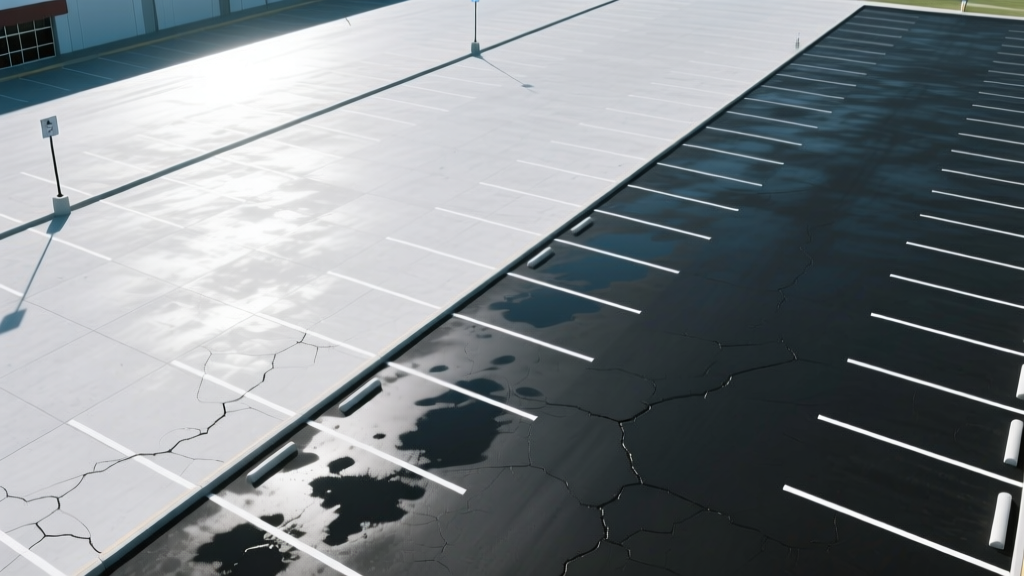
Beyond paving and maintenance, the choice of material impacts daily operational expenditures. The most significant factor is the albedo effect (solar reflectance).
Concrete possesses a high albedo, typically reflecting 30% to 50% of incoming solar radiation. Fresh asphalt reflects only 5% to 10%, absorbing the rest as heat. This thermal and reflective disparity yields two major operational cost savings for concrete:
- Lighting Reductions: Because concrete reflects ambient light, commercial lots can achieve required foot-candle illumination levels using fewer light poles or lower-wattage LED fixtures. Facility managers report 20% to 30% reductions in nighttime lighting energy costs and lower initial electrical infrastructure bids.
- Urban Heat Island Mitigation: In dense municipal environments, asphalt lots can reach surface temperatures exceeding 140°F in summer, increasing cooling loads for adjacent buildings and accelerating the degradation of the asphalt binder itself. Concrete remains significantly cooler, preserving its structural integrity and reducing localized cooling costs.
Final Verdict: Calculating the Break-Even Point
When conducting a net present value (NPV) analysis using a standard 4% discount rate, the break-even point where concrete becomes cheaper than asphalt typically occurs between Year 12 and Year 16. If your organization utilizes a 20-year or 30-year asset holding strategy, the concrete parking lot is unequivocally the more cost-effective choice. However, for developers planning to build, operate for 5 to 7 years, and sell the property, the lower initial capitalization cost of asphalt remains the superior financial lever, provided the buyer does not heavily discount the property value based on impending overlay maintenance.
"The cheapest pavement to install is rarely the cheapest to own. Developers must align their paving material selection with their specific asset lifecycle strategy, rather than defaulting to the lowest initial bid."
Written by
David NakamuraDavid Nakamura is a licensed architect (AIA) and construction technology writer focused on sustainable building methods, mass timber engineering, and high-performance building envelopes. He holds a Master of Architecture from the University of Washington and is a certified Passive House Consultant (CPHC). David spent eight years at the Seattle firm Mithun, where he led the design of three LEED Platinum projects, before founding his own practice specializing in net-zero residential design. He serves on the editorial advisory board of GreenBuilder Magazine and has authored peer-reviewed papers on cross-laminated timber (CLT) connections for the Journal of Structural Engineering. In his spare time, David teaches woodworking at Pratt Fine Arts Center and kayaks the Puget Sound.
More from David Nakamura
View all
Construction Cost
Labor Cost to Build a Deck Per Sq Ft: 2026 Installation Guide
Discover the exact labor cost to build a deck per sq ft in 2026. This installation guide breaks down contractor rates, complexity factors, and hidden fees.
Aug 4, 2026

Construction Cost
How Much Does It Cost to Build a 3 Bedroom House? Financing Guide
Learn exactly how much it costs to build a 3 bedroom house and explore 2026 financing options, construction loan types, and budget frameworks for your build.
Aug 4, 2026

Construction Cost
Cost to Build a Tennis Court: 2026 Guide
How much does it cost to build a tennis court in 2026? Breakdowns for asphalt, concrete, and synthetic surfaces plus fencing and lighting.
Jul 30, 2026