Comparing Types of Trowels for Concrete and Alternative Finishes
Compare the best types of trowels for concrete against alternative finishing methods. Learn which steel, magnesium, or power trowel fits your slab project.

The Material Matrix: Hand Trowel Blades Explained
Selecting the correct tool during the critical hydration window dictates the longevity and surface integrity of a concrete slab. The types of trowels for concrete are not interchangeable; each blade material interacts differently with the cement paste, aggregate, and bleed water. Using a steel trowel too early traps water, while using a magnesium float too late fails to consolidate the surface cream. Below is a technical breakdown of hand trowel materials, their specific applications, and current 2026 market pricing for professional-grade models.
| Blade Material | Gauge / Thickness | Primary Function | Edge Case / Limitation | 2026 Avg. Cost (14" x 4") |
|---|---|---|---|---|
| Magnesium | 3/16" to 1/4" | Initial floating; pulls cream without digging into aggregate. | Too porous for final burnishing; leaves a slightly textured finish. | $45 - $75 |
| Polyurethane | 5/16" | Stamping prep and broom finishes; lighter than magnesium. | Wears down 3x faster than metal on high-PSI (4000+) mixes. | $35 - $60 |
| Blue Steel | 14-gauge (0.075") | Standard final troweling; creates a dense, hard surface. | Can rust if not oiled; will discolor white cement overlays. | $50 - $85 |
| Stainless Steel | 16-gauge (0.060") | Decorative overlays, white cement, and epoxy prep. | Highly flexible; requires a perfectly flat subgrade to avoid gouging. | $80 - $130 |
| Resin / Epoxy | Variable | Applying self-leveling underlayments and micro-toppings. | Strictly for low-viscosity polymer mixes, not standard Portland cement. | $60 - $110 |
Scaling Up: Hand Trowels vs. Power Trowels
For slabs exceeding 400 square feet, manual finishing becomes physically unsustainable and economically unviable. Power trowels (rotary floats) mechanize the consolidation process, but they introduce complex variables like RPM, blade pitch, and weight distribution that hand tools do not.
The Pitch and Blade Dilemma
Walk-behind power trowels (typically 36" to 46" diameters, such as the Multiquip Whiteman HDX46) rely on adjustable blade pitch to transition from floating to finishing.
- Float Blades (0° to 5° pitch): Used when the concrete can support the machine's weight (approx. 300-400 lbs) without sinking more than 1/8 inch. This flattens the slab and embeds aggregate.
- Finish Blades (10° to 15° pitch): Used in the final stages to burnish the surface. The steep angle creates high friction, generating heat that seals the pores.
In 2026, a standard 36" walk-behind power trowel with a Honda GX270 engine costs between $3,800 and $4,500. Ride-on models (e.g., Wacker Neuson CRT 36V3) feature dual overlapping rotors and cost upwards of $28,000, justified only for industrial warehouse floors requiring F-min (flatness/levelness) numbers above FF 50 / FL 35.
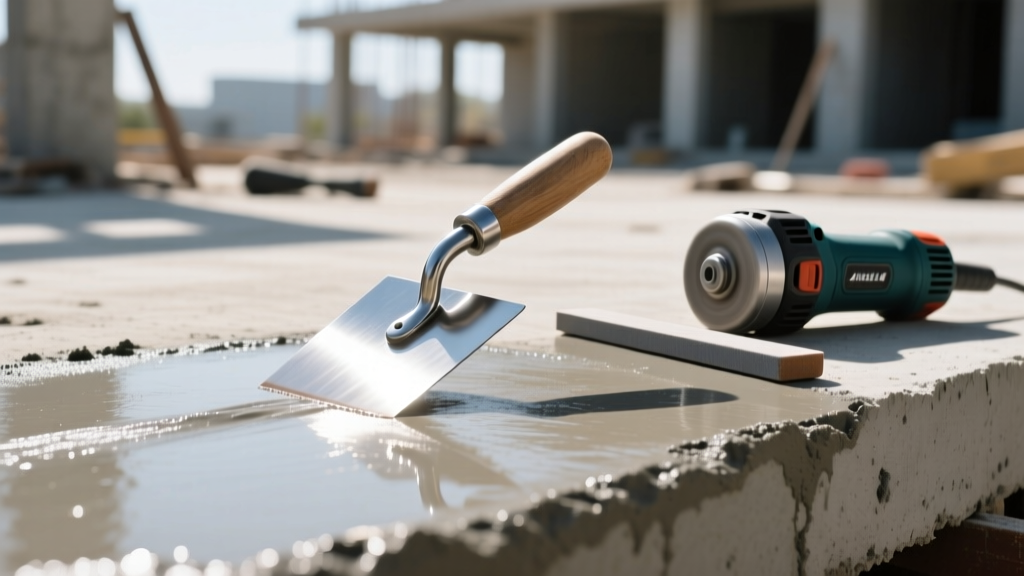
Troweling vs. Alternative Concrete Finishing Methods
A smooth, hard-troweled finish is not universally optimal. In exterior, wet, or high-traffic pedestrian environments, a burnished trowel finish becomes a severe slip hazard. Comparing troweling to alternative finishing methods reveals distinct trade-offs in cost, traction, and maintenance.
1. Broom Finish (The Standard Exterior Alternative)
Instead of a steel trowel, a coarse-bristled push broom is dragged across the surface after magnesium floating.
Comparison: Broom finishes achieve an ASTM C156 slip-resistant profile at virtually zero additional tool cost. However, the ridges created by the broom trap dirt, snow, and de-icing salts, accelerating surface spalling in freeze-thaw climates compared to a sealed troweled surface.
2. Exposed Aggregate (Chemical Retardation)
This method eliminates final troweling entirely. A surface retarder (like Sika Rugasol) is sprayed on the fresh concrete to delay the setting of the top 1/4 inch of cement paste, which is then washed away with a pressure washer 12 to 24 hours later.
Comparison: Exposed aggregate offers superior traction and hides surface discoloration. The trade-off is a 30% increase in labor costs and the inability to apply standard film-forming acrylic sealers without altering the natural stone aesthetic.
3. Liquid Densifiers (The Anti-Trowel Approach for Interiors)
For modern polished or industrial floors, contractors are increasingly skipping the final hard-trowel burnish. Instead, they power-trowel to a medium grit and apply a lithium silicate liquid densifier post-cure.
Comparison: Hard troweling can sometimes overwork the surface, bringing excess fat (cement paste) to the top, which eventually dusts. Densifiers chemically react with free lime to harden the slab from the inside out. This alternative costs roughly $0.15 to $0.25 per square foot in materials but eliminates the risk of trowel-induced surface delamination.
The most common catastrophic failure in concrete finishing is troweling while bleed water is still present on the surface. According to the Portland Cement Association, troweling bleed water back into the surface increases the water-cement ratio at the top layer. This guarantees a weak, dusty surface that will scale and delaminate within the first winter freeze-thaw cycle. Always wait until the sheen of water has completely evaporated and the concrete can bear weight with only a 1/4-inch indentation before introducing any trowel.
Real-World Failure Modes and Edge Cases
Even when selecting the correct types of trowels for concrete, operator error during the finishing window leads to specific, diagnosable failure modes.
- Surface Burning: Occurs when a steel trowel or power trowel is used on concrete that has already achieved initial set. The extreme friction burns the cement paste, creating a brittle, glass-like crust that will flake off under forklift traffic. Fix: Monitor the penetration resistance; if a 1/4" rod requires more than 50 lbs of force to penetrate, the window for steel troweling has closed.
- Plastic Shrinkage Cracking: In high-wind or low-humidity environments, the surface dries faster than the bleed water can rise. Troweling over micro-cracks seals them temporarily, but they will propagate through the slab depth. Alternative: Apply an aliphatic alcohol-based evaporation retarder (e.g., E-CON) immediately after screeding, rather than rushing the trowel.
- Blade Gouging (Power Trowels): Using finish blades with too steep a pitch before the slab has fully hardened causes the leading edge of the blade to dig into the concrete, creating crescent-shaped gouges. Fix: Always transition from float blades to finish blades incrementally, adjusting the pitch wheel by no more than 2 degrees per pass.
For comprehensive standards on floor flatness and finishing tolerances, contractors should consult the ACI 302.1R-15 Guide to Concrete Floor and Slab Construction, which outlines the precise F-number requirements for various troweling and alternative finishing techniques. Additionally, tool manufacturers like Marshalltown provide detailed metallurgical specifications for matching blade flexibility to specific mix designs, ensuring that the tool yields to the concrete rather than forcing a profile onto it.
Written by
Priya KapoorPriya Kapoor is a real estate market analyst and construction economics researcher with expertise in housing affordability, development feasibility, and infrastructure investment. She holds a Master of Regional Planning from Cornell University and previously worked as a senior analyst at CBRE's Investment Properties group, where she modeled returns for $4B in mixed-use development pipelines. Priya now runs an independent research practice advising developers, municipalities, and REITs on construction cost forecasting and market timing. She publishes the quarterly "BuildMat Market Pulse" report tracking material price indices across 12 commodity categories. Based in Austin, TX, Priya serves on the board of Habitat for Humanity Austin and is a marathon runner.
More from Priya Kapoor
View all
Construction Cost
Cost to Build a 1600 Sq Ft Home in 2026: Full Breakdown
Accurate 2026 cost to build a 1600 sq ft home—material, labor, and regional pricing breakdowns included. Plan your budget with real-time estimates.
Aug 11, 2026

Wood & Lumber
Name the Types of Wood for Pressure Treatment and Preservation
Learn how to name the types of wood best suited for pressure treatment. Compare species treatability, chemical retention levels, and 2026 preservation costs.
Aug 4, 2026

Stone & Masonry
Stone Veneer Suppliers Lindenhurst: 2026 Cost Analysis
Analyze 2026 stone veneer costs in Lindenhurst, NY. Compare local supplier pricing, delivery fees, and Suffolk County installation labor rates.
Aug 4, 2026