Concrete vs Pavers Pros and Cons: Mix Design & Lifespan
Evaluate concrete vs pavers pros and cons through the lens of mix design, PSI strength, permeability, and 2026 lifecycle costs for driveways.

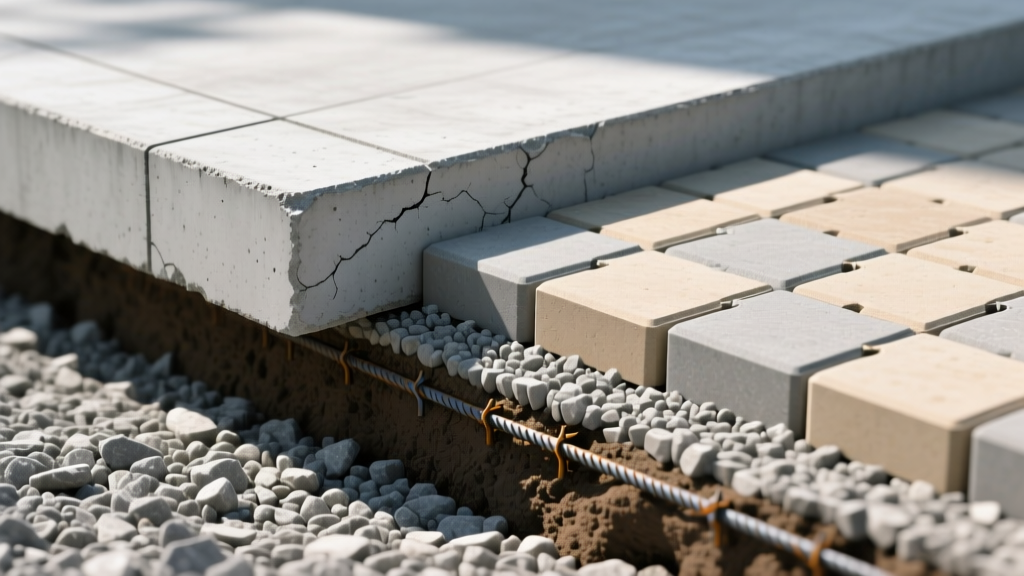
When evaluating concrete vs pavers pros and cons, most property owners focus exclusively on surface aesthetics or initial installation costs. However, from a materials engineering perspective, the true differentiator lies beneath the surface in the mix design, structural behavior, and load-transfer mechanisms of each system. Poured concrete relies on monolithic slab action and tensile reinforcement, while interlocking concrete pavers utilize segmental flexural strength and aggregate interlock. Understanding these material science fundamentals is critical for specifying the right pavement for specific soil conditions, freeze-thaw cycles, and load requirements.
The Material Science: Poured Concrete Mix Designs vs. Paver Composition
The fundamental difference between a poured slab and a paver system begins at the batch plant. Poured concrete for residential and light-commercial driveways is typically specified as a wet-cast, plastic mix. To achieve the necessary durability, a standard driveway mix requires a minimum compressive strength of 4,000 PSI, a maximum water-cement (w/c) ratio of 0.45, and 3/4-inch crushed aggregate. In climates subject to freezing temperatures, the mix must also include 4% to 6% air-entrainment to create microscopic voids that allow expanding ice to dissipate without spalling the surface, a critical durability factor detailed by the Portland Cement Association.
Conversely, concrete pavers are manufactured using a completely different process. They are dry-cast using a zero-slump concrete mixture with very low water content and fine aggregates (typically passing a 3/8-inch sieve). This mixture is vibrated and compressed under extreme hydraulic pressure in steel molds. The result is a highly dense unit that routinely exceeds 8,000 PSI in compressive strength and meets the rigorous absorption and freeze-thaw requirements of ASTM C936 standards as overseen by the National Concrete Masonry Association (NCMA).
Concrete vs Pavers Pros and Cons: A Structural Comparison Matrix
| Engineering Feature | Poured Concrete (Monolithic) | Interlocking Pavers (Segmental) |
|---|---|---|
| Compressive Strength | 4,000 - 5,000 PSI | 8,000 - 10,000+ PSI |
| Load Transfer Mechanism | Slab bending / Tensile reinforcement | Aggregate interlock / Lateral confinement |
| Flexibility & Settlement | Rigid; cracks if subgrade shifts | Flexible; shifts uniformly without cracking |
| Permeability Options | Limited (requires specific porous mix) | High (permeable joint aggregates available) |
| Curing Time to Traffic | 7 days (minimum for vehicles) | Immediate (no curing required on-site) |
Poured Concrete: Strengths, Weaknesses, and Edge Cases
A monolithic concrete slab distributes vehicular loads across a wide area through beam action. When properly thickened at the edges and reinforced, it handles heavy static loads exceptionally well.
The Inevitability of Cracking
The primary structural vulnerability of poured concrete is its low tensile strength. As the slab cures, it undergoes volumetric shrinkage. Even with control joints cut at 10-foot intervals, thermal expansion and subgrade settlement will eventually induce cracking. Wire mesh (typically 6x6 W1.4xW1.4) does not prevent cracking; it merely holds the cracks tightly together. For true crack mitigation, macro-synthetic fibers (dosed at 3 to 5 lbs per cubic yard) or #4 rebar spaced at 18 inches on center are required.
A 4-inch concrete slab is only as strong as the soil beneath it. In expansive clay soils, a minimum 4-inch base of compacted, crushed angular aggregate (ASTM D2940) is mandatory. Rounded river gravel should never be used as a base, as it lacks the mechanical interlock required to prevent lateral shifting under load.
When Poured Concrete Excels
- Heavy Static Loads: Ideal for RV pads or areas where heavy truck traffic will remain stationary for long periods.
- Smooth Surface Requirements: Necessary for wheelchair ramps, basketball courts, or areas requiring a seamless finish.
- Budget Constraints: Standard broom-finish poured concrete remains the most cost-effective hardscape option per square foot.
Interlocking Pavers: The Flexural Advantage
Interlocking concrete pavers do not rely on the bending strength of the individual unit. Instead, they function as a flexible composite mat. The load from a vehicle tire is transferred laterally through the joint sand to adjacent pavers, distributing the stress over a much wider area of the base material. This phenomenon, known as interlock, is what allows a relatively thin (2 3/8-inch) paver to support massive loads without fracturing.
'The structural capacity of a paver pavement is derived not from the concrete units themselves, but from the confinement provided by the edge restraints and the shear resistance of the jointing sand. Without proper edge restraint, the system will unravel under traffic.' — Interlocking Concrete Pavement Institute (ICPI) Technical Guidelines.
Dry-Cast vs. Wet-Cast Pavers
Not all pavers are manufactured equally. Dry-cast pavers (the industry standard for driveways) are machine-vibrated and possess high compressive strength but a slightly rougher texture. Wet-cast pavers are poured into molds like traditional concrete, yielding a smoother, more architectural finish (often mimicking natural stone). However, wet-cast pavers generally have lower compressive strength (around 5,000 - 6,000 PSI) and are more susceptible to surface scaling in freeze-thaw climates if not properly sealed.
When Pavers Excel
- Expansive or Unstable Soils: The flexible nature of segmental paving allows the surface to heave and settle uniformly without catastrophic cracking.
- Utility Access: Pavers can be unzipped and reinstalled seamlessly to access underground plumbing or electrical lines.
- Permeability Requirements: Permeable interlocking concrete pavement (PICP) systems use open-graded aggregates in the joints to manage stormwater runoff directly into the subgrade.
Cost Breakdown: Initial vs. Lifecycle (2026 Pricing)
While initial installation costs heavily favor poured concrete, the lifecycle cost analysis often narrows the gap when factoring in maintenance and repairs over a 30-year horizon.
Poured Concrete
Initial Cost: $8.00 - $14.00 / sq. ft.
Sealing/Maintenance: $0.15 / sq. ft. every 3 years.
Repair Cost: High. Slab replacement or visible patching required for structural cracks.
Concrete Pavers
Initial Cost: $16.00 - $28.00 / sq. ft.
Joint Sand/Sealing: $0.50 / sq. ft. every 5-7 years.
Repair Cost: Near zero. Individual units can be swapped out invisibly.
Decision Framework: Which Material Fits Your Site?
Use the following engineering and site-specific parameters to make your final material selection:
- IF your site has highly expansive clay soil and you cannot afford deep excavation and engineered fill, THEN choose interlocking pavers. The flexible matrix will accommodate minor seasonal heaving without visual degradation.
- IF the project requires strict ADA compliance, zero-trip-hazard tolerances, or smooth rolling surfaces for heavy carts, THEN choose poured concrete with a hard-trowel finish.
- IF local municipal codes mandate strict stormwater retention and you have limited space for retention ponds, THEN specify a Permeable Interlocking Concrete Pavement (PICP) system with an open-graded crushed stone reservoir base.
- IF the budget is strictly capped and the subgrade consists of stable, well-draining sandy loam, THEN a 4,000 PSI air-entrained poured concrete slab with saw-cut control joints is the most economically viable choice.
Frequently Asked Questions
Can I install pavers directly over an existing cracked concrete driveway?
Yes, this is known as an overlay application. However, the existing slab must be structurally sound (no heaving or severe vertical displacement). You must use a coarse, sharp concrete sand bedding layer (minimum 1 inch) and ensure the added height does not interfere with garage doors or drainage slopes. Edge restraints must be anchored directly into the existing concrete slab using concrete wedge anchors.
Does stamped concrete perform as well as standard broom-finish concrete?
Structurally, yes, provided the base mix design remains at 4,000 PSI with proper air-entrainment. However, the addition of color hardeners and antiquing release agents can alter the surface porosity. Stamped concrete requires more frequent application of acrylic sealers (every 1-2 years) to prevent UV fading and surface wear, increasing long-term maintenance compared to a standard broom finish.
What is the most critical failure point for paver driveways?
Edge restraint failure. If the perimeter restraints (typically heavy-duty plastic or poured concrete curbing) shift or break, the pavers lose their lateral confinement. This breaks the interlock, allowing the units to spread apart under vehicular turning forces, which subsequently washes out the joint sand and leads to localized settling.
Written by
Elena RodriguezElena Rodriguez is a civil engineer and technical writer specializing in concrete technology, masonry systems, and ASTM/ACI compliance. She earned her B.S. in Civil Engineering from Texas A&M University and spent a decade at a materials testing laboratory, performing over 2,000 concrete compressive strength tests and masonry prism evaluations. Elena is an ACI-certified Field Testing Technician (Grade I) and a member of ASTM Committee C12 on Natural Building Stone. She currently consults on forensic engineering cases involving concrete failures and moisture intrusion. Based in San Antonio, TX, Elena is a proud member of the Society of Women Engineers (SWE) and coaches her daughter's FIRST Robotics team.
More from Elena Rodriguez
View all
Walls & Panels
Cost Analysis: Light Gauge Steel Framing Advantages and Disadvantages
Evaluate light gauge steel framing advantages and disadvantages through a strict cost analysis lens, comparing material, labor, and lifecycle expenses.
Aug 4, 2026

Walls & Panels
Gypsum Board Types: Exact Specifications, Thickness & Dimensions
Compare standard, Type X, and moisture-resistant gypsum board types. Get exact specifications, thicknesses, dimensions, and ASTM standards for your project.
Aug 4, 2026

Fire Resistance
Best Fire-Resistant Outdoor Decking Materials: 2026 Buyer Guide
Discover the best fire-resistant outdoor decking materials for 2026. Compare Class A PVC, aluminum, and hardwood options for WUI compliance and safety.
Aug 4, 2026