Water Based vs Acid Based Concrete Stain: 2026 Cost Breakdown
Compare the 2026 installed costs of water based vs acid based concrete stain. Analyze material, labor, prep, and long-term maintenance expenses.

The True Cost of Concrete Staining: Beyond the Gallon Price
When evaluating water based vs acid based concrete stain, contractors and property owners frequently make the mistake of comparing only the retail price per gallon. This superficial metric obscures the actual financial impact of the project. In 2026, the total installed cost of decorative concrete is dictated by surface preparation requirements, application labor, chemical neutralization, and long-term UV maintenance. Acid stains rely on a chemical reaction with calcium hydroxide in the concrete to create translucent, mottled effects, while water-based stains utilize penetrating acrylics and polymers to deposit consistent, UV-stable pigments. Understanding the granular cost breakdown of these two distinct chemical pathways is critical for accurate budgeting and preventing mid-project change orders.
2026 Quick Cost Snapshot (Per Square Foot)
- Acid Stain Total Installed: $4.50 – $8.00 / sq. ft.
- Water-Based Stain Total Installed: $3.25 – $6.50 / sq. ft.
- Primary Cost Driver (Acid): Labor-intensive neutralization and multi-day washing phases.
- Primary Cost Driver (Water-Based): Higher material cost per gallon and stringent moisture-vapor prep.
Material Costs: Chemical Reactions vs. Penetrating Pigments
The raw material costs for both staining systems are surprisingly similar on a per-square-foot basis, though the purchasing dynamics differ. Acid stains are highly concentrated and require on-site dilution, whereas water-based stains are typically sold as ready-to-use or lightly reducible formulations.
Acid Stain Formulations
Premium acid stains, such as Kemiko Stone Tone or Scofield Formula One, typically retail between $45 and $65 per gallon in 2026. Because these are concentrated metallic salts (iron chloride, copper sulfate, zinc sulfate) suspended in mild hydrochloric acid, they must be diluted with water at ratios ranging from 1:1 to 1:4, depending on the desired color intensity. At a standard 1:2 dilution, one gallon of concentrate yields three gallons of working solution, covering approximately 600 to 900 square feet. This drives the material cost down to $0.08 – $0.15 per square foot. However, acid staining requires the purchase of neutralizing agents (like sodium bicarbonate or specialized alkaline cleaners), which adds roughly $0.04 per square foot to the material ledger.
Water-Based Acrylic and Polymer Stains
Water-based penetrating stains, such as Direct Colors EverStain or Ghostshield architectural lines, rely on nano-sized acrylic polymers to carry inorganic pigments into the concrete pores. These products generally cost $55 to $85 per gallon and are not heavily diluted. Coverage rates average 250 to 400 square feet per gallon depending on the concrete's porosity. Consequently, the material cost sits higher at $0.18 – $0.35 per square foot. While the upfront chemical cost is double that of acid, water-based stains eliminate the need for neutralizing chemicals and heavy-duty wet-vacuuming equipment rentals.
Labor and Preparation: Where the Budget Actually Breaks
According to the Concrete Network, surface preparation accounts for up to 60% of a decorative concrete project's labor budget. Both systems require a clean, open-pore surface (typically a CSP 1 or CSP 2 profile as defined by the International Concrete Repair Institute), but the application and post-application labor diverge drastically.
| Project Phase | Acid Stain Labor Impact | Water-Based Stain Labor Impact |
|---|---|---|
| Surface Prep | Mechanical grinding or light shot-blasting. Must remove all cure-and-seals. ($0.75 - $1.50/sq ft) | Diamond grinding preferred. Must test for moisture vapor transmission (MVT). ($0.75 - $1.50/sq ft) |
| Application | Pump sprayer application, back-rolling, and working the stain into the pores. ($0.50 - $0.80/sq ft) | HVLP sprayer or microfiber applicator. Fast, even application. ($0.40 - $0.60/sq ft) |
| Post-Application | CRITICAL: Neutralization, scrubbing, and wet-vacuuming residue. Requires 2-3 passes. ($1.25 - $2.00/sq ft) | None required. Allow to dry for 2-4 hours before sealing. ($0.00/sq ft) |
| Total Labor Cost | $2.50 – $4.30 / sq. ft. | $1.15 – $2.10 / sq. ft. |
The neutralization phase of acid staining is a massive cost center. If the acidic residue is not completely neutralized and extracted, it will continue to etch the concrete and will eventually cause the protective topcoat sealer to delaminate or turn milky white. This mandatory wet-vacuuming and rinsing cycle adds a full day of labor to a standard commercial project, a cost entirely absent in water-based applications.
Hidden Costs: Sealing and Environmental Compliance
Neither acid nor water-based stains provide a protective wear layer; they are purely decorative penetrants. Both require a high-quality sealer, but the compatibility requirements differ. Acid-stained concrete must be completely bone-dry and free of alkaline salts before sealing. If moisture is trapped, solvent-based acrylics will blush (turn white). Water-based stains, being vapor-permeable, allow for a broader range of breathable sealers, such as silane-siloxane water repellents or penetrating lithium densifiers.
In 2026, stringent Volatile Organic Compound (VOC) regulations, particularly in regions governed by the SCAQMD (South Coast Air Quality Management District) and similar environmental bodies, have pushed the cost of compliant solvent-based sealers up by 15-20%. Many commercial contractors are defaulting to high-solids, water-based polyurethanes or polyaspartic topcoats. Expect to budget $0.40 to $0.90 per square foot for a commercial-grade UV-stable sealer, regardless of the stain type used beneath it.
Long-Term ROI: UV Stability and Maintenance Cycles
The initial installation cost is only half of the financial equation. The Portland Cement Association emphasizes that surface treatments must be matched to their environmental exposure to ensure durability. Acid stains are chemically bonded to the concrete and are inherently UV stable; the metallic oxides will not fade in direct sunlight. However, the sealer over the acid stain will degrade. Water-based stains utilize inorganic iron-oxide pigments that are also highly UV resistant, but cheaper organic pigment variants will chalk and fade within 24 months in exterior applications.
Maintenance Cost Projection (10-Year Horizon)
Exterior Patio (1,000 sq. ft.):
- Acid Stain + Solvent Acrylic Sealer: Requires resealing every 1-2 years. 10-year maintenance cost: $2,500 - $4,000.
- Water-Based Stain + Polyaspartic Topcoat: Requires resealing every 5-7 years. 10-year maintenance cost: $1,200 - $1,800.
While water-based stains paired with advanced polyaspartic sealers carry a higher day-one cost, they frequently yield a superior 10-year ROI for exterior applications due to drastically reduced maintenance cycles.
Common Application Failures and Costly Fixes
Understanding failure modes prevents catastrophic budget overruns. The most expensive mistake in decorative concrete is attempting to use acid stain on modern concrete mixes that incorporate high volumes of fly ash or slag.
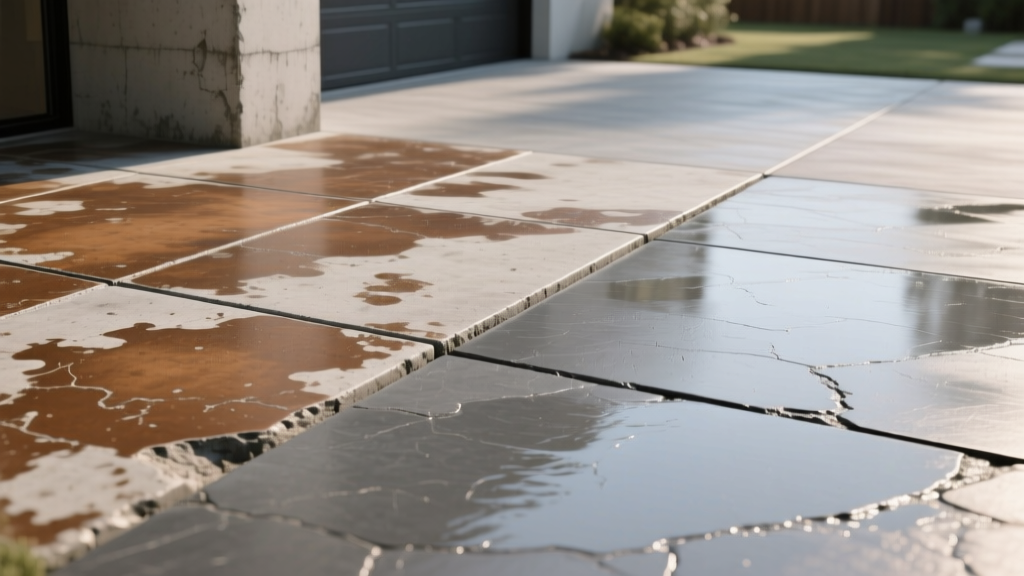
- The Fly Ash Failure (Acid Stain): Type F fly ash consumes calcium hydroxide during the hydration process. Because acid stains require calcium hydroxide to trigger the color-changing chemical reaction, concrete with high fly ash content will result in a weak, washed-out, or entirely non-existent color. The Fix: The contractor must pivot to a water-based penetrating stain, but only after the failed acid has been neutralized and the surface re-profiled, adding $2.00+ per square foot in rework costs.
- Moisture Vapor Blushing (Water-Based Stain): If a water-based stain is applied to a slab with a high Moisture Vapor Emission Rate (MVER) without a proper densifier or vapor-barrier primer, the hydrostatic pressure will push the acrylic polymers back to the surface, creating a sticky, white, blistered mess. The Fix: Complete mechanical removal via shot-blasting and reapplication, often costing more than the original installation.
Decision Framework: Which System Should You Specify?
Use this practical matrix to determine the most cost-effective and aesthetically appropriate system for your specific 2026 project parameters:
- Choose Acid Stain If: You are working on an interior slab (retail, residential floors), the concrete is a traditional Portland cement mix with low fly-ash content, and the client specifically demands a variegated, antique, marble-like aesthetic with natural color variations.
- Choose Water-Based Stain If: You are staining exterior concrete (driveways, pool decks) where UV consistency is paramount, the concrete mix contains high percentages of fly ash or slag, the project timeline is compressed and cannot accommodate 24-hour neutralization/drying phases, or local VOC regulations restrict the use of the solvents required for acid-stain cleanup and sealing.
By analyzing the total lifecycle cost—including preparation, labor-intensive neutralization, environmental compliance, and long-term sealing—rather than just the per-gallon material price, specifiers can accurately forecast budgets and select the optimal chemical pathway for their concrete surfaces. For further technical data on surface profiling and stain compatibility, consult the Concrete Network's technical guides on decorative concrete maintenance.
Written by
David NakamuraDavid Nakamura is a licensed architect (AIA) and construction technology writer focused on sustainable building methods, mass timber engineering, and high-performance building envelopes. He holds a Master of Architecture from the University of Washington and is a certified Passive House Consultant (CPHC). David spent eight years at the Seattle firm Mithun, where he led the design of three LEED Platinum projects, before founding his own practice specializing in net-zero residential design. He serves on the editorial advisory board of GreenBuilder Magazine and has authored peer-reviewed papers on cross-laminated timber (CLT) connections for the Journal of Structural Engineering. In his spare time, David teaches woodworking at Pratt Fine Arts Center and kayaks the Puget Sound.
More from David Nakamura
View all
Construction Cost
Labor Cost to Build a Deck Per Sq Ft: 2026 Installation Guide
Discover the exact labor cost to build a deck per sq ft in 2026. This installation guide breaks down contractor rates, complexity factors, and hidden fees.
Aug 4, 2026

Construction Cost
How Much Does It Cost to Build a 3 Bedroom House? Financing Guide
Learn exactly how much it costs to build a 3 bedroom house and explore 2026 financing options, construction loan types, and budget frameworks for your build.
Aug 4, 2026

Construction Cost
Cost to Build a Tennis Court: 2026 Guide
How much does it cost to build a tennis court in 2026? Breakdowns for asphalt, concrete, and synthetic surfaces plus fencing and lighting.
Jul 30, 2026