What Type of Rock Is Concrete? Comparing It to Natural Stone
Discover what type of rock concrete actually is and compare its strength, cost, and durability against natural stone alternatives for your next project.

The Geological Misconception: Is Concrete a Rock?
When homeowners and junior builders ask, 'what type of rock is concrete,' the answer requires a fundamental correction in material science. Concrete is not a rock in the geological sense; it is a synthetic composite material. Geologically, rocks are classified into three categories—igneous, sedimentary, and metamorphic—formed by natural processes over millennia. Concrete, however, is an artificial conglomerate manufactured through the chemical hydration of Portland cement, water, and mineral aggregates.
The confusion arises because concrete visually and physically mimics natural sedimentary conglomerates. In fact, the 'rock' you see in a concrete slab is the aggregate—typically crushed limestone, granite, or river gravel—bound together by a cementitious paste. According to the Portland Cement Association, the cement paste accounts for only 10% to 15% of the concrete mix by volume, while the aggregate (the actual rock) makes up 60% to 75%. Therefore, concrete is not a type of rock itself, but rather a human-engineered matrix that suspends natural rock fragments in a hardened chemical binder.
Material Science Matrix: Synthetic vs. Geological
When evaluating concrete against natural stone alternatives for paving, structural walls, or architectural facades, you are comparing a customizable composite against a fixed geological product. Below is a direct comparison of standard structural concrete versus three common natural stone alternatives used in construction.
| Material | Compressive Strength (PSI) | Water Absorption Rate | Mohs Hardness |
|---|---|---|---|
| Standard Concrete (4,000 PSI Mix) | 4,000 - 5,000 | 5% - 8% | 5 - 6 (Aggregate dependent) |
| Granite (Igneous) | 19,000 - 28,000 | < 0.5% | 6 - 7 |
| Limestone (Sedimentary) | 5,000 - 10,000 | 2% - 12% | 3 - 4 |
| Basalt (Igneous) | 20,000 - 35,000 | 0.5% - 1.5% | 6 |
Compressive Strength and Load-Bearing Limits
The data from the Natural Stone Institute highlights a massive disparity in compressive strength. Natural granite and basalt are formed under immense tectonic pressure and heat, resulting in crystalline structures that can withstand up to 35,000 PSI. Standard residential concrete, cured for 28 days, typically reaches 3,000 to 4,000 PSI. While high-performance concrete (HPC) mixes utilizing silica fume and superplasticizers can achieve 10,000 to 15,000 PSI, they remain vastly inferior to solid igneous rock in pure compression. However, concrete's true structural advantage emerges when it is reinforced with steel rebar, granting it tensile strength that natural stone completely lacks.
Porosity, Sealing, and Weather Resistance
Water absorption is the primary driver of freeze-thaw degradation in hardscaping. Because concrete is a porous network of capillary tubes left behind by evaporating mix water, it readily absorbs moisture. If water penetrates a concrete slab and freezes, the 9% volumetric expansion of the ice causes spalling and micro-cracking. Dense natural stones like granite absorb virtually no water, making them highly resistant to freeze-thaw cycles without the need for chemical sealers. Conversely, highly porous stones like sandstone or certain limestones can absorb more water than standard concrete, making them poor choices for driveways in northern climates.
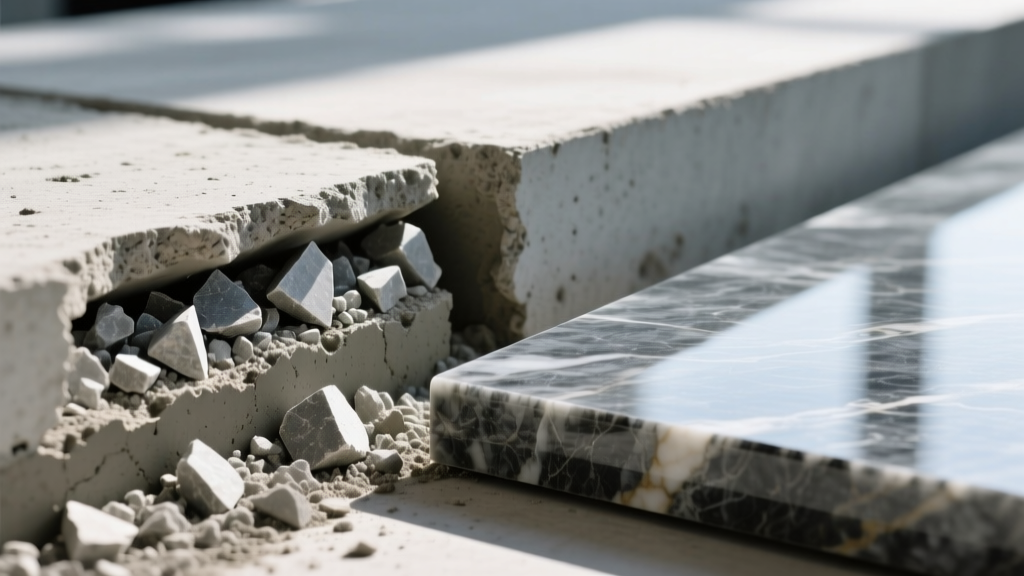
Cost Breakdown: Poured Concrete vs. Natural Rock Alternatives
Financial feasibility often dictates the choice between synthetic concrete and natural stone. The pricing below reflects 2026 installed costs for residential hardscaping, including base preparation (excavation, compacted gravel sub-base), materials, and labor.
- Standard Broom-Finish Concrete (4-inch slab): $8.00 – $12.00 per square foot.
- Stamped/Decorative Concrete (mimicking stone): $14.00 – $22.00 per square foot.
- Natural Flagstone (Sedimentary, irregular cuts): $18.00 – $28.00 per square foot.
- Granite Pavers (Igneous, precision cut): $30.00 – $45.00 per square foot.
- Bluestone Treads and Coping: $35.00 – $50.00 per linear foot.
Application Decision Framework: When to Use Which?
Choosing between concrete and natural stone requires matching the material's physical properties to the specific environmental and mechanical demands of the project.
1. Vehicular Driveways and Heavy Load Zones
Winner: Reinforced Concrete. Natural stone pavers set in sand or mortar are prone to shifting under the dynamic shear forces of vehicle tires, particularly during turning maneuvers. Poured concrete, reinforced with a #4 rebar grid at 18-inch centers, distributes point loads across a monolithic slab. Furthermore, snow plows will catch the uneven joints of natural flagstone, whereas a smooth broom-finish or exposed-aggregate concrete slab allows for seamless plow operations.
2. High-End Patios and Pool Decks
Winner: Natural Stone (specifically Bluestone or Travertine). Concrete is highly susceptible to efflorescence—a white, powdery salt deposit that migrates to the surface as moisture evaporates. While sealers can mitigate this, natural stone does not suffer from cementitious salt migration. Additionally, natural stone stays significantly cooler under direct sunlight than standard gray concrete, making travertine or light-colored limestone the superior choice for barefoot pool decks.
3. Retaining Walls and Structural Veneers
Winner: Hybrid Approach. For structural retaining walls exceeding 4 feet in height, engineered poured concrete or reinforced CMU (concrete masonry units) are mandatory to resist lateral earth pressure. However, for the aesthetic finish, a natural stone veneer applied over the concrete structural core provides the geological beauty of solid rock with the engineered load-bearing capacity of synthetic concrete.
Environmental Impact and Lifecycle Comparisons
The environmental footprint of these materials differs drastically in their production and end-of-life phases. The production of Portland cement is highly carbon-intensive, accounting for roughly 8% of global CO2 emissions due to the calcination of limestone and the extreme heat required in kilns. Conversely, natural stone requires no chemical alteration; its carbon footprint is limited to the diesel fuel used in quarrying, cutting, and transportation.
However, concrete's lifecycle offers a distinct advantage in recyclability. According to data tracked by the United States Geological Survey, millions of tons of old concrete are crushed annually and reused as recycled concrete aggregate (RCA) for new road bases and sub-layers. Natural stone, while entirely inert and non-toxic, is rarely recycled at an industrial scale due to the bespoke cutting and shaping required for architectural use, often ending up as fill dirt when demolished.
Maintenance Realities: Long-Term Upkeep
The long-term maintenance profiles of concrete and natural stone dictate their total cost of ownership over a 30-year lifespan.
- Concrete Sealing: Requires application of a penetrating silane/siloxane sealer every 2 to 4 years to prevent water ingress and chloride ion penetration (which rusts internal rebar). Cost: $0.25 – $0.50 per square foot per application.
- Concrete Crack Repair: Control joints will inevitably crack. Routing and sealing cracks with polyurethane caulk is required every 5 to 10 years to prevent water from undermining the sub-base.
- Natural Stone Sealing: Dense igneous stones (granite, basalt) rarely require sealing. Calcareous stones (limestone, marble, travertine) must be sealed with an impregnating fluoropolymer sealer to prevent acid etching from rain or organic debris. Cost: $0.75 – $1.20 per square foot.
- Stone Joint Maintenance: Mortared stone joints will degrade and require repointing every 15 to 20 years. Dry-laid stone requires periodic sweeping of polymeric sand into the joints to prevent weed growth and ant infestations.
Ultimately, while concrete is not a geological rock, it remains the most versatile, cost-effective, and structurally adaptable 'synthetic rock' available in modern construction. Natural stone offers unmatched geological permanence and aesthetic superiority, but demands a premium budget and specific environmental conditions to justify the investment.
Written by
Marcus ChenMarcus Chen is a licensed structural engineer (PE) and building materials analyst with over 12 years of experience across residential, commercial, and industrial construction. He holds a Master of Science in Civil Engineering from UC Berkeley and spent six years at Thornton Tomasetti before transitioning to independent consulting and technical writing. Marcus specializes in material selection for seismic-prone regions, concrete reinforcement strategies, and lifecycle cost analysis. His work has been cited by the American Concrete Institute (ACI) and the Structural Engineers Association of California (SEAOC). When he is not on a job site or at his desk, you will find him hiking the Sierra Nevada or restoring a 1920s craftsman bungalow in Oakland, CA.
More from Marcus Chen
View all
Construction Cost
How Much Did the Eiffel Tower Cost to Build?
How much did the Eiffel Tower cost to build in 1889? We adjust for inflation and compare its budget to modern skyscraper construction.
Aug 4, 2026

Fire Resistance
What Is a Fire Resistant Material? Testing & Certification Guide
Discover what is a fire resistant material through ASTM and UL testing. Learn how fire ratings, certifications, and assemblies work in construction.
Aug 4, 2026

Construction Cost
How Much Did the Burj Khalifa Cost to Build?
How much did the Burj Khalifa cost to build? We break down the $1.5B project and extract 5 money-saving strategies for your next build.
Jul 30, 2026