Stone vs Concrete Paving: Durability, Cost, and Installation Guide
Compare stone vs concrete paving for patios and driveways. Explore material costs, durability, ASTM standards, and installation tips to choose the best option.

Material Composition and Engineering Origins
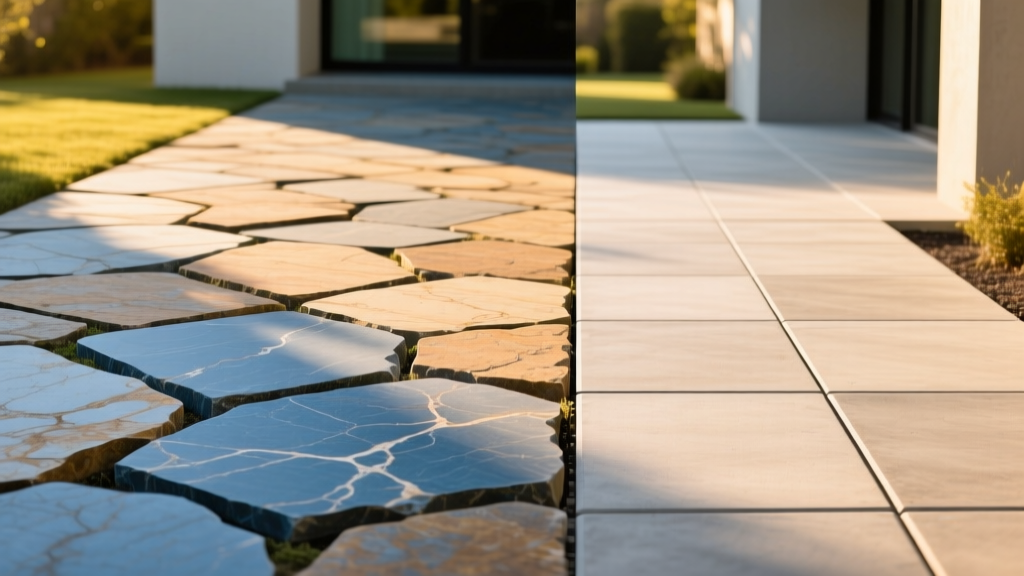
Selecting between natural stone and manufactured concrete for hardscaping dictates the structural longevity, aesthetic trajectory, and maintenance lifecycle of the project. The fundamental difference lies in their origins. Natural stone—such as bluestone, flagstone, granite, and limestone—is quarried from the earth and processed via thermal finishing, clefting, or honing. Its density, porosity, and compressive strength are dictated by geological formation. Concrete pavers, conversely, are engineered products. They are manufactured using a precise ratio of Portland cement, graded aggregates, and iron-oxide pigments, then vibro-compacted under high pressure to achieve uniform structural properties.
When evaluating stone vs concrete for load-bearing applications like driveways, the predictability of the material is paramount. Manufactured concrete pavers offer consistent dimensions and engineered interlocking capabilities, whereas natural stone requires meticulous sorting and custom cutting to achieve structural cohesion.
Comprehensive Cost Matrix
Pricing for hardscape materials extends far beyond the cost per square foot of the surface unit. A proper evaluation must account for subgrade preparation, bedding materials, and specialized labor. Below is a detailed cost breakdown for standard residential installations.
| Cost Category | Concrete Pavers | Natural Stone (Bluestone/Granite) |
|---|---|---|
| Material Cost (per sq. ft.) | $4.00 - $8.50 | $14.00 - $28.00 |
| Base Aggregate & Geotextile | $2.50 - $3.50 | $3.00 - $4.50 |
| Bedding Sand & Jointing | $0.75 - $1.25 | $1.00 - $2.00 |
| Installation Labor | $5.00 - $9.00 | $12.00 - $22.00 |
| Total Installed Cost | $12.25 - $22.25 | $30.00 - $56.50 |
Note: Natural stone labor costs are significantly higher due to the irregular thickness of cleft stone, which requires masons to individually grade and shim each piece to maintain a level surface plane.
Structural Performance and ASTM Standards
Durability in hardscaping is not subjective; it is governed by strict materials testing. For concrete pavers, the governing standard is ASTM C936. This specification mandates a minimum compressive strength of 8,000 PSI and a maximum water absorption rate of 5%. This extreme density is what allows concrete pavers to withstand the dynamic shear forces of vehicular traffic without cracking.
Natural stone does not have a single universal PSI standard, as its strength varies wildly by geology. Granite routinely exceeds 15,000 PSI and possesses near-zero water absorption, making it virtually indestructible in freeze-thaw climates. Conversely, porous sandstones and some limestones can absorb up to 10% of their weight in water. When this trapped moisture freezes and expands, it causes spalling and delamination—a catastrophic failure mode where the top layers of the stone flake away.
Decision Framework: Which Material Fits Your Site?
- Heavy Vehicular Loads (Driveways, Fire Lanes): Choose interlocking concrete pavers. Their uniform thickness and structural interlock distribute point loads across the entire subgrade, preventing differential settlement.
- High-End Aesthetics & Shaded Gardens: Choose natural cleft bluestone or flagstone. The organic color variations and irregular joints blend seamlessly with natural landscaping.
- Severe Freeze-Thaw Climates: Choose ASTM C936 compliant concrete or high-density granite. Avoid sandstone, limestone, and slate unless heavily sealed and installed on a fully drained, elevated base.
- Pool Coping and Wet Environments: Choose thermally finished natural stone. Concrete pavers can become slick and are prone to efflorescence (white salt deposits) when constantly exposed to pool chemicals and splash-out.
Subgrade Engineering and Installation Nuances
The most common cause of hardscape failure is not the surface material, but the subgrade beneath it. Both stone and concrete require a meticulously engineered base, but the execution differs slightly.
Base Preparation and Geotextiles
According to the Interlocking Concrete Pavement Institute (ICPI), a standard pedestrian patio requires a minimum of 4 to 6 inches of compacted crushed angular aggregate (ASTM D2940). For driveways, this increases to 10 to 12 inches. Crucially, a non-woven geotextile separation fabric (such as Mirafi 500X) must be laid over the native soil before the aggregate is applied. This prevents the base rock from migrating down into the clay subgrade and stops fine soil particles from pumping up into the drainage layer.
Bedding and Jointing Mechanics
Concrete pavers are laid on a 1-inch layer of ASTM C33 washed concrete sand. This sand must be screeded perfectly flat and never compacted before the pavers are placed. Once the pavers are laid, a vibratory plate compactor drives them into the bedding sand, creating a tight, uniform lock. Joints are then filled with polymeric sand, which hardens upon water activation to prevent weed growth and insect infiltration.
Natural stone, particularly irregular flagstone, often requires a different approach. While some masons use a traditional sand-set method, high-end stone installations frequently utilize a permeable mortar bed or a specialized open-graded base with specialized jointing compounds to accommodate the varying thicknesses of the stone without compromising drainage.
Long-Term Maintenance and Chemical Sealers
The maintenance profiles of stone and concrete diverge significantly after installation.
- Concrete Efflorescence: Manufactured concrete contains calcium hydroxide, which can migrate to the surface and react with carbon dioxide to form a white, powdery residue known as efflorescence. While harmless, it is aesthetically displeasing. It is typically treated with a specialized efflorescence cleaner and prevented long-term by applying a breathable, solvent-based acrylic sealer (e.g., SureBond SB-6000) every 3 to 5 years.
- Stone Sealing Requirements: Natural stone must be sealed to prevent oil and organic stains, but the wrong sealer will ruin the material. Film-forming sealers trap moisture inside the stone, leading to subsurface spalling. The Natural Stone Institute recommends using penetrating silane/siloxane sealers (such as Tenax Akeem). These sealers line the microscopic pores of the stone, repelling liquid water while allowing water vapor to escape, preserving the natural cleft texture without creating an artificial gloss.
Environmental Permeability and Runoff Management
Modern municipal codes increasingly mandate permeable hardscaping to manage stormwater runoff and reduce the burden on municipal sewer systems. Both stone and concrete can be installed as permeable surfaces, but the methodology differs.
Permeable concrete pavers (PICP) are specifically designed with wider joint gaps and are installed over a base of clean, washed, open-graded crushed stone (ASTM No. 57 and No. 8). This creates a subterranean reservoir that temporarily stores stormwater, allowing it to infiltrate the native soil slowly. Natural stone can mimic this effect if installed with wide, gravel-filled joints over a similar open-graded base, though it lacks the engineered structural interlock of PICP systems, making it less suitable for high-traffic permeable driveways.
Final Verdict on Material Selection
There is no universally superior material; the choice between stone and concrete hinges on the specific engineering demands and aesthetic goals of the site. Concrete pavers provide unmatched structural predictability, lower lifetime costs, and superior load-bearing capabilities for vehicular zones. Natural stone offers an irreplaceable, timeless aesthetic and geological permanence, provided the specific stone type is matched correctly to the local climate and the budget accommodates the premium installation labor.
Written by
David NakamuraDavid Nakamura is a licensed architect (AIA) and construction technology writer focused on sustainable building methods, mass timber engineering, and high-performance building envelopes. He holds a Master of Architecture from the University of Washington and is a certified Passive House Consultant (CPHC). David spent eight years at the Seattle firm Mithun, where he led the design of three LEED Platinum projects, before founding his own practice specializing in net-zero residential design. He serves on the editorial advisory board of GreenBuilder Magazine and has authored peer-reviewed papers on cross-laminated timber (CLT) connections for the Journal of Structural Engineering. In his spare time, David teaches woodworking at Pratt Fine Arts Center and kayaks the Puget Sound.
More from David Nakamura
View all
Construction Cost
Labor Cost to Build a Deck Per Sq Ft: 2026 Installation Guide
Discover the exact labor cost to build a deck per sq ft in 2026. This installation guide breaks down contractor rates, complexity factors, and hidden fees.
Aug 4, 2026

Construction Cost
How Much Does It Cost to Build a 3 Bedroom House? Financing Guide
Learn exactly how much it costs to build a 3 bedroom house and explore 2026 financing options, construction loan types, and budget frameworks for your build.
Aug 4, 2026

Construction Cost
Cost to Build a Tennis Court: 2026 Guide
How much does it cost to build a tennis court in 2026? Breakdowns for asphalt, concrete, and synthetic surfaces plus fencing and lighting.
Jul 30, 2026