Types of Concrete Damage: Application Showcase and Repair Guide
Explore common types of concrete damage across driveways, foundations, and patios. Expert diagnostic matrix and advanced repair protocols.

The Application Showcase: How Damage Manifests in the Field
Concrete is engineered for immense compressive strength—typically 3,000 to 5,000 psi for residential flatwork and exceeding 10,000 psi for commercial structural elements. However, its inherent tensile weakness, combined with environmental exposure and improper curing, creates distinct failure modes. Understanding the specific types of concrete damage requires looking beyond textbook definitions and examining how these failures manifest in real-world applications.
Driveways and Flatwork: Scaling and Spalling
In exterior flatwork, particularly in freeze-thaw climates, scaling and spalling are the most prevalent types of concrete damage. Scaling presents as the localized flaking of the surface mortar, exposing the underlying aggregate. When this progresses deeper than 1/4 inch, it is classified as spalling.
- Root Cause: Inadequate air entrainment (target is 4% to 7% per ASTM C260) combined with the application of calcium chloride or magnesium chloride deicing salts during the first winter. The salts lower the freezing point of the pore water, creating immense osmotic and hydraulic pressures that exceed the tensile strength of the surface paste.
- Application Context: Frequently seen on residential driveways where homeowners apply aggressive ice melters before the concrete has achieved a full 28-day cure and proper surface densification.
Retaining Walls and Foundations: Efflorescence and Hydrostatic Cracking
Below-grade structures and retaining walls face constant moisture exposure. Efflorescence appears as a white, powdery deposit of calcium carbonate on the surface, while hydrostatic cracking manifests as horizontal or stair-step fractures.
- Root Cause: Efflorescence occurs when water dissolves calcium hydroxide within the concrete matrix and carries it to the surface, where it reacts with atmospheric carbon dioxide. Hydrostatic cracking is driven by lateral earth pressure and water buildup behind the wall when weep holes or French drains fail.
- Application Context: Poured basement foundations and segmental retaining walls where exterior waterproofing membranes have degraded or subsurface drainage was omitted.
Decorative Patios and Stamped Concrete: Delamination and Craze Cracking
Decorative concrete relies on surface integrity for aesthetic value. Delamination results in a hollow-sounding surface layer, while craze cracking creates a fine, shallow network of random fissures resembling alligator skin.
- Root Cause: Delamination is almost exclusively a finishing error. Hard troweling the surface too early traps bleed water and air voids just beneath the crust. Craze cracking is caused by rapid surface drying (plastic shrinkage) due to high wind or low humidity during the initial set.
- Application Context: Stamped patios and pool decks where contractors rush the finishing process to beat incoming weather or apply color hardeners improperly.
Diagnostic Matrix: Matching Damage to Root Cause
Accurate diagnosis prevents costly repair failures. Use this matrix to identify the specific types of concrete damage and their underlying triggers before selecting a repair protocol.
| Damage Type | Visual Symptom | Primary Root Cause | Typical Application Context |
|---|---|---|---|
| D-Cracking | Series of short cracks parallel to joints/edges | Freeze-thaw expansion of porous coarse aggregate | Municipal sidewalks, older highway pavements |
| Alkali-Silica Reaction (ASR) | Map cracking with gel exudation, expansion | Reactive silica in aggregate + high-alkali cement | Dams, bridge piers, marine structures |
| Plastic Shrinkage | Short, parallel diagonal cracks on surface | Rapid evaporation exceeding bleed rate | Large warehouse slabs, exterior flatwork |
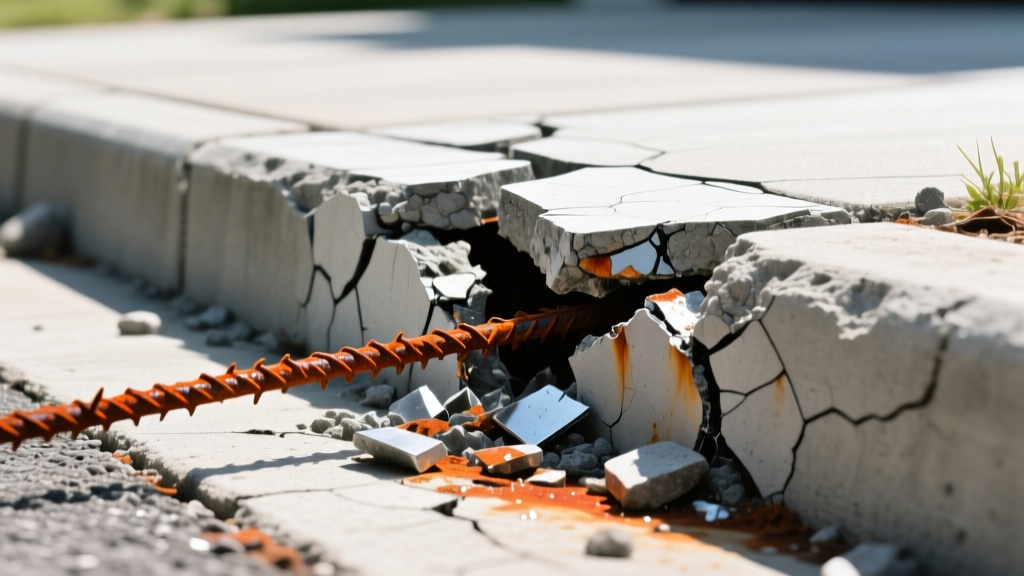
| Corrosion-Induced Spalling | Linear cracking along rebar, rust staining | Carbonation or chloride ingress reaching steel | Bridge decks, parking garages, balconies |
Advanced Repair Protocols for Specific Damage Profiles
Superficial patching fails when the root mechanics of the damage are ignored. The International Concrete Repair Institute (ICRI) emphasizes that surface preparation and material compatibility dictate repair longevity. Below are engineered protocols for the most common damage types.
Protocol A: Structural Crack Injection (Epoxy)
For active or dormant structural cracks in foundations and retaining walls where monolithic strength must be restored:
- Routing and Sealing: Route the crack to a depth of 1/4 inch and width of 1/2 inch using a diamond blade grinder. Clean with compressed air (ensure oil-free compressors).
- Port Installation: Bond surface injection ports every 6 to 8 inches using a fast-setting epoxy paste (e.g., Simpson Strong-Tie SET-XP or equivalent structural paste).
- Injection: Inject 100% solids, low-modulus epoxy from the lowest port upward until the resin purges from the adjacent port. Cap the purging port and move up.
- Cure and Grind: Allow 24-48 hours for full cure, then grind off the surface paste and ports.
Protocol B: Spall and Scale Repair (Polymer-Modified Mortar)
For driveway scaling and edge spalling where freeze-thaw resistance is mandatory:
- Substrate Preparation: Saw-cut the perimeter of the spall to a minimum depth of 1/2 inch to create a straight edge and prevent feather-edging. Chip out loose material down to sound concrete.
- Rebar Treatment: If reinforcing steel is exposed, mechanically clean to bright metal and apply a zinc-rich anti-corrosion primer.
- Bonding and Patching: Apply a polymer-modified mortar (PMM) with a minimum compressive strength of 5,000 psi at 28 days. Products like SikaTop Patch Plus or MasterEmaco S 488 provide the necessary freeze-thaw durability and low shrinkage.
- Curing: Wet-cure the patch for a minimum of 48 hours using saturated burlap to prevent plastic shrinkage of the repair mortar.
Preventative Engineering: Designing Out Failure Modes
The most cost-effective approach to the various types of concrete damage is eliminating them at the batching and placement stages. According to the Portland Cement Association (PCA), proper jointing and mix design mitigate 80% of non-structural cracking.
- Control Joint Spacing: For unreinforced slabs, control joints must be spaced at intervals of 24 to 36 times the slab thickness. A 4-inch driveway slab requires joints every 10 to 12 feet. Joints must be cut to a depth of 25% of the slab thickness within 4 to 12 hours of placement.
- Water-to-Cement (w/c) Ratio: Maintain a maximum w/c ratio of 0.45 for exterior flatwork exposed to deicing salts. Every 0.05 increase in the w/c ratio above 0.45 reduces the surface durability and freeze-thaw resistance exponentially.
- Subgrade Preparation: Ensure a uniformly compacted subgrade (minimum 95% Proctor density). Differential settlement is the primary driver of structural corner breaks and diagonal slab fractures.
Cost Implications: Proactive vs. Reactive Repair
Delaying intervention allows moisture and chlorides to accelerate degradation, shifting the project from a minor repair to a full-depth replacement. Below are current average commercial and residential pricing benchmarks for addressing concrete damage:
| Intervention Type | Average Cost | Expected Lifespan |
|---|---|---|
| Crack Routing and Polyurethane Sealing | $5.00 - $8.50 per linear foot | 5 - 8 years |
| Structural Epoxy Injection | $18.00 - $28.00 per linear foot | Permanent (Life of structure) |
| Polymer-Modified Mortar Spall Repair | $35.00 - $55.00 per square foot | 10 - 15 years |
| Full-Depth Slab Replacement (Demo + Pour) | $14.00 - $22.00 per square foot | 30+ years |
By accurately identifying the specific types of concrete damage and applying engineered, material-specific repair protocols, facility managers and homeowners can extend the service life of their concrete assets by decades, avoiding the massive capital expenditure of premature replacement.
Written by
James ThorntonJames Thornton is a construction industry veteran with 25 years of hands-on experience in wood framing, lumber grading, and residential building codes. He started as a framing carpenter in rural Oregon, earned his ICC Residential Building Inspector certification, and eventually became a senior plan reviewer for the City of Portland Bureau of Development Services. James holds a B.S. in Wood Science & Technology from Oregon State University and is a certified lumber grader through the West Coast Lumber Inspection Bureau (WCLIB). He has inspected over 3,000 residential construction sites and authored the city's internal guide on advanced framing techniques (2x6 at 24" O.C.). James lives in Bend, OR, where he builds custom timber-frame cabins and competes in lumberjack sports.
More from James Thornton
View all
Insulation
Best Home Insulation Materials: Complete 2026 Guide
Compare top home insulation materials for 2026. Find R-values, installed costs per square foot, and best uses for fiberglass, spray foam, and mineral wool.
Aug 4, 2026

Sustainable Building
Certify Your Green Building Material for LEED and WELL
Step-by-step guide to certifying a green building material for LEED v5 and WELL v2. Master EPDs, HPDs, and VOC limits for 2026 project specifications.
Aug 4, 2026

Stone & Masonry
Veneer Stacked Stone Panels: Interior Design & Style Showcase
Discover how veneer stacked stone panels transform interiors. Explore modern design profiles, material pairings, and technical installation specs.
Aug 4, 2026