How Much Does It Cost to Build a Track? Running vs Racing Compared
Compare 2026 construction costs for athletic running tracks, asphalt go-kart circuits, and dirt motocross tracks. Detailed pricing, materials, and ROI.

The True Cost of Building a Track in 2026
Estimating the cost to build a track requires defining the exact use case, as the engineering tolerances, surfacing materials, and drainage requirements vary wildly between disciplines. A competitive athletic running track demands millimeter-perfect grading and synthetic surfacing, while a recreational motocross circuit relies on heavy earthmoving and soil stabilization. In 2026, material volatility—particularly in petroleum-based binders and asphalt—has shifted baseline pricing upward. This guide breaks down the exact construction costs, material specifications, and hidden site-prep variables for the three most common track types: all-weather athletic tracks, asphalt go-kart circuits, and dirt motocross layouts.
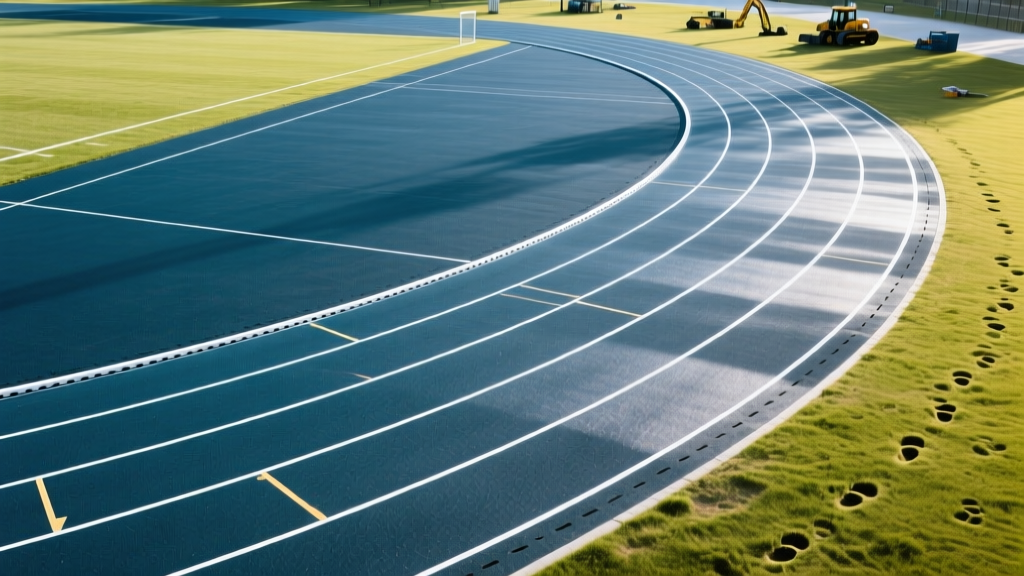
All-Weather Athletic Running Tracks (Polyurethane & Rubber)
Building a standard 400-meter, 8-lane competitive running track is a high-precision civil engineering project. According to the USATF Facility Guidelines, the surface must maintain strict planarity to ensure athlete safety and record eligibility. The total cost for a full-scale high school or collegiate track typically ranges from $850,000 to $1,600,000.
Base Preparation and Asphalt Paving
The foundation dictates the lifespan of the synthetic surface. A failing base will cause the polyurethane to delaminate within three years. Contractors must excavate 18 to 24 inches of native soil, replace it with a compacted aggregate base course (ABC), and pave with a specialized, fine-graded asphalt mix. Unlike highway asphalt, track asphalt requires a laser-guided paver to achieve a maximum deviation of 3mm over a 3-meter straightedge. In 2026, expect to pay between $140 and $175 per ton for this specialized hot-mix asphalt, bringing the base paving cost for a 23,000-square-foot track surface to roughly $180,000 to $240,000.
Synthetic Surfacing Systems
There are three primary surfacing systems, each with distinct cost profiles:
- Porous (Permeable) Polyurethane: The most cost-effective option at $5.50 to $7.00 per sq ft. Water drains directly through the surface into the asphalt base. Best for high schools in moderate climates.
- Sandwich System: A rubber base mat sealed with a polyurethane top coat and EPDM granules. Costs $7.50 to $9.50 per sq ft. Offers superior shock absorption and is the standard for NCAA Division II and III facilities.
- Full-Pour (Prefabricated Rubber):strong> Brands like Mondo or Beynon offer premium vulcanized rubber rolls poured on-site or pre-manufactured. Costs range from $11.00 to $16.00+ per sq ft. This is the mandatory choice for Olympic trials and NCAA Division I championships due to its exact energy-return metrics.
Perimeter Drainage Infrastructure
Water is the primary enemy of track longevity. A continuous slot-drain system must be installed along the inside edge of Lane 1. Using stainless steel or heavy-duty polymer concrete trench drains (such as ACO Sport systems) adds $45,000 to $85,000 to the project but prevents hydrostatic pressure from blistering the track surface.
Asphalt Go-Kart and Club Racing Tracks
Constructing a 1/2-mile (2,640 linear feet) asphalt go-kart or club racing track prioritizes high-friction surfacing, aggressive banking, and impact-absorbing barriers. Total construction costs generally fall between $350,000 and $750,000, heavily dependent on the complexity of the turns and elevation changes.
Paving and Superelevation (Banking)
A standard 24-foot-wide kart track requires roughly 63,000 square feet of paving. While the asphalt mix does not require the laser-precision of an athletic track, it does require a high-binder content (PG 76-22 or similar polymer-modified asphalt) to withstand the extreme lateral shearing forces of racing slicks. The Asphalt Institute recommends specific polymer modifications for high-stress turning radii. Paving costs average $3.50 to $5.00 per sq ft. If the design includes banked turns (superelevation up to 15 degrees), custom formwork and hand-finishing will increase paving costs in those sections by 40%.
Safety Barriers and Lighting
Modern kart tracks mandate continuous impact attenuation. A mix of concrete K-rails on high-speed straights and stacked, zip-tied tire barriers in technical corners is standard. Procuring and installing 5,000 linear feet of barrier systems costs $60,000 to $110,000. Additionally, if night racing is planned, LED sports lighting (aimed to eliminate cornering shadows) requires specialized pole placements, adding $80,000 to $150,000 for a fully illuminated 1/2-mile circuit.
Dirt Motocross and Off-Road Tracks
Dirt tracks are the most budget-friendly to construct but demand the highest ongoing maintenance. A 1.5-mile motocross or off-road track costs between $25,000 and $85,000 to build, as the process relies entirely on heavy equipment hours rather than expensive imported materials.
Earthmoving and Soil Amendment
Construction involves clearing, grubbing, and shaping the track using D8 bulldozers and 330-series excavators. The critical cost factor is soil composition. Pure clay becomes dangerously slick when wet and concrete-hard when dry; pure sand offers no traction. The ideal motocross loam requires a mix of 40% clay, 40% silt, and 20% sand. If native soil is unsuitable, importing and blending topsoil costs $15 to $28 per cubic yard delivered and spread. Shaping jumps, berms, and rhythm sections typically requires 200 to 400 machine hours at $125 to $175 per hour.
Irrigation and Dust Control
A dirt track is unusable without moisture management. Installing a perimeter water line with quick-connect hydrants and a tow-behind sprinkler system costs $8,000 to $18,000. For commercial facilities, automated pop-up sprinkler heads embedded in the infield add $30,000 but drastically reduce daily prep time.
Head-to-Head Cost Comparison Matrix
| Metric | Athletic Running Track (400m) | Asphalt Kart Track (1/2 Mile) | Dirt Motocross Track (1.5 Mile) |
|---|---|---|---|
| Total Build Cost (2026) | $850,000 - $1,600,000 | $350,000 - $750,000 | $25,000 - $85,000 |
| Primary Material | Polyurethane / EPDM Rubber | Polymer-Modified Asphalt | Compacted Loam / Clay Blend |
| Base Depth Required | 18" - 24" Aggregate + 3" Asphalt | 12" - 18" Aggregate + 4" Asphalt | Native Subgrade (Scarified 6") |
| Estimated Lifespan | 12 - 18 Years (Surface) | 15 - 20 Years (Pavement) | Indefinite (with weekly grading) |
| Annual Maintenance | $8,000 (Pressure washing, patching) | $12,000 (Sealcoating, crack fill) | $15,000+ (Tractor fuel, grading, water) |
Never skip the geotechnical soil report (cost: $2,500 - $5,000). Expansive clays can heave and crack a $200,000 asphalt track base within a single freeze-thaw cycle. If the geotech report identifies high-plasticity clay (PI > 25), you must budget an additional $40,000 to $90,000 for chemical soil stabilization (lime or fly ash mixing) before laying a single inch of aggregate.
Hidden Costs and Site Preparation Variables
Beyond the visible surface, site-specific variables frequently cause budget overruns in track construction. The American Sports Builders Association (ASBA) consistently cites improper site selection as the leading cause of premature track failure.
- Cut and Fill Balancing: Moving dirt off-site is exponentially more expensive than balancing it on-site. If your site requires importing 5,000 cubic yards of fill dirt, expect to pay $25+ per yard, adding $125,000 to the budget. Always select a site that allows for a cut-and-fill balance.
- Utility Relocation: Running tracks and racing circuits cover massive footprints. Relocating existing municipal water lines, gas mains, or high-voltage conduits beneath the track footprint can trigger municipal permitting delays and add $50,000 to $200,000 in utility contractor fees.
- Environmental Stormwater Mitigation: Paving 3 acres of land for a kart track triggers strict EPA and local stormwater runoff regulations. You may be required to construct a retention pond or install underground stormwater detention crates, adding $40,000 to $120,000 to the civil works budget.
Decision Framework: Which Track Should You Build?
Build an Athletic Track If:
You represent a school district, university, or municipal parks department with a capital budget exceeding $1M. You need a low-maintenance, high-liability-protection surface that guarantees consistent footing for cleated athletes and can support heavy foot traffic during multi-day invitational meets.
Build an Asphalt Kart Track If:
You are developing a commercial entertainment venue, private country club, or racing school. You have 3 to 5 acres of relatively flat land, a budget of $500k+, and need a high-speed, paved environment that generates revenue through arrive-and-drive rentals, corporate events, and league racing.
Build a Dirt Moto Track If:
You are an independent club, private landowner, or local municipality with a limited initial budget (<$100k) but access to heavy machinery and cheap water. You are willing to commit to the high operational overhead of weekly grading, watering, and jump rebuilding to maintain a safe riding surface.
Accurate cost estimation for track construction hinges on respecting the subsurface. Whether you are pouring a $12-per-square-foot prefabricated rubber surface or shaping a 40-foot motocross step-up, the budget must prioritize geotechnical stability and drainage above all else. Secure your soil borings, finalize your civil grading plans, and lock in your 2026 material contracts before breaking ground.
Written by
Elena RodriguezElena Rodriguez is a civil engineer and technical writer specializing in concrete technology, masonry systems, and ASTM/ACI compliance. She earned her B.S. in Civil Engineering from Texas A&M University and spent a decade at a materials testing laboratory, performing over 2,000 concrete compressive strength tests and masonry prism evaluations. Elena is an ACI-certified Field Testing Technician (Grade I) and a member of ASTM Committee C12 on Natural Building Stone. She currently consults on forensic engineering cases involving concrete failures and moisture intrusion. Based in San Antonio, TX, Elena is a proud member of the Society of Women Engineers (SWE) and coaches her daughter's FIRST Robotics team.
More from Elena Rodriguez
View all
Walls & Panels
Cost Analysis: Light Gauge Steel Framing Advantages and Disadvantages
Evaluate light gauge steel framing advantages and disadvantages through a strict cost analysis lens, comparing material, labor, and lifecycle expenses.
Aug 4, 2026

Walls & Panels
Gypsum Board Types: Exact Specifications, Thickness & Dimensions
Compare standard, Type X, and moisture-resistant gypsum board types. Get exact specifications, thicknesses, dimensions, and ASTM standards for your project.
Aug 4, 2026

Fire Resistance
Best Fire-Resistant Outdoor Decking Materials: 2026 Buyer Guide
Discover the best fire-resistant outdoor decking materials for 2026. Compare Class A PVC, aluminum, and hardwood options for WUI compliance and safety.
Aug 4, 2026