Average Cost to Build a House in TN: 2026 Regional Comparison
Discover the average cost to build a house in TN for 2026. Compare regional pricing, hidden site-work expenses, and custom vs. production budgets.

The True Baseline: What Does the Average Cost to Build a House in TN Actually Look Like?
When evaluating the average cost to build a house in TN, relying on national averages will severely distort your budget. Tennessee's construction economy is highly localized, driven by distinct regional labor markets, varying topographical challenges, and specific climate demands. As of 2026, the baseline average cost to build a house in TN ranges from $165 to $310 per square foot. For a standard 2,200-square-foot single-family home, this translates to a total project cost between $363,000 and $682,000, excluding land acquisition.
According to data tracked by the U.S. Census Bureau's New Residential Construction reports, the South region (which includes Tennessee) consistently sees construction costs 8% to 12% lower than the national median, primarily due to lower baseline labor rates and fewer mandatory seismic or extreme-winterization building codes. However, this macro-level discount quickly evaporates if you fail to account for micro-regional variables.
• Production/Tract Home: $165 - $195 per sq. ft.
• Semi-Custom Build: $200 - $250 per sq. ft.
• Full Architectural Custom: $275 - $400+ per sq. ft.
• Average Permit & Impact Fees: $4,500 - $11,000 (varies heavily by municipality)
Regional Cost Breakdown: Nashville vs. Knoxville vs. Memphis
The most critical mistake out-of-state buyers and local developers make is applying a uniform cost-per-square-foot metric across the state. The National Association of Home Builders (NAHB) frequently highlights how localized labor shortages and material logistics impact final pricing. In Tennessee, the state is effectively divided into three distinct construction economies.
| Region | Avg Cost / Sq. Ft. | Labor Index | Primary Site Challenge |
|---|---|---|---|
| Middle TN (Nashville, Franklin, Murfreesboro) | $190 - $320 | High (115% of state avg) | Karst topography & sinkhole risks |
| East TN (Knoxville, Chattanooga, Tri-Cities) | $175 - $280 | Moderate (100% of state avg) | Sloped lots & bedrock excavation |
| West TN (Memphis, Jackson, Dyersburg) | $155 - $240 | Low (88% of state avg) | Expansive clay soils & drainage |
Middle Tennessee: The Premium Market
Middle Tennessee commands the highest construction premiums in the state. The explosive population growth in Williamson and Rutherford counties has created a severe bottleneck for skilled trades, particularly framers and HVAC technicians. Expect to pay a 15% to 20% premium on labor here compared to rural counties. Furthermore, Middle TN sits on limestone karst topography. Before pouring a foundation, a geotechnical survey ($2,500 to $4,500) is highly recommended to ensure your lot isn't prone to subsidence or sinkholes.
East Tennessee: The Topographical Tax
While labor rates in East TN are more moderate, site-work costs frequently blow up budgets. Building in the foothills of the Smokies or around Chattanooga often means dealing with sloped lots and shallow bedrock. Excavating for a basement or crawlspace in these areas frequently requires rock blasting or heavy mechanical ripping, which can add $15 to $25 per cubic yard to your site-prep budget. A standard flat-lot site prep might cost $6,000, but a sloped, rock-heavy lot in Sevier or Knox County can easily push site-work costs past $25,000.
West Tennessee: The Soil Engineering Factor
West TN offers the lowest baseline labor and material costs, but the soil composition demands specialized engineering. The region is dominated by expansive clay soils that swell significantly when wet and shrink during droughts. Standard monolithic slab foundations will crack. Builders here must utilize bell-bottom piers, post-tensioned slabs, or deep grade beams, which adds $8,000 to $14,000 to the foundation budget but prevents catastrophic structural failure down the line.
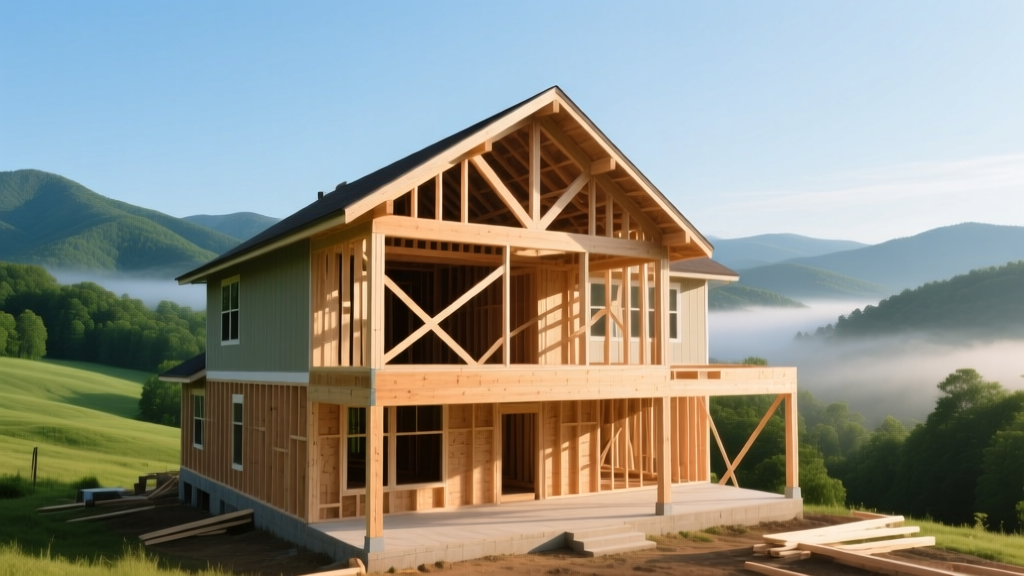
Production Builder vs. Custom Architect: Where Your Budget Goes
Understanding the average cost to build a house in TN requires distinguishing between production tract homes and custom builds. The divergence in cost is not just about finishes; it is about supply chain leverage and engineering overhead.
- Production Builders (e.g., DR Horton, Lennar): These builders operate on economies of scale. They purchase lumber, trusses, and windows in bulk, locking in prices that custom builders cannot access. Their average cost hovers around $165 to $195 per square foot. However, you are locked into their floor plans, and upgrading structural elements (like moving load-bearing walls or increasing ceiling heights from 8' to 10') is either prohibited or exorbitantly priced.
- Semi-Custom Builders: Operating in the $200 to $250 per square foot range, these builders offer a portfolio of base plans that can be modified. You can typically upgrade to 2x6 exterior walls for deeper insulation cavities and select your own exterior cladding (e.g., switching from vinyl to James Hardie fiber cement siding).
- Full Custom Architectural Builds: Starting at $275 per square foot and easily exceeding $400, full custom builds involve bespoke engineering. Costs scale rapidly when incorporating specialized structural elements like cantilevered decks, steel moment frames for open-concept great rooms, or complex multi-plane rooflines.
Hidden Site-Work Costs Unique to Tennessee Topography
When calculating your budget, the structural shell and interior finishes only tell half the story. Tennessee's diverse geography introduces several hidden site-work costs that routinely derail poorly planned budgets.
If you are building outside municipal limits in counties like Cannon, Macon, or rural Blount County, you will likely need a private well and septic system. A 400-foot deep well with a constant pressure pump system will cost between $8,500 and $14,000. An engineered aerobic septic system, required if your soil percolation test fails standard gravity-flow metrics, can cost $12,000 to $18,000. Always budget $25,000 for rural utility infrastructure before purchasing land.
Additional Edge Cases to Budget For:
- Tree Mitigation & Root Barriers: In heavily wooded areas of Oak Ridge or Signal Mountain, preserving mature hardwoods during construction requires root pruning and physical barriers, adding $2,000 to $5,000 to site prep.
- Stormwater Retention Ponds: Many Middle TN municipalities now require strict stormwater management for new impervious surfaces. Digging and engineering a retention basin can cost $4,500 to $9,000.
- Driveway Culverts & Aprons: County road departments require specific concrete aprons and corrugated steel culverts where your driveway meets the road. Budget $3,500 to $6,000 for this specific compliance item.
Climate-Specific Material Upgrades for Tennessee
Tennessee experiences high humidity in the summer and significant temperature swings in the winter. Building to minimum code is a false economy. To protect your investment and minimize long-term HVAC costs, integrate these specific material upgrades into your estimate:
Advanced Moisture & Air Barriers
Standard OSB sheathing and house wrap are insufficient for TN's humid summers, which drive moisture into wall cavities. Upgrade to Huber ZIP System R-sheathing. This product integrates a structural panel with a built-in water-resistive barrier and continuous exterior insulation. While it adds roughly $1.50 to $2.00 per square foot of wall area to your material costs, it drastically reduces air infiltration and prevents the mold growth common in poorly sealed Southern homes.
HVAC Sizing and SEER2 Ratings
The 2026 federal minimum for air conditioners in the South is 15.2 SEER2. However, given Tennessee's July and August heat indices, specifying a Carrier Infinity or Trane XV series heat pump at 18 SEER2 or higher with variable-speed compressors is highly recommended. Furthermore, ensure your HVAC contractor performs a Manual J load calculation. Oversized units will short-cycle, failing to dehumidify the air properly, leading to a clammy indoor environment and premature equipment failure.
Insulation Strategies
Move away from standard fiberglass batts in exterior walls. Use open-cell spray foam insulation (approximately $0.50 to $0.75 per board foot) in the roofline to create an unvented, conditioned attic space. This keeps your HVAC ductwork within the thermal envelope, preventing the 20% to 30% energy loss typical in vented attics that can reach 140°F in August.
Actionable Framework: Estimating Your Specific TN Build
To generate a highly accurate budget for your specific project, follow this sequential framework:
- Secure the Land & Geotech Data: Before finalizing a home design, spend $3,000 on a boundary survey, soil bore tests, and a topographical map. This dictates your foundation type and site-work costs.
- Calculate the Hard Construction Costs: Multiply your desired heated square footage by the regional average (e.g., 2,200 sq ft x $210 for Middle TN semi-custom = $462,000).
- Add the 15% Site-Work Contingency: Driveways, utilities, grading, and landscaping typically add 12% to 15% to the hard construction costs.
- Factor in Soft Costs: Architectural plans, engineering stamps, permits, and builder overhead/profit (typically 15% to 20% if acting as an owner-builder hiring subs, or built into the contract if using a GC).
- Apply a 10% Material Escalation Buffer: Lumber and concrete prices remain volatile. Hold 10% of your total budget in reserve to absorb mid-build market fluctuations.
Frequently Asked Questions
Is it cheaper to build or buy an existing house in Tennessee right now?
In 2026, building a new custom home generally costs 10% to 15% more per square foot than purchasing an equivalent existing home in the same market, primarily due to the premium on new, unused materials and current labor rates. However, building allows you to integrate high-efficiency HVAC and advanced insulation, which significantly lowers monthly operating costs compared to older TN housing stock.
Do I need a builder's license to build my own house in TN?
No. Tennessee law allows homeowners to act as their own general contractor (owner-builder) for a primary residence, provided you do not intend to sell the home within a specific timeframe (usually one to two years) after completion. However, you must still pull all local permits, and specialized trades like electrical, plumbing, and HVAC must be performed by licensed TN professionals.
How long does it take to build a house in Tennessee?
A standard production home takes 5 to 7 months from groundbreaking to final walkthrough. A semi-custom or full custom home typically takes 9 to 14 months. Delays in East TN are frequently caused by weather-related site-work halts, while Middle TN delays are usually tied to subcontractor scheduling bottlenecks and municipal inspection backlogs.
Written by
Elena RodriguezElena Rodriguez is a civil engineer and technical writer specializing in concrete technology, masonry systems, and ASTM/ACI compliance. She earned her B.S. in Civil Engineering from Texas A&M University and spent a decade at a materials testing laboratory, performing over 2,000 concrete compressive strength tests and masonry prism evaluations. Elena is an ACI-certified Field Testing Technician (Grade I) and a member of ASTM Committee C12 on Natural Building Stone. She currently consults on forensic engineering cases involving concrete failures and moisture intrusion. Based in San Antonio, TX, Elena is a proud member of the Society of Women Engineers (SWE) and coaches her daughter's FIRST Robotics team.
More from Elena Rodriguez
View all
Walls & Panels
Cost Analysis: Light Gauge Steel Framing Advantages and Disadvantages
Evaluate light gauge steel framing advantages and disadvantages through a strict cost analysis lens, comparing material, labor, and lifecycle expenses.
Aug 4, 2026

Walls & Panels
Gypsum Board Types: Exact Specifications, Thickness & Dimensions
Compare standard, Type X, and moisture-resistant gypsum board types. Get exact specifications, thicknesses, dimensions, and ASTM standards for your project.
Aug 4, 2026

Fire Resistance
Best Fire-Resistant Outdoor Decking Materials: 2026 Buyer Guide
Discover the best fire-resistant outdoor decking materials for 2026. Compare Class A PVC, aluminum, and hardwood options for WUI compliance and safety.
Aug 4, 2026