Average Cost to Build a Septic System: 2026 Installation Guide
Discover the true cost to build a septic system in 2026. Breakdowns for tank types, soil conditions, leach fields, and hidden installation expenses.

National Baselines: The True Cost to Build a Septic System
When evaluating the cost to build a septic system for a new residential build or rural property, the national average in 2026 sits between $8,500 and $15,000 for a conventional anaerobic setup. However, treating this average as a hard rule is a critical budgeting error. Site-specific variables—namely soil morphology, local health department mandates, and leach field technology—can push complex installations past $30,000. Understanding the mechanical and geological variables that dictate pricing is the only way to accurately forecast your project's financial footprint.
System Architecture: Pricing by Treatment Type
The baseline architecture of your system is the primary cost multiplier. According to the Environmental Protection Agency (EPA), system selection is strictly dictated by site limitations, not homeowner preference. Below is a comparative matrix of the four primary system types and their 2026 installation costs.
| System Type | Average Cost Range | Ideal Application | Key Components |
|---|---|---|---|
| Conventional Anaerobic | $7,500 - $15,000 | Deep, well-draining soils (Type I & II) | Concrete tank, gravel/chamber leach field |
| Aerobic Treatment Unit (ATU) | $16,000 - $26,000 | Small lots, high water tables, poor soil | Aeration tank, air compressor, UV/chlorine disinfection |
| Mound System | $18,000 - $32,000 | Shallow soil depth over bedrock or high groundwater | Dosing chamber, sand mound, specialized fill dirt |
| Drip Distribution | $14,000 - $22,000 | Sloped terrain, shallow soil horizons | Large pump tank, filtration, shallow drip tubing |
Tank Material & Sizing Matrix
Local plumbing codes (often mirroring the International Residential Code Section P3103) mandate tank sizing based on the number of bedrooms, not the number of bathrooms or occupants. A 3-bedroom home requires a minimum 1,000-gallon tank, while a 5-bedroom home requires 1,500 gallons. Material selection impacts both the upfront cost to build a septic system and the long-term structural integrity.
1. Precast Concrete ($1,400 - $2,800 for the tank)
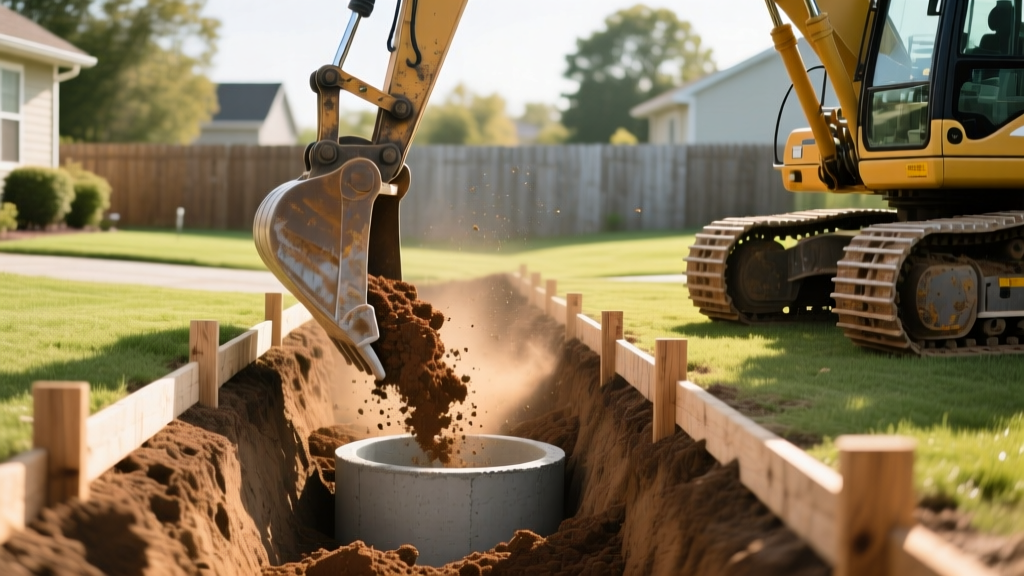
Concrete is the industry standard. It is heavy, requiring a crane or large trackhoe for placement, but it is immune to buoyancy issues in high water tables. Modern precast tanks utilize high-density polyethylene (HDPE) risers and sealed rubber gaskets to prevent root intrusion and groundwater infiltration. Expect a 40+ year lifespan.
2. Fiberglass ($1,800 - $3,200 for the tank)
Fiberglass tanks are lightweight and immune to the corrosive effects of hydrogen sulfide gas (which degrades concrete above the waterline). However, their low weight is a severe liability in areas with seasonal high water tables; an empty fiberglass tank can literally float out of the ground, shearing the inlet/outlet pipes. Installation requires pouring a concrete anchor slab (deadman) beneath the tank, adding $600 to the labor cost.
3. Polyethylene ($1,200 - $2,200 for the tank)
Poly tanks feature ribbed exteriors to resist soil shifting. They are the most budget-friendly and easiest to transport, but they are susceptible to deformation if backfilled improperly. Installers must use specific slurry backfill (a mix of pea gravel and cement) to prevent the tank walls from bowing inward under soil pressure.
Leach Field Technologies: Gravel vs. Chamber Systems
The drain field (leach field) represents 40% to 60% of the total installation labor and material cost. The industry has largely pivoted away from traditional washed gravel and perforated PVC pipe in favor of geosynthetic aggregate chambers.
- Traditional Gravel Trenches: Costs $35 to $55 per linear foot installed. Requires heavy machinery to move tons of washed stone, plus the labor of laying pipe and covering it with straw and topsoil. Highly susceptible to 'biomat' clogging if fine soil particles wash into the gravel.
- Chamber Systems (e.g., Infiltrator Quick4 Standard): Costs $45 to $70 per linear foot installed. These high-density polyethylene arches snap together and sit directly on the soil floor, eliminating the need for gravel. According to data aggregated by the National Environmental Services Center (NESC), chamber systems provide 30% more infiltrative surface area per linear foot than gravel, allowing for smaller overall footprints and reduced excavation time.
The Pre-Installation Gauntlet: Site Prep & Permitting
The physical digging only happens after a rigorous, costly evaluation process. Failing to budget for site prep is the most common reason rural construction projects stall.
- Soil Morphological Evaluation ($400 - $1,500): Modern health departments rarely rely on traditional 'perc tests' (digging a hole and timing how fast water drains), as seasonal moisture can skew results. Instead, a licensed soil scientist digs deep observation pits to analyze soil horizons, mottling, and chroma to determine the seasonal high water table and permissible loading rates.
- System Design & Engineering Stamps ($1,500 - $4,000): If your site requires an alternative system (ATU, mound, or drip), a licensed professional engineer (PE) must design the hydraulic schematics and stamp the blueprints for county approval.
- Permitting Fees ($300 - $900): County health department fees for the construction permit and final operational inspection.
Hidden Cost Triggers & Edge Cases
When calculating the cost to build a septic system, contractors often exclude site anomalies from their baseline bids. Be prepared for the following edge cases:
Bedrock Blasting and Ripping
If your soil scientist hits solid bedrock at 30 inches, but the code requires 36 inches of suitable soil beneath the leach field, you must excavate the rock. Hydraulic hammering (ripping) with a large excavator costs $150–$250 per hour. If the rock requires dynamite blasting, costs skyrocket to $50–$120 per cubic yard, alongside the cost of importing engineered fill dirt to replace the removed rock.
Tree Root Buffer Zones
Most counties mandate a 10-foot clear zone between large trees and the leach field. Removing mature hardwoods or pines to satisfy this setback can add $1,500 to $4,500 in arborist and stump-grinding fees.
Pump Tanks and Lift Stations
If your home's foundation is lower than the municipal or leach field elevation, gravity flow is impossible. You will need a separate concrete pump tank equipped with a submersible effluent pump (e.g., a Zoeller M267 or Liberty Pumps LE40 series), adding $2,500 to $4,000 to the project.
Long-Term ROI & Maintenance Realities
The initial capital expenditure is only half the financial equation. Alternative systems carry significantly higher operational expenditures (OpEx) compared to conventional anaerobic setups.
Conventional Systems: Require pumping every 3 to 5 years at a cost of $400 to $650. Total annual maintenance cost averages under $150.
Aerobic Treatment Units (ATUs): Require continuous electricity to run the air compressor ($15–$30/month in energy). The air compressor diaphragms must be rebuilt every 2 years ($250), and the UV disinfection bulb must be replaced annually ($120). Furthermore, many counties mandate a $150–$300 annual inspection by a licensed maintainer to ensure the effluent is properly disinfected before hitting the soil.
Accurately forecasting the cost to build a septic system requires looking past the tank itself. By securing a detailed soil morphological evaluation early in your land acquisition process, you can accurately predict whether a $9,000 conventional system will suffice, or if a $28,000 engineered mound system is geologically unavoidable.
Written by
Sarah WhitfieldSarah Whitfield is a chartered quantity surveyor (MRICS) and construction cost analyst with 15 years of experience in material pricing, procurement strategy, and project budgeting. She earned her degree in Construction Management from the University of Reading (UK) and has worked on projects ranging from $2M custom homes to $180M mixed-use developments across North America and Europe. Sarah currently leads cost estimating for BuildMat Insight, maintaining a proprietary database of 4,000+ material price points updated quarterly. She is a frequent contributor to RSMeans cost data panels and has presented at the International Cost Engineering Council (ICEC) congress. Based in Denver, CO, Sarah is an avid trail runner and volunteer mentor for Women in Construction.
More from Sarah Whitfield
View all
Wood & Lumber
What Are the Different Types of Wood? A Builder's Guide
Compare structural softwoods, finish hardwoods, and engineered lumber. Analyze Janka ratings, MOE values, and 2026 pricing for construction.
Aug 4, 2026

Walls & Panels
Steel Framing vs Wood Framing: Corrosion and Moisture Defense
Compare steel framing vs wood framing for moisture resistance. Learn about galvanized coatings, condensation risks, and corrosion protection strategies.
Jul 21, 2026

Stone & Masonry
How to Cut Stone Veneer: Wet Saw vs Grinder Comparison
Compare the best tools for cutting stone veneer. We review wet saws, angle grinders, and chop saws to help you achieve clean, chip-free cuts.
Jul 21, 2026