How Much Does It Cost to Build a Billboard? Size & Scope Calculator
Calculate exactly how much it costs to build a billboard. Break down 14x48 monopole, digital LED, and static vinyl construction costs by size and scope.

The Core Variables: Calculating Billboard Construction Scope
When project developers and outdoor advertising companies ask how much does it cost to build a billboard, the answer requires a multi-variable calculation rather than a flat rate. A standard static highway bulletin and a multi-face digital LED installation represent entirely different structural, electrical, and geotechnical scopes. In 2026, the baseline cost to construct a traditional 14x48 static monopole billboard ranges from $28,000 to $45,000, while a comparable digital LED structure easily scales from $140,000 to over $280,000. To accurately estimate your project, you must calculate the intersection of face dimensions, structural support type, display technology, and subsurface foundation requirements.
Size & Scope Matrix: Standard Billboard Dimensions
Billboard sizes are standardized by the outdoor advertising industry to match vinyl printing dimensions and highway visibility sightlines. Below is the structural scope matrix for the three most common highway and arterial formats.
| Format Name | Dimensions (H x W) | Total Sail Area | Estimated Steel Tonnage (Monopole) | Base Structure Cost (Static) |
|---|---|---|---|---|
| Junior Poster / Arterial | 10' x 22' | 220 sq ft | 3.5 - 5 Tons | $18,000 - $24,000 |
| Standard Bulletin (Highway) | 14' x 48' | 672 sq ft | 8 - 12 Tons | $28,000 - $45,000 |
| Premiere / Oversized | 20' x 60' | 1,200 sq ft | 16 - 22 Tons | $55,000 - $85,000 |
Structural Breakdown: Monopole vs. Multi-Pole vs. Wall-Mount
The support structure dictates up to 40% of your total physical construction budget. The choice depends on soil conditions, local zoning height restrictions, and aesthetic ordinances.
1. Steel Monopole (Tubular Steel)
The industry standard for highway corridors. Monopoles utilize a single, tapered galvanized steel tube (typically 36 to 54 inches in diameter at the base) anchored into a concrete caisson. They minimize the ground footprint, making them ideal for highway right-of-way (ROW) setbacks and tight commercial lots. The steel alone for a 14x48 monopole engineered for 110 mph wind loads costs between $14,000 and $22,000 in 2026, heavily dependent on fluctuating raw steel commodity prices.
2. Multi-Pole (Wood or Steel I-Beam)
Often used for lower-profile arterial roads or areas with bedrock close to the surface where deep caissons are impossible. Multi-pole structures distribute the wind load across 3 to 5 vertical supports. While material costs for wood poles or lighter I-beams can be 20% cheaper than a heavy monopole, the labor and equipment costs to plumb and align multiple poles often negate the material savings.
3. Wall-Mounted and Roof-Mounted
Urban environments rely on existing architecture. Wall-mounted billboards require structural tie-ins to the host building's load-bearing masonry or steel frame. The scope here shifts from geotechnical foundation work to structural reinforcement of the host building, requiring specialized engineering to ensure the building's facade can handle the transferred wind shear.
The Technology Multiplier: Static Vinyl vs. Digital LED
The single largest scope variable in modern billboard construction is the display face. Transitioning from a static wood-or-metal catwalk face to a Digital Out-Of-Home (DOOH) LED display fundamentally alters the structural, electrical, and thermal requirements of the build.
Static Vinyl Faces
A traditional static face consists of a corrugated metal deck or treated timber catwalk frame, overlaid with track systems for tensioning vinyl sheets.
- Materials: Galvanized steel purlins, aluminum tracking, 13oz vinyl.
- Electrical: Minimal. Requires a standard 120V/240V drop for front-facing halogen or LED billboard lights (approx. $1,500 for lighting installation).
- Weight Load: Lightweight, imposing minimal dead-load stress on the monopole.
Digital LED Faces (e.g., Daktronics, Watchfire)
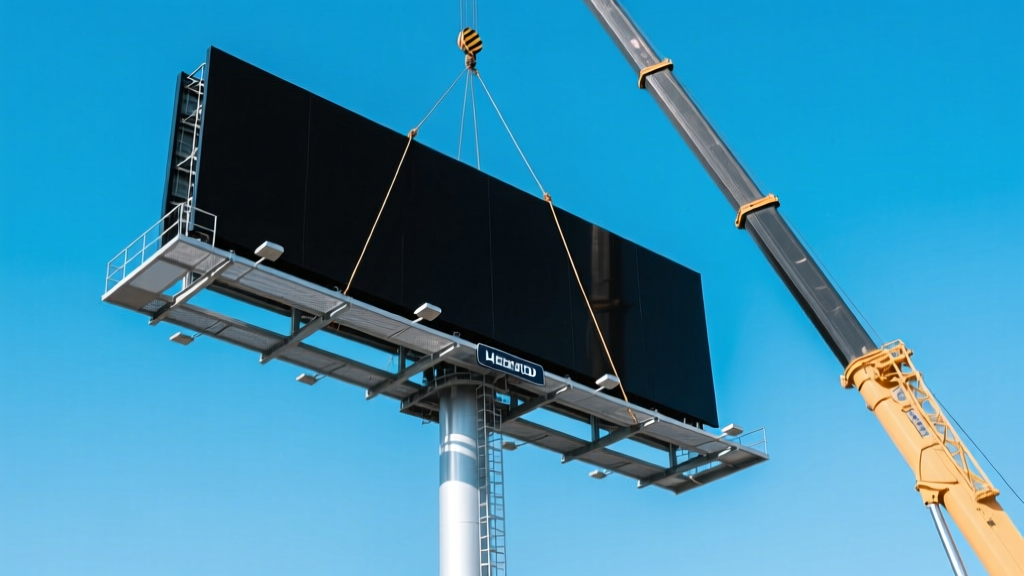
Digital billboards are essentially massive, weather-sealed outdoor televisions. A 14x48 digital face utilizing a 16mm pixel pitch LED matrix introduces severe scope creep:
- Dead Weight & Wind Sail: LED cabinets are significantly heavier than vinyl tracks. Furthermore, digital faces often lack the wind-sail relief gaps found in catwalk structures, requiring the monopole and foundation to be engineered for a 25% to 40% higher wind-load coefficient.
- Electrical Infrastructure: Digital faces require massive power draws. A standard 14x48 LED billboard operating at 8,000 nits brightness requires a dedicated 480V 3-phase electrical service. Trenching and installing a commercial utility drop can add $15,000 to $35,000 to the site scope.
- Thermal Management: Cabinets require integrated HVAC or forced-air ventilation systems to prevent pixel burnout in direct summer sunlight, adding to the ongoing operational load.
Subsurface Scope: Foundation and Wind Load Engineering
You cannot finalize a billboard construction budget without a geotechnical soil report. The foundation must counteract the overturning moment generated by high winds hitting the sail area. Engineers calculate these forces using the ASCE 7 Minimum Design Loads standards, which dictate specific wind-speed maps based on the structure's geographic coordinates.
If Soil is Stable/Clay: Drilled concrete caisson (shaft) extending 15 to 25 feet below grade. Cost: $8,000 - $15,000.
If Soil is Sandy/Loose: Spread footing (massive excavated concrete pad) or heavily reinforced belled caisson. Cost: $18,000 - $30,000.
If Bedrock is Shallow: Rock-anchored foundation using epoxy-set anchor bolts drilled directly into the stone shelf. Cost: $6,000 - $12,000.
Itemized Cost Breakdown: 14x48 Highway Billboard (2026 Estimates)
The following matrix provides a realistic scope calculation for a standard 14x48 monopole structure on stable soil, comparing a static setup to a single-face digital LED upgrade.
| Construction Phase | Static Vinyl Scope | Digital LED Scope (Single Face) |
|---|---|---|
| Geotechnical & Structural Engineering | $3,500 | $6,500 (Higher wind/load calcs) |
| Permits & Highway ROW Approvals | $2,500 | $4,000 (Environmental light studies) |
| Concrete Foundation (Caisson) | $11,000 | $18,500 (Wider/Deeper for torque) |
| Steel Monopole & Catwalk/Cabinets | $22,000 | $28,000 (Heavier gauge steel) |
| Display Face (Vinyl vs LED Hardware) | $4,500 (Tracks & Lighting) | $95,000 - $130,000 (LED Matrix) |
| Electrical Drop & Trenching | $3,000 (Standard 240V) | $24,000 (480V 3-Phase Service) |
| Crane Rigging & Installation Labor | $6,500 | $12,000 (Precision cabinet alignment) |
| TOTAL ESTIMATED CONSTRUCTION COST | $53,000 | $188,000 - $223,000 |
Hidden Scope Creep: Zoning, HWA, and Right-of-Way
Physical construction is only half the battle. Billboard development is heavily regulated at the federal, state, and municipal levels. The Federal Highway Administration (FHWA) enforces the Highway Beautification Act (HBA), which strictly limits billboard placement along Interstate and primary highway systems. To calculate your total project scope, you must budget for the following regulatory hurdles:
- HBA Compliance & DOT Permits: Structures must be placed in zoned commercial or industrial areas, or in "unzoned commercial/industrial" areas recognized by the state DOT. Permitting fees and legal surveys to prove compliance typically range from $3,000 to $8,000.
- Vegetation Clearing: State DOTs require clear sight triangles for highway safety. Budget $2,000 to $5,000 for professional arborist clearing, which often requires separate environmental permits if near protected wetlands.
- Aviation & FAA Notices: If your monopole exceeds 200 feet in total height (AGL), or is near an airport approach path, you must file a Notice of Proposed Construction with the FAA, adding $2,500 in aeronautical study fees and potential aviation warning lighting installations.
Size & Scope Decision Framework
Use this framework to finalize your construction estimator inputs before soliciting bids from structural steel fabricators and civil contractors:
Step 1: Define the Sightline. Measure the highway approach distance. If the sightline is under 500 feet, a 10x30 junior poster is sufficient and saves 40% on steel. If the sightline exceeds 1,000 feet on an Interstate, a 14x48 or 20x60 is mandatory for legibility.
Step 2: Assess the Power Grid. Contact the local utility cooperative. If a 480V 3-phase line is more than 1,500 feet from the site, the trenching and transformer costs for a digital LED face will likely destroy the project's ROI. Default to static vinyl or tri-vision mechanical faces.
Step 3: Order the Boring Test. Never sign a land lease or purchase steel without a $2,500 geotechnical soil boring test. Discovering high water tables or unstable peat after the crane arrives will result in $20,000+ change orders for helical piles or over-excavation.
Accurately calculating how much it costs to build a billboard requires treating the project as a heavy civil engineering endeavor rather than a simple signage installation. By meticulously scoping the sail area, subsurface geology, and electrical requirements, developers can prevent catastrophic budget overruns and ensure their structures are engineered to withstand decades of environmental stress.
Written by
Marcus ChenMarcus Chen is a licensed structural engineer (PE) and building materials analyst with over 12 years of experience across residential, commercial, and industrial construction. He holds a Master of Science in Civil Engineering from UC Berkeley and spent six years at Thornton Tomasetti before transitioning to independent consulting and technical writing. Marcus specializes in material selection for seismic-prone regions, concrete reinforcement strategies, and lifecycle cost analysis. His work has been cited by the American Concrete Institute (ACI) and the Structural Engineers Association of California (SEAOC). When he is not on a job site or at his desk, you will find him hiking the Sierra Nevada or restoring a 1920s craftsman bungalow in Oakland, CA.
More from Marcus Chen
View all
Construction Cost
How Much Did the Eiffel Tower Cost to Build?
How much did the Eiffel Tower cost to build in 1889? We adjust for inflation and compare its budget to modern skyscraper construction.
Aug 4, 2026

Fire Resistance
What Is a Fire Resistant Material? Testing & Certification Guide
Discover what is a fire resistant material through ASTM and UL testing. Learn how fire ratings, certifications, and assemblies work in construction.
Aug 4, 2026

Construction Cost
How Much Did the Burj Khalifa Cost to Build?
How much did the Burj Khalifa cost to build? We break down the $1.5B project and extract 5 money-saving strategies for your next build.
Jul 30, 2026