How Much Does It Cost to Build a Bridge? Complete Pricing Guide
Discover exactly how much it costs to build a bridge. Complete 2026 pricing breakdown for pedestrian, timber, steel, and vehicular spans.

The True Cost of Spanning a Gap: Beyond the Per-Foot Metric
Estimating the cost of a bridge requires moving past simplistic averages. When clients ask how much does it cost to build a bridge, the answer hinges entirely on the structural classification, live load requirements, and subsurface geotechnical conditions. A 60-foot residential timber footbridge and a 60-foot rural vehicular crossing share a similar span but operate in entirely different financial universes due to AASHTO (American Association of State Highway and Transportation Officials) loading standards. In 2026, material volatility and stringent environmental permitting have shifted baseline costs upward, making precise early-stage estimating critical for project feasibility.
Comprehensive Bridge Cost Matrix (2026 Estimates)
The following matrix breaks down baseline construction costs by bridge category. These figures represent the total installed cost, including substructure (foundations), superstructure (deck and beams), and standard mobilization, but exclude extreme geotechnical remediation or complex environmental mitigation.
| Bridge Category | Primary Material | Typical Span Range | Cost per Linear Foot (PLF) | Estimated Total (Example Span) |
|---|---|---|---|---|
| Residential Pedestrian | Timber / Glulam | 20' - 60' | $125 - $250 | $10,000 (40' span) |
| Municipal Pedestrian | Prefab Steel Truss | 40' - 150' | $250 - $450 | $37,500 (100' span) |
| Light Vehicular (Private) | Steel Girder / Timber | 30' - 80' | $800 - $1,500 | $60,000 (50' span) |
| Rural Highway / County | Precast Concrete Box | 40' - 120' | $1,800 - $3,200 | $160,000 (80' span) |
| Major Highway Overpass | Steel Plate Girder | 150' - 500'+ | $4,500 - $8,500+ | $1,275,000 (300' span) |
Residential and Pedestrian Bridges: Material Deep Dive
Pedestrian bridges are governed by lighter load codes (typically 85-90 psf live load) compared to vehicular structures, allowing for highly optimized, cost-effective material choices.
Timber and Glulam (Glued Laminated Timber)
For spans under 60 feet over backyard ravines or private creeks, pressure-treated Southern Yellow Pine or Douglas Fir Glulam beams offer the lowest cost per linear foot. A 40-foot Glulam stringer bridge with a composite or treated wood deck typically costs between $5,000 and $10,000 fully installed. The critical cost variable here is the substructure. Using helical piers instead of poured concrete abutments can save $4,000 to $8,000 in excavation and curing time, especially in wet or unstable soils.
Prefabricated Steel Truss Systems
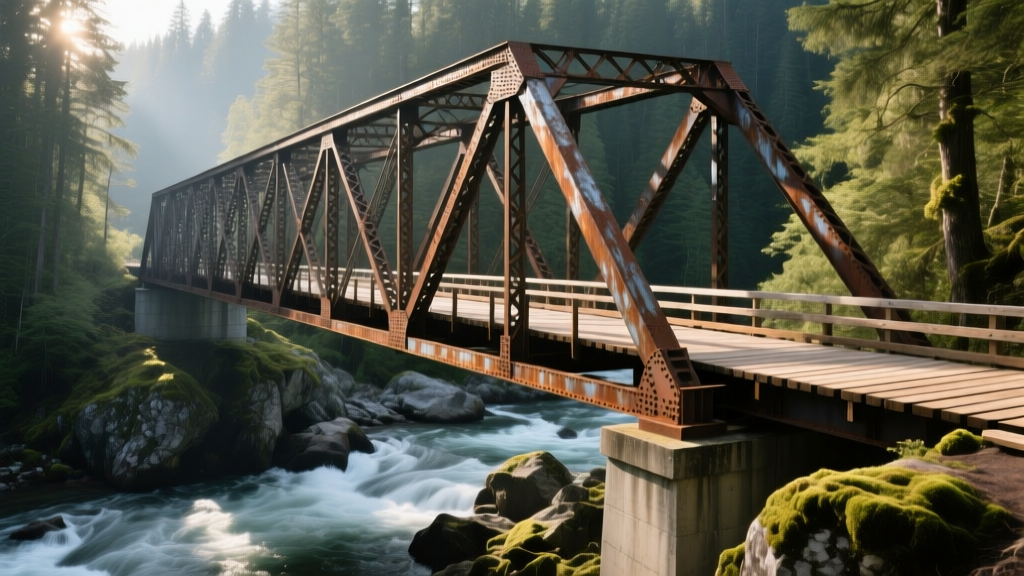
For municipal trail networks or golf course crossings spanning 80 to 150 feet, prefabricated steel truss bridges are the industry standard. Manufacturers ship these modular units in sections that bolt together on-site. Utilizing weathering steel (ASTM A588) eliminates the need for initial and lifecycle paint systems, as the steel forms a protective rust patina. Expect to pay $250 to $450 PLF. According to the American Institute of Steel Construction (AISC), weathering steel reduces initial bridge construction costs by approximately 5% and lifecycle maintenance costs by up to 30% compared to painted alternatives.
Aluminum and FRP (Fiber Reinforced Polymer)
Aluminum bridges are reserved for highly corrosive environments (coastal areas, saltwater marshes) or sites where crane access is impossible. Because aluminum components are 60% lighter than steel, they can often be installed using a standard excavator or even by hand in modular sections. However, the raw material premium pushes costs to $400 - $650 PLF.
Never finalize a pedestrian bridge budget without a hydrological scour analysis. If a 100-year flood event is predicted to scour 4 feet of soil from the creek bed, your abutment footings must be driven 4 feet deeper than initially planned. This single geotechnical reality routinely adds $10,000 to $25,000 in foundation costs for seemingly simple creek crossings.
Vehicular and Highway Bridge Economics
Vehicular bridges must be engineered to withstand AASHTO HL-93 design truck loading, which simulates the dynamic impact of heavy commercial freight. This massive leap in structural demand fundamentally alters the cost profile.
Precast Concrete Arch and Box Culverts
For short-span rural roads and private driveways crossing seasonal washes (spans up to 40 feet), precast concrete three-sided arches or box culverts are the most economical choice. These are essentially buried bridges. The cost is heavily dictated by earthwork and backfill requirements. While the precast unit itself might only cost $15,000, the required engineered structural backfill, headwalls, and wingwalls will push the total installed cost to $60,000 - $110,000.
Cast-in-Place and Steel Girder Spans
For county roads and state highways requiring clear spans over waterways or railways, cast-in-place concrete or steel plate girders are mandatory. The Federal Highway Administration (FHWA) notes that modern highway bridge costs are heavily influenced by accelerated bridge construction (ABC) techniques. Using prefabricated bridge elements and systems (PBES) costs more upfront (adding 10-15% to material budgets) but drastically reduces lane closure times and traffic control costs, often resulting in a lower total project cost when user-delay penalties are factored in.
"The most expensive component of a modern highway bridge is rarely the superstructure itself; it is the subsurface foundation and the traffic control required to build it safely over active corridors." — Structural Engineering Industry Consensus, 2025.
The 5 Hidden Cost Multipliers in Bridge Engineering
Novice estimators frequently budget only for the steel, concrete, and labor, only to face massive change orders later. Account for these five multipliers in your initial pro-forma:
- Geotechnical Subsurface Conditions: If bedrock is located 60 feet below grade instead of the anticipated 20 feet, your drilled shaft foundations will require specialized casing and drilling rigs, potentially doubling the substructure budget.
- Environmental Permitting (Section 404): Building over Waters of the United States requires Army Corps of Engineers permits. Mitigation banking (purchasing wetland credits to offset impacts) can cost $50,000 to $150,000 per acre impacted, sometimes exceeding the cost of a small pedestrian bridge.
- Crane Mobilization and Access: Setting a 40,000 lb steel truss requires a 200-ton crane. If the site is remote, crane mobilization, assembly, and demobilization can cost $25,000 to $45,000 before the boom ever lifts a load.
- Seismic and Wind Retrofitting: In zones 3 and 4, bridge bents require complex rebar detailing, base isolators, or shear keys that increase concrete and labor costs by 15-25%.
- Utility Relocation: Discovering an unmapped fiber-optic line or high-pressure gas main beneath a proposed abutment will trigger work stoppages and relocation fees that routinely run into the hundreds of thousands.
Decision Framework: Matching Span to Structure
Use this rapid framework to determine the most cost-effective structural typology for your specific site parameters:
1. Span is under 40 feet + Light Load (Pedestrian/ATV)
Solution: Glulam timber stringers with helical pier foundations. Lowest capital expenditure, fastest installation, minimal environmental footprint.
2. Span is 40 to 120 feet + Pedestrian/Cyclist
Solution: Prefabricated weathering steel truss. Optimal balance of durability, span capability, and low lifecycle maintenance.
3. Span is under 50 feet + Heavy Vehicular (HL-93)
Solution: Precast three-sided concrete arch or precast concrete box culvert. Utilizes the surrounding soil for structural support, minimizing concrete volume.
4. Span is 100+ feet + Heavy Vehicular
Solution: Steel plate girders with a cast-in-place concrete deck. Steel provides the tensile strength for long spans, while the composite concrete deck handles the direct wear and compression of traffic loads.
Frequently Asked Questions
How long does it take to build a pedestrian bridge?
A prefabricated steel pedestrian bridge typically takes 3 to 6 months from contract signing to completion. Manufacturing the truss takes 6-10 weeks, while site preparation, foundation pouring, and curing account for the remainder. Actual physical assembly on-site often takes less than 48 hours.
What is the cheapest material for a driveway bridge?
For a private driveway crossing a small ditch or creek, corrugated steel pipe (CSP) or structural steel plate arches backfilled with compacted aggregate represent the cheapest viable option. These act as buried bridges and avoid the need for complex beam-and-deck engineering, often costing 40% less than a traditional girder bridge.
Do I need an engineer to build a bridge on my private property?
Yes. Even on private land, any structure spanning a waterway or exceeding 5 feet in height requires stamped structural and geotechnical engineering drawings to secure local building permits and Army Corps of Engineers clearance. Attempting to build without engineered plans exposes the owner to severe liability, fines, and mandatory demolition orders.
Written by
James ThorntonJames Thornton is a construction industry veteran with 25 years of hands-on experience in wood framing, lumber grading, and residential building codes. He started as a framing carpenter in rural Oregon, earned his ICC Residential Building Inspector certification, and eventually became a senior plan reviewer for the City of Portland Bureau of Development Services. James holds a B.S. in Wood Science & Technology from Oregon State University and is a certified lumber grader through the West Coast Lumber Inspection Bureau (WCLIB). He has inspected over 3,000 residential construction sites and authored the city's internal guide on advanced framing techniques (2x6 at 24" O.C.). James lives in Bend, OR, where he builds custom timber-frame cabins and competes in lumberjack sports.
More from James Thornton
View all
Insulation
Best Home Insulation Materials: Complete 2026 Guide
Compare top home insulation materials for 2026. Find R-values, installed costs per square foot, and best uses for fiberglass, spray foam, and mineral wool.
Aug 4, 2026

Sustainable Building
Certify Your Green Building Material for LEED and WELL
Step-by-step guide to certifying a green building material for LEED v5 and WELL v2. Master EPDs, HPDs, and VOC limits for 2026 project specifications.
Aug 4, 2026

Stone & Masonry
Veneer Stacked Stone Panels: Interior Design & Style Showcase
Discover how veneer stacked stone panels transform interiors. Explore modern design profiles, material pairings, and technical installation specs.
Aug 4, 2026