How Much Does It Cost to Build a Bathroom? 2026 Guide
Discover exactly how much it costs to build a bathroom. Get detailed 2026 pricing for half, full, and master baths, plus material and labor splits.

The cost to build a new bathroom varies drastically based on plumbing complexity, fixture grades, and regional labor rates. In 2026, the national average to build a standard 5x8 full bathroom ranges from $14,500 to $28,000, while a luxury master ensuite easily exceeds $55,000. Understanding where these costs originate requires looking past surface-level averages and examining the mechanical, structural, and material specifications that drive your final invoice.
The True Cost to Build a Bathroom: Size & Scope Matrix
Bathroom costs are fundamentally dictated by wet-area count and square footage. A half-bath requires minimal plumbing and no waterproofing beyond the floor, whereas a master suite demands complex drainage, high-CFM ventilation, and extensive surface membrane application.
| Bathroom Type | Avg. Size | 2026 Cost Range | Cost per Sq. Ft. | Primary Cost Drivers |
|---|---|---|---|---|
| Half-Bath (Powder Room) | 15 - 25 sq ft | $4,200 - $9,500 | $250 - $380 | Wall-hung toilet carriers, pedestal sink plumbing, ventilation |
| 3/4 Bath (Shower Only) | 30 - 45 sq ft | $11,000 - $19,500 | $300 - $430 | Shower pan slope, glass enclosure, frameless door hardware |
| Full Bath (Tub + Shower) | 40 - 60 sq ft | $16,500 - $32,000 | $350 - $530 | Dual drainage, tub filler valves, cement backer board |
| Master Ensuite | 80 - 150+ sq ft | $42,000 - $85,000+ | $450 - $650+ | Freestanding tub structural support, radiant floor heat, dual vanities |
Material vs. Labor: Where Your Budget Actually Goes
A common misconception is that high-end finishes consume the majority of a bathroom budget. In reality, skilled trades dictate the financial baseline. According to data tracked by the National Association of the Remodeling Industry (NARI), labor and rough materials (lumber, drywall, PEX piping, electrical wire) typically account for 55% to 65% of the total project cost, leaving 35% to 45% for finish materials and fixtures.
- Rough Plumbing & HVAC: $3,500 - $6,000 (Running new 2-inch ABS drain lines and 1/2-inch PEX supply lines)
- Electrical & Lighting: $1,800 - $3,200 (Adding 20A GFCI circuits, dedicated vanity lighting, and exhaust fans)
- Framing & Drywall: $1,500 - $2,800 (Including moisture-resistant purple board or cementitious backer units)
- Tile & Waterproofing Labor: $2,500 - $5,500 (Highly dependent on tile format and pattern complexity)
Fixture & Finish Specifications (With Real Pricing)
Selecting fixtures requires balancing upfront costs with long-term maintenance and water efficiency. The EPA WaterSense program provides critical baselines for flow rates that directly impact both your utility bills and municipal compliance.
Toilets & Rough-In Constraints
Standard toilets require a 12-inch rough-in (measured from the finished wall to the center of the flange). Older homes may feature 10-inch or 14-inch rough-ins, which severely limits your product selection and forces the use of offset flanges or specialized models. For a reliable, high-performing 1.28 GPF (gallons per flush) toilet, the Toto Ultramax II (Model MS604114CEFG) retails between $520 and $620. It features a fully glazed 2-1/8-inch trapway that virtually eliminates clogging. Budget alternatives like the Kohler Cimarron (Model K-3166) cost around $280 to $340 but utilize a slightly less robust flush valve mechanism.
Waterproofing & Shower Systems
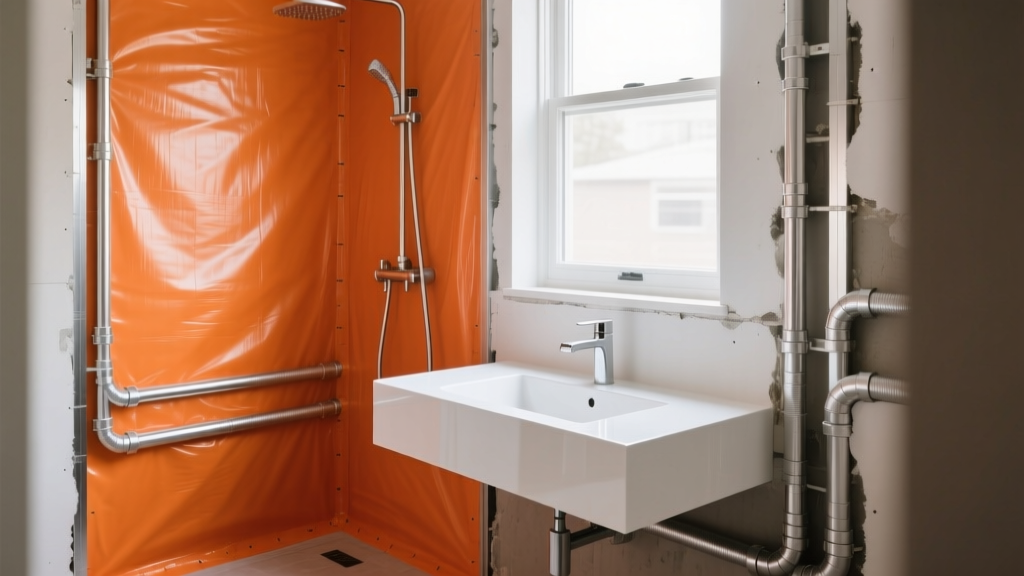
Traditional shower pans rely on a PVC or CPE liner sloped to a weep-hole drain. The primary failure mode of this system is weep-hole clogging from mortar fines, leading to a saturated, heavy mud bed and eventual efflorescence or mold. Modern construction mandates surface-applied waterproofing membranes.
Flooring & Radiant Heat
Porcelain tile remains the standard for bathroom flooring due to its sub-0.5% water absorption rate. However, stepping onto cold porcelain is a common comfort complaint. Integrating electric radiant heat beneath the tile adds $12 to $18 per square foot in materials. The Schluter-DITRA-HEAT uncoupling membrane (Model DHEMATE 5M) serves a dual purpose: it prevents tile cracking from subfloor deflection while housing the heating cables, eliminating the need for a separate self-leveling pour over the wires.
Hidden Cost Traps & Edge Cases
Budget overruns rarely happen because of tile choices; they happen behind the walls. When estimating how much it costs to build a bathroom, you must account for these structural and mechanical edge cases:
- Moving the Soil Stack: If your new bathroom layout requires relocating the main 3-inch or 4-inch soil stack, expect to add $2,500 to $5,000. This involves cutting through floor joists, which may require structural sistering or installing engineered lumber headers to maintain load-bearing integrity.
- Ventilation Undersizing: Building codes require a minimum of 50 CFM for intermittent exhaust or 20 CFM for continuous operation. However, a large master shower with a 9-foot ceiling requires 110+ CFM to prevent moisture migration into the attic. The Panasonic WhisperCeiling FV-0511VQ1 ($160-$190) offers 110 CFM at an incredibly quiet 0.3 sones, preventing the acoustic fatigue that causes homeowners to disable their fans.
- PEX-A vs. PEX-B Supply Lines: While PEX-B (crimp ring) is cheaper and faster for DIYers, PEX-A (Uponor ProPEX expansion) is vastly superior for behind-the-wall reliability. PEX-A fittings expand and contract with freeze-thaw cycles without bursting, and the internal diameter of the fittings matches the pipe, eliminating flow restriction. Upgrading to PEX-A adds roughly 15% to your rough plumbing labor but drastically reduces future leak risks.
Regional Labor Rate Variations
The National Kitchen & Bath Association (NKBA) notes that geographic location can swing final costs by up to 40%. Plumbing and electrical unions, local permit fees, and disposal costs create distinct pricing tiers across the country.
- Tier 1 (High Cost): San Francisco Bay Area, New York City, Boston. Expect licensed plumber rates of $175-$250/hour. Total project costs run 30-45% above national averages.
- Tier 2 (Moderate Cost): Chicago, Atlanta, Denver, Dallas. Plumber rates average $120-$160/hour. Costs align closely with national baselines.
- Tier 3 (Low Cost): Rural Midwest, Deep South. Plumber rates range from $85-$115/hour. Material costs remain identical, but total project costs drop 15-25% due to labor savings.
Decision Framework: DIY vs. General Contractor
Determining whether to self-manage the build or hire a General Contractor (GC) depends entirely on your ability to sequence trades and manage municipal inspections. A GC typically charges a 15% to 25% project management fee on top of subcontractor bids.
If you choose to act as your own GC, your critical path must follow this exact sequence to avoid costly rework: Demolition → Rough Framing → Rough Plumbing/Electrical/HVAC → Municipal Rough Inspection → Insulation → Drywall/Backerboard → Waterproofing → Tile → Finish Plumbing/Electrical. Skipping the waterproofing flood test (plugging the drain and filling the pan with 2 inches of water for 24 hours) is the most frequent and expensive mistake made by owner-builders.
Written by
David NakamuraDavid Nakamura is a licensed architect (AIA) and construction technology writer focused on sustainable building methods, mass timber engineering, and high-performance building envelopes. He holds a Master of Architecture from the University of Washington and is a certified Passive House Consultant (CPHC). David spent eight years at the Seattle firm Mithun, where he led the design of three LEED Platinum projects, before founding his own practice specializing in net-zero residential design. He serves on the editorial advisory board of GreenBuilder Magazine and has authored peer-reviewed papers on cross-laminated timber (CLT) connections for the Journal of Structural Engineering. In his spare time, David teaches woodworking at Pratt Fine Arts Center and kayaks the Puget Sound.
More from David Nakamura
View all
Construction Cost
Labor Cost to Build a Deck Per Sq Ft: 2026 Installation Guide
Discover the exact labor cost to build a deck per sq ft in 2026. This installation guide breaks down contractor rates, complexity factors, and hidden fees.
Aug 4, 2026

Construction Cost
How Much Does It Cost to Build a 3 Bedroom House? Financing Guide
Learn exactly how much it costs to build a 3 bedroom house and explore 2026 financing options, construction loan types, and budget frameworks for your build.
Aug 4, 2026

Construction Cost
Cost to Build a Tennis Court: 2026 Guide
How much does it cost to build a tennis court in 2026? Breakdowns for asphalt, concrete, and synthetic surfaces plus fencing and lighting.
Jul 30, 2026