Cost to Build a Basic AR-15: 2024 Baseline vs 2026 Money-Saving Guide
Discover the true cost to build a basic AR-15 in 2026 compared to 2024 baselines. Expert money-saving strategies, exact part lists, and tool cost breakdowns.

The Shift in AR-15 Build Economics: 2024 vs 2026
Estimating the cost to build basic AR-15 configurations requires separating internet forum myths from actual market economics. When analyzing the baseline cost to build basic AR-15 setups from the 2024 market, builders typically budgeted between $600 and $750 for a reliable, entry-level rifle. However, the 2026 landscape has shifted. While supply chain bottlenecks for 7075-T6 aluminum forgings and 4150 Chrome Moly Vanadium (CMV) steel have largely resolved, inflation in precision machining and specialized coatings (like Melonite/QPQ nitride) has pushed the true baseline for a safe, duty-grade build to $650–$820.
The most effective money-saving strategy is not buying the cheapest parts available; it is strategically allocating capital to high-stress components while trimming fat on non-critical aesthetics. This guide provides an exact cost-estimating framework for a 16-inch, 5.56 NATO direct-impingement build, highlighting where to cut costs and where to maintain strict quality control.
Core Component Cost Breakdown (The 'Basic' Build)
A 'basic' AR-15 does not mean a low-quality AR-15. It refers to a standard 16-inch mid-length gas system rifle with a free-float M-LOK handguard and a durable finish. Below is the cost matrix comparing 2024 average pricing to current 2026 estimates for mil-spec equivalent components.
| Component Category | 2024 Avg Cost | 2026 Est. Cost | Recommended Spec / Material |
|---|---|---|---|
| Stripped Lower Receiver | $105 | $115 | 7075-T6 Aluminum, Mil-Spec Anodized |
| Lower Parts Kit (LPK) | $65 | $75 | Standard Mil-Spec (Exclude trigger/grip) |
| Buffer Tube Assembly | $70 | $85 | Mil-Spec 7075-T6, Carbine H1 Buffer |
| Stripped Upper Receiver | $95 | $110 | 7075-T6 Forged, M4 Feed Ramps |
| Barrel (16' Mid-Length) | $160 | $185 | 4150 CMV Steel, Nitride, 1:7 Twist |
| Bolt Carrier Group (BCG) | $135 | $155 | Carpenter 158 Bolt, HPT/MPI, Staked |
| Handguard (13.5' - 15') | $140 | $160 | 6061-T6 Aluminum, Free-Float M-LOK |
| Charging Handle & Gas Block | $55 | $65 | Low-Profile Steel Gas Block, Pinned |
| Total Core Hardware | $825 | $950 | Excludes Tools, Optics, and Furniture |
The 80% Lower Receiver Myth in 2026
A common money-saving strategy historically involved purchasing '80% lower receivers' to avoid the cost of an FFL transfer fee and the associated paperwork. Following the ATF's Final Rule on the definition of a frame or receiver, the regulatory landscape has fundamentally changed. As detailed by the ATF's official guidance on frames and receivers, partially completed receivers that can be 'readily converted' are now classified as firearms.
Consequently, the secondary market and retail pricing for jigs and 80% blanks have inflated, while the legal risks and serialization requirements have increased. As noted in NRA-ILA's analysis of the Final Rule, the cost-benefit ratio of 80% lowers has collapsed for the average builder. In 2026, purchasing a serialized, stripped 7075-T6 lower receiver from a reputable manufacturer like Aero Precision or Anderson Manufacturing for $115, plus a $10-$20 FFL transfer fee, is significantly more cost-effective and legally secure than navigating the modern 80% lower market.
Essential Gunsmithing Tools: Capital vs. Sunk Costs
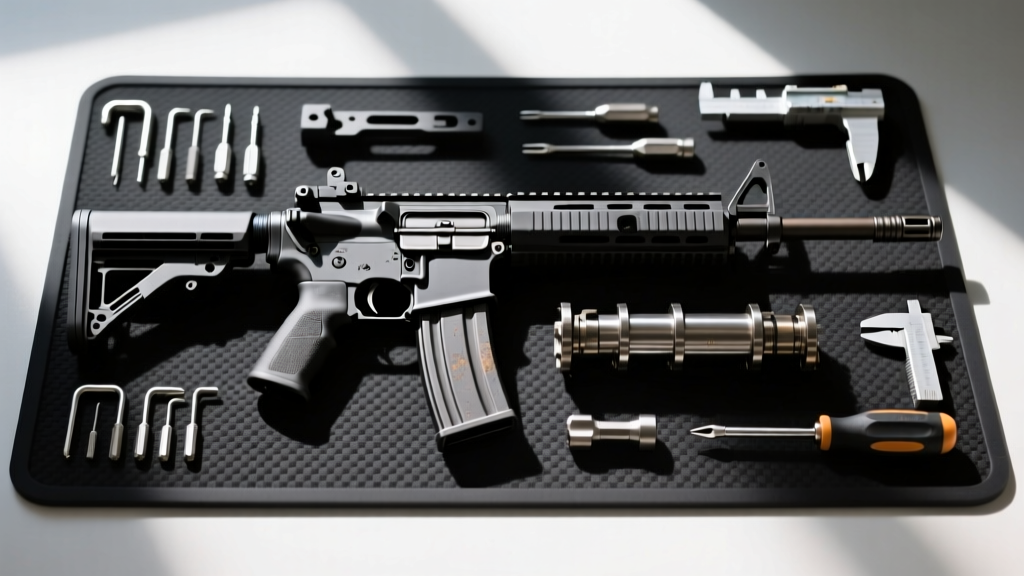
You cannot assemble an AR-15 safely with a standard household toolbox. Improper torque on a barrel nut or flash hider can lead to catastrophic failure. However, buying a $300 armorer's kit is a waste of capital for a single basic build. Here is the exact tooling required and the estimated cost.
- Upper Receiver Vise Block: Wheeler Engineering Delta Series Block ($35). Do not use cheap clamshell blocks; they can crack the upper receiver indexing pin hole when torquing the barrel nut.
- Armorer's Wrench: Brownells or Magpul Armorer's Wrench ($25-$30). Required for the castle nut and barrel nut.
- Barrel Nut Torque Tool: Depends on the handguard. Many modern free-float handguards (like Aero Precision Atlas) require a specific proprietary wrench, often included in the box. Verify before purchasing.
- Roll Pin Starter Punches: Wheeler Engineering Roll Pin Starter Punch ($15). Essential for installing the bolt catch and trigger guard without marring the lower receiver's anodized finish.
- 1/2' Torque Wrench: A standard automotive beam-style or click torque wrench ($40). Required to torque the barrel nut to 35-80 ft-lbs (depending on manufacturer specs).
Never rely on Loctite alone for the BCG gas key screws. They must be mechanically staked. If your chosen BCG arrives with improperly staked screws, you will need a staking tool (like the Pierce Engineering GI Staking Tool, ~$45) and a 3/16' Allen key. Budget for this tool if buying a budget BCG, or simply buy a BCG from BCM or SOLGW that comes properly staked from the factory to save the tool cost.
Where to Actually Cut Costs (Without Compromising Safety)
To bring the 2026 build cost down from $950 closer to the $700 mark, you must apply strategic value engineering to non-critical components.
1. The LPK and Trigger Strategy
Do not buy an 'Enhanced' Lower Parts Kit for $120. Instead, buy a standard mil-spec LPK without the trigger and grip (e.g., CMMG or Bravo Company Manufacturing standard kit for ~$55). Use the included mil-spec trigger and standard A2 pistol grip. This saves $40-$60 immediately. If you want a better trigger later, upgrade to an ALG ACT (Advanced Combat Trigger) for $65, which offers a vastly superior pull for a fraction of the cost of a Geissele or Radian trigger.
2. Furniture and Stocks
The stock and grip do not affect the ballistic performance or safety of the rifle. While a Magpul CTR stock and MOE grip are excellent, they add $90 to the build. Utilizing a standard mil-spec M4 carbine stock and A2 grip (often available as a complete assembly for $45) saves nearly $50. You can easily swap the stock out years later without affecting the rifle's core mechanics.
3. Sourcing 'Blem' or Cerakote Overruns
Manufacturers like Aero Precision and Palmetto State Armory frequently sell 'Blem' (blemished) receivers. These are structurally flawless forgings that feature minor cosmetic defects in the Type III hardcoat anodizing, such as slight color variations or minor machining marks in non-visible areas. Purchasing a Blem upper/lower combo can shave $60 to $80 off the total build cost while maintaining exact structural integrity.
Hidden Costs and Assembly Gotchas
First-time builders frequently blow their budget by making avoidable mistakes that require purchasing replacement parts. Factor these potential hidden costs into your initial estimate:
- Stripped Castle Nuts: Using an armorer's wrench that is not fully seated on the castle nut will round off the notches. A replacement mil-spec castle nut costs $10, but the frustration and delayed build time are costly.
- Sheared Bolt Catch Roll Pins: If you do not use a roll pin starter punch and a dedicated bolt catch installation tool (or the 'tape and hammer' method), you will gouge the lower receiver. Cosmetic damage lowers resale value significantly.
- Gas Block Alignment: If you buy a barrel without a dimpled gas block seat, you must use a jig to ensure the set-screw gas block is perfectly aligned with the gas port. Misalignment causes short-stroking, requiring you to buy a new gas block and potentially a new gas tube ($30 total).
- Anti-Seize and Solvents: You need high-temperature anti-seize for the barrel nut and flash hider threads, and a high-quality CLP (like Slip 2000 EWL) for initial BCG lubrication. Budget $25 for these consumables.
Expert Insight: The barrel and the Bolt Carrier Group (BCG) are the heart of the rifle. Never buy a $90 no-name barrel or a $70 surplus BCG to save money. The cost of a catastrophic failure or the need to replace a headspaced bolt that fails Magnetic Particle Inspection (MPI) will instantly erase any initial savings. Allocate 40% of your total hardware budget strictly to the Barrel and BCG.
Final Cost Tally and Verdict
By utilizing stripped receivers, standard mil-spec furniture, and avoiding the inflated 80% lower market, a builder in 2026 can assemble a highly reliable, duty-capable AR-15 for approximately $740 to $780, including essential armorer tools and consumables.
While this represents a slight increase over the rock-bottom pricing seen during the 2024 market dips, the strategic allocation of funds ensures the rifle will withstand tens of thousands of rounds without critical failure. True cost estimation in firearms assembly is not about finding the lowest price tag; it is about identifying the exact intersection of metallurgical reliability and financial efficiency.
Written by
Elena RodriguezElena Rodriguez is a civil engineer and technical writer specializing in concrete technology, masonry systems, and ASTM/ACI compliance. She earned her B.S. in Civil Engineering from Texas A&M University and spent a decade at a materials testing laboratory, performing over 2,000 concrete compressive strength tests and masonry prism evaluations. Elena is an ACI-certified Field Testing Technician (Grade I) and a member of ASTM Committee C12 on Natural Building Stone. She currently consults on forensic engineering cases involving concrete failures and moisture intrusion. Based in San Antonio, TX, Elena is a proud member of the Society of Women Engineers (SWE) and coaches her daughter's FIRST Robotics team.
More from Elena Rodriguez
View all
Walls & Panels
Cost Analysis: Light Gauge Steel Framing Advantages and Disadvantages
Evaluate light gauge steel framing advantages and disadvantages through a strict cost analysis lens, comparing material, labor, and lifecycle expenses.
Aug 4, 2026

Walls & Panels
Gypsum Board Types: Exact Specifications, Thickness & Dimensions
Compare standard, Type X, and moisture-resistant gypsum board types. Get exact specifications, thicknesses, dimensions, and ASTM standards for your project.
Aug 4, 2026

Fire Resistance
Best Fire-Resistant Outdoor Decking Materials: 2026 Buyer Guide
Discover the best fire-resistant outdoor decking materials for 2026. Compare Class A PVC, aluminum, and hardwood options for WUI compliance and safety.
Aug 4, 2026