Cost to Build a House in NC: 2026 Regional Price Analysis
Discover the true cost to build a house in NC for 2026. Compare regional prices across the Coast, Piedmont, and Mountains with expert budget frameworks.
Why Statewide Averages Fail in North Carolina
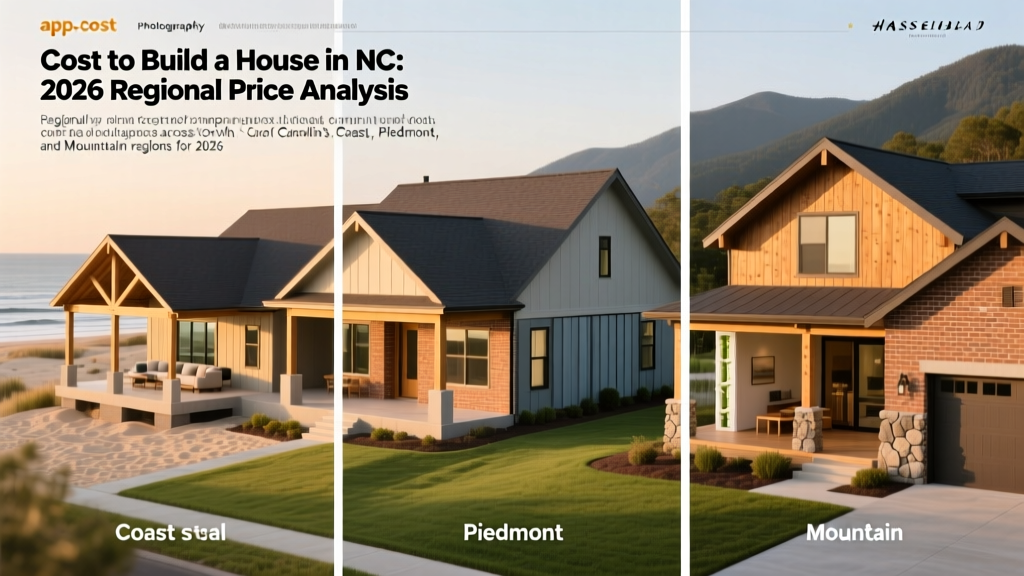
Quoting a single average for the cost to build a house in NC is a fundamental estimating error. North Carolina spans three distinct geophysical and regulatory zones: the Coastal Plain, the Piedmont, and the Appalachian Mountains. A 2,500-square-foot custom home that costs $412,500 to build in Raleigh could easily cost $525,000 on the Outer Banks or $485,000 in Boone, driven entirely by regional soil conditions, micro-climates, and localized building codes.
The Three North Carolinas: Regional Cost Breakdown
To accurately estimate your project, you must align your budget with the specific geological and regulatory demands of your county.
1. The Coastal Plain (Wilmington, Outer Banks, Morehead City)
Building on the coast is an exercise in wind and water mitigation. The NC Building Code Council enforces strict Wind-Borne Debris Regions (WBDR) along the coast, requiring structural enhancements that drastically alter foundation and framing costs.
- Foundation Premiums: Standard slab-on-grade is rarely viable in flood zones. Elevating a home on driven timber pilings or helical piles adds $18 to $32 per square foot to the foundation budget.
- Wind Load Engineering: Homes in 130-150 mph wind zones require continuous load-path hardware (e.g., Simpson Strong-Tie hurricane ties on every truss) and structural shear walls.
- Glazing Requirements: Impact-resistant windows with a minimum PG60 design pressure rating are mandatory in WBDR zones. Expect to pay $850 to $1,400 per opening, compared to $350 for standard vinyl dual-pane units.
2. The Piedmont (Charlotte, Raleigh, Greensboro)
The Piedmont is the state's population and construction hub. While it avoids the extreme wind codes of the coast, builders here battle expansive soils and high municipal tap fees.
- Soil Mitigation: The region is dominated by the Cecil clay series and Triassic Basin clays, which expand and contract violently with moisture changes. Standard shallow footings often fail. Budget an extra $8,000 to $14,000 for geotechnical engineering and reinforced grade beams or drilled concrete piers.
- Utility Tap Fees: Municipalities in the Research Triangle (e.g., Raleigh, Durham, Cary) charge some of the highest water and sewer capacity fees in the Southeast. A single residential water/sewer tap can cost between $8,500 and $14,000 before a single trench is dug.
- Labor Demand: High commercial and residential volume in the I-85 and I-40 corridors keeps framing and MEP (mechanical, electrical, plumbing) labor rates 12% to 18% above the state average.
3. The Mountains (Asheville, Boone, Banner Elk)
Mountain construction is defined by topography, rock, and temperature. The logistical challenges of moving materials up steep, winding access roads create immediate budget friction.
- Excavation and Blasting: Building on a sloped lot often requires cutting into bedrock. Rock blasting permits and specialized excavation equipment can add $15,000 to $40,000 to site prep.
- Frost Line Depths: The NC Residential Code dictates deeper footings in the mountains to prevent frost heave. While the coastal frost line is roughly 6 inches, Watauga and Avery counties require footings down to 18 inches, increasing concrete volume by up to 30%.
- Off-Grid Utilities: Municipal sewer is rare outside city limits. A conventional septic system on rocky, sloped terrain often fails a standard perc test, necessitating an engineered drip-dispersal or aerobic system costing $18,000 to $28,000.
2026 Regional Cost Matrix: Hard Cost Projections
The following table illustrates the estimated hard construction costs (materials and labor, excluding land and soft costs) for a 2,500-square-foot, mid-grade custom home across the three regions.
| Region | Base Cost / Sq Ft | Site Prep & Foundation Premium | Code & Climate Premium | Total Est. Hard Cost (2,500 sq ft) |
|---|---|---|---|---|
| Coastal Plain | $185 - $215 | +$35,000 (Piling/Elevation) | +$28,000 (Impact glass, wind ties) | $555,000 - $620,000 |
| Piedmont | $175 - $205 | +$12,000 (Clay mitigation) | +$8,000 (Radon, standard codes) | $475,000 - $545,000 |
| Mountains | $190 - $225 | +$25,000 (Rock blasting, deep footings) | +$15,000 (Snow loads, freeze-proofing) | $545,000 - $615,000 |
Hidden Soft Costs That Derail NC Budgets
According to economic analyses by the National Association of Home Builders (NAHB), soft costs and regulatory fees account for nearly 25% of the final price of a new home. In North Carolina, specific localized fees catch out-of-state buyers and novice builders off guard.
If you are building in the designated coastal counties (e.g., Dare, Carteret, Brunswick), standard homeowners insurance may not cover wind damage. You must factor in the premiums for the NC Joint Underwriting Association (Windstorm Pool), which can cost 40% to 60% more than standard inland property policies. This ongoing cost affects the long-term affordability analysis of your build.
Top 3 Overlooked NC Soft Costs
- Driveway and Access Permits (Mountains & Rural): NCDOT requires strict driveway entrance permits for any cut into a state-maintained road. In mountain counties, if your driveway exceeds a 12% grade, you must engineer paved turnarounds and retaining walls just to get the permit approved.
- Tree Conservation Ordinances (Piedmont): Cities like Charlotte and Raleigh enforce strict tree canopy retention rules. You may be forced to redesign your footprint to save specific hardwoods, or pay hefty mitigation fees (up to $400 per inch of trunk diameter) to remove them.
- Coastal Area Management Act (CAMA) Permits: Building near estuaries or marshlands requires CAMA permits, which involve environmental surveys, biological assessments, and months of waiting time, adding $4,000 to $8,000 in consulting fees.
The 2026 NC Build Budget Framework
To protect your capital, apply this regional decision framework before finalizing your lot purchase or architectural plans:
- If building on the Coast: Allocate 18% of your total budget strictly to the foundation and building envelope. Do not value-engineer your roof deck; use 5/8-inch tongue-and-groove plywood with ring-shank nails to meet high-wind uplift codes.
- If building in the Piedmont: Mandate a Phase I geotechnical soil test ($1,500 - $2,500) before closing on the lot. If the plasticity index (PI) of the clay exceeds 25, immediately budget for an engineered post-tension slab or grade beam foundation.
- If building in the Mountains: Verify the lot's winter access and well-drilling depth. A 400-foot deep well in Avery County can cost $15,000+ to drill and case. Always include a $20,000 contingency specifically for subsurface rock removal.
Frequently Asked Questions
Is it cheaper to buy an existing home or build in NC in 2026?
In high-growth Piedmont markets like Mooresville and Apex, building a custom home often costs 10% to 15% more per square foot than buying a 5-year-old resale, primarily due to current labor rates and land scarcity. However, building allows you to avoid the immediate $40,000+ renovation costs often required to update older coastal or mountain properties to current energy and wind codes.
How do lumber tariffs affect NC framing costs?
Southern Yellow Pine (SYP), heavily harvested in the Carolinas, buffers NC builders from some Canadian softwood lumber tariffs. However, engineered wood products (LVL beams, I-joists) remain subject to global supply chain pricing. Expect engineered framing materials to consume 8% to 11% of your total material budget in 2026.
Written by
Priya KapoorPriya Kapoor is a real estate market analyst and construction economics researcher with expertise in housing affordability, development feasibility, and infrastructure investment. She holds a Master of Regional Planning from Cornell University and previously worked as a senior analyst at CBRE's Investment Properties group, where she modeled returns for $4B in mixed-use development pipelines. Priya now runs an independent research practice advising developers, municipalities, and REITs on construction cost forecasting and market timing. She publishes the quarterly "BuildMat Market Pulse" report tracking material price indices across 12 commodity categories. Based in Austin, TX, Priya serves on the board of Habitat for Humanity Austin and is a marathon runner.
More from Priya Kapoor
View all
Construction Cost
Cost to Build a 1600 Sq Ft Home in 2026: Full Breakdown
Accurate 2026 cost to build a 1600 sq ft home—material, labor, and regional pricing breakdowns included. Plan your budget with real-time estimates.
Aug 11, 2026

Wood & Lumber
Name the Types of Wood for Pressure Treatment and Preservation
Learn how to name the types of wood best suited for pressure treatment. Compare species treatability, chemical retention levels, and 2026 preservation costs.
Aug 4, 2026

Stone & Masonry
Stone Veneer Suppliers Lindenhurst: 2026 Cost Analysis
Analyze 2026 stone veneer costs in Lindenhurst, NY. Compare local supplier pricing, delivery fees, and Suffolk County installation labor rates.
Aug 4, 2026