Exact Cost to Build a House by Yourself: Detailed Material Breakdown
Discover the exact cost to build a house by yourself with our detailed material and labor breakdown, helping owner-builders budget accurately.
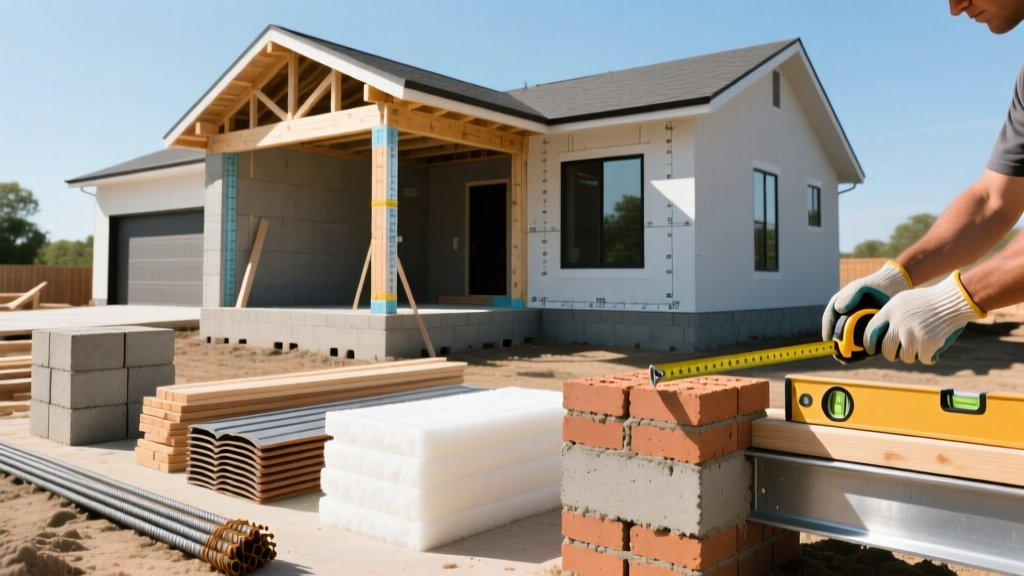
The Owner-Builder Financial Framework
Acting as your own general contractor—often called an owner-builder—fundamentally alters the financial architecture of residential construction. The primary appeal is the elimination of the general contractor (GC) markup, which typically ranges from 15% to 25% of the total project cost. However, calculating the true cost to build a house by yourself requires moving beyond simple material receipts. You are trading capital for sweat equity, time, and project management risk.
According to data tracked by the U.S. Census Bureau regarding new residential construction, the median price per square foot for contractor-built homes continues to climb. For a standard 2,000-square-foot stick-built home, hiring a GC in 2026 will cost between $300,000 and $400,000 depending on regional labor rates. By managing the project and performing select labor yourself, the material-only cost drops to roughly $160,000 to $220,000. But this delta is not pure profit; it is consumed by hidden overhead, tool acquisition, and the steep learning curve of building code compliance.
Phase-by-Phase Cost Breakdown (2,000 Sq Ft Home)
To understand where your money goes, we must dissect the construction process into its core phases. The National Association of Home Builders (NAHB) regularly publishes construction cost surveys that outline the percentage breakdown of residential building phases. Below is a detailed material-cost matrix for a 2,000 sq ft home, comparing turnkey contractor pricing against owner-builder material costs.
| Construction Phase | Contractor Turnkey Cost | DIY Material-Only Cost | Primary Material Drivers |
|---|---|---|---|
| Site Prep & Earthwork | $14,000 | $8,500 | Gravel base, erosion control, utility trenching |
| Foundation (Poured) | $28,000 | $16,500 | 4,000 PSI concrete, #4 rebar, Sonotubes |
| Framing & Sheathing | $45,000 | $24,000 | SPF #2 lumber, engineered trusses, OSB |
| Exterior (Roof/Siding) | $38,000 | $22,500 | Architectural shingles, Tyvek wrap, vinyl/fiber cement |
| MEP Systems (Subbed) | $45,000 | $38,000 | PEX plumbing, copper wire, HVAC ducting |
| Interior Finishes | $70,000 | $42,000 | Drywall, LVP flooring, cabinetry, trim |
| Total Estimated Cost | $240,000 | $151,500 | Savings: $88,500 (Gross) |
Deep Dive: The Framing Package
Framing is where owner-builders often miscalculate the most. A 2,000 sq ft home requires approximately 16,000 to 19,000 board feet of framing lumber. With SPF #2 2x4x8 studs averaging $3.85 to $4.50 each in 2026, the raw wall framing demands a $14,000 budget. However, you must also factor in engineered roof trusses ($8,500 to $11,000 depending on pitch and span), LVL beams for open-concept spans ($1,200), and 7/16-inch OSB sheathing ($4,500). Attempting to hand-frame a complex roof instead of ordering pre-fabricated trusses rarely saves money once you calculate the labor hours and waste factor.
The Hidden Overhead of Self-Building
When researching the cost to build a house by yourself, most estimates focus strictly on the physical structure. They ignore the logistical infrastructure required to sustain a construction site for 6 to 12 months. These hidden overhead costs routinely consume $8,000 to $14,000 of an owner-builder's budget.
- Temporary Utilities: Installing a temporary power pole and meter base ($800 to $1,200) and paying commercial construction electricity rates during the build.
- Waste Management: A 30-yard construction dumpster costs $400 to $550 per haul. A 2,000 sq ft home generates roughly 4 to 6 full dumpsters of waste ($2,000 to $3,300 total).
- Site Sanitation: Renting a portable toilet for the duration of the build ($100 to $150 per month).
- Builder's Risk Insurance: Unlike standard homeowner's insurance, a builder's risk policy covers materials on-site against theft, fire, and wind. Expect to pay $1,500 to $3,000 for a 12-month policy.
- Tool Acquisition & Depreciation: If you do not already own professional-grade tools, purchasing a pneumatic framing nailer, air compressor, compound miter saw, and laser levels will add $3,500 to $5,000 to your upfront costs.
Trade Delegation Matrix: DIY vs. Subcontract
The most successful owner-builders do not attempt to build the entire house with their own hands. They act as project managers, performing low-risk, high-labor tasks while subcontracting highly regulated or time-sensitive trades. Below is a decision framework to help you allocate your sweat equity effectively.
High-Value DIY Tasks
- Drywall Hanging & Finishing: High labor cost, low code risk. Materials (1/2-inch standard, 5/8-inch Type X for garages) are cheap.
- Insulation: Installing Rockwool Comfortbatt (R-15 for 2x4 walls, R-23 for 2x6 walls) is straightforward and saves thousands in labor.
- Interior Painting & Trim: Time-consuming but requires zero licensing. High margin for sweat equity.
- Landscaping & Final Grading: Moving dirt and laying sod post-construction is easily managed by the owner.
Mandatory Subcontracts
- Excavation & Septic: Requires heavy machinery and precise laser grading. Mistakes lead to catastrophic water intrusion.
- Concrete Flatwork: Concrete cures rapidly. Pouring and finishing a 1,200 sq ft garage slab requires a 5-man crew to meet the 4,000 PSI finish window.
- Electrical & Plumbing: Municipalities require licensed masters to pull permits and perform rough-in inspections. Unpermitted work will halt your certificate of occupancy.
- Roofing: Fall liability and manufacturer warranty requirements (e.g., GAF Golden Pledge) mandate certified installers.
Financing the Sweat Equity
Securing capital is the steepest hurdle for owner-builders. Traditional mortgage lenders view self-built homes as high-risk because they lack the guarantees provided by a licensed, bonded general contractor. To finance the cost to build a house by yourself, you will likely need a specialized Construction-to-Permanent (C2P) loan.
According to Bankrate's construction loan guidelines, lenders offering owner-builder loans typically require a significantly higher down payment—often 20% to 30% compared to the 5% to 10% required for standard mortgages. Furthermore, the lender will require a comprehensive, line-item budget, architectural blueprints, and proof of your ability to manage the project. Some lenders mitigate their risk by requiring you to hire a licensed GC as a 'consultant' or mandating that a third-party construction inspector verify each draw phase before releasing funds. If you possess significant equity in existing land, leveraging that land as collateral can vastly improve your approval odds and reduce your out-of-pocket cash requirements for the initial site work and foundation phases.
Written by
Marcus ChenMarcus Chen is a licensed structural engineer (PE) and building materials analyst with over 12 years of experience across residential, commercial, and industrial construction. He holds a Master of Science in Civil Engineering from UC Berkeley and spent six years at Thornton Tomasetti before transitioning to independent consulting and technical writing. Marcus specializes in material selection for seismic-prone regions, concrete reinforcement strategies, and lifecycle cost analysis. His work has been cited by the American Concrete Institute (ACI) and the Structural Engineers Association of California (SEAOC). When he is not on a job site or at his desk, you will find him hiking the Sierra Nevada or restoring a 1920s craftsman bungalow in Oakland, CA.
More from Marcus Chen
View all
Construction Cost
How Much Did the Eiffel Tower Cost to Build?
How much did the Eiffel Tower cost to build in 1889? We adjust for inflation and compare its budget to modern skyscraper construction.
Aug 4, 2026

Fire Resistance
What Is a Fire Resistant Material? Testing & Certification Guide
Discover what is a fire resistant material through ASTM and UL testing. Learn how fire ratings, certifications, and assemblies work in construction.
Aug 4, 2026

Construction Cost
How Much Did the Burj Khalifa Cost to Build?
How much did the Burj Khalifa cost to build? We break down the $1.5B project and extract 5 money-saving strategies for your next build.
Jul 30, 2026