Cost to Build Inground Swimming Pool: 2026 Size & Scope Calculator
Calculate the exact cost to build inground swimming pool projects in 2026. Break down pricing by size, depth, materials, and equipment scope.

The Core Formula: Base Material Costs by Footprint
Calculating the true cost to build inground swimming pool projects requires moving beyond national averages. In 2026, the base price is dictated by your chosen shell material and the total square footage of the water surface. The footprint determines excavation volume, steel rebar tonnage, and plumbing run lengths.
| Shell Material | Small (10x20 ft / 200 sq ft) | Medium (14x28 ft / 392 sq ft) | Large (20x40 ft / 800 sq ft) | Cost per Sq Ft (2026) |
|---|---|---|---|---|
| Gunite / Shotcrete | $45,000 - $55,000 | $65,000 - $85,000 | $110,000 - $145,000 | $130 - $180 |
| Fiberglass (Pre-molded) | $35,000 - $45,000 | $50,000 - $65,000 | $75,000 - $95,000 | $110 - $150 |
| Vinyl Liner | $30,000 - $40,000 | $45,000 - $60,000 | $70,000 - $90,000 | $90 - $125 |
Note: These baseline costs include excavation, shell installation, basic plumbing, and standard coping. They do not include hardscaping, fencing, or advanced equipment.
The Depth Multiplier: Volume and Engineering Constraints
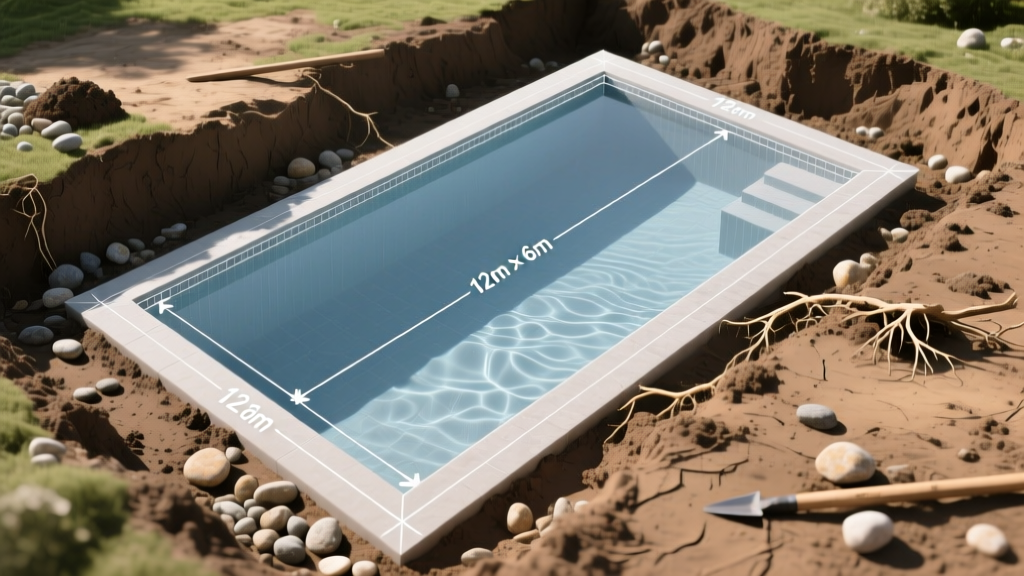
Depth is the most misunderstood variable in pool estimating. Increasing the deep end from 5 feet to 8 feet does not merely add 3 feet of dirt removal; it fundamentally alters the structural engineering and hydraulic requirements of the build.
If your scope includes a diving board or jump rock, you must adhere to the ANSI/APSP-7 standard for safety. This mandates a minimum 8-foot deep end, a specific transition slope (usually 3:1 or 4:1), and an extended deep-water envelope. Transitioning from a standard 'play pool' (3' to 5' depth) to a diving profile increases excavation and gunite costs by $6,500 to $12,000 due to the need for deeper structural footings and additional shotcrete thickness to withstand the hydrostatic pressure.
Volume-Based Cost Scaling
- Standard Play Pool (3' - 5' depth): ~15,000 to 20,000 gallons. Base excavation and structural costs apply.
- Deep End / Lap Pool (3' - 6' depth): Adds roughly 15% to excavation costs due to increased soil removal and shoring requirements.
- Diving Profile (3' - 8'+ depth): Adds 25-35% to excavation and shell costs. Requires specialized soil compaction testing.
Equipment Sizing: Matching BTUs and GPM to Pool Volume
As your pool's square footage and depth increase, the equipment required to maintain it scales non-linearly. Undersizing equipment to save on upfront costs will result in premature failure and poor water clarity.
According to current Energy Star guidelines for pool pumps, variable-speed pumps are mandatory for new residential installations in most jurisdictions. When sizing your equipment pad, use the following 2026 benchmarks:
Filtration and Pump Sizing
For a 20,000-gallon medium pool, you need a pump capable of turning over the water in 6-8 hours. A single-speed 2 HP pump costs around $800 but consumes roughly 3,000 kWh annually. Upgrading to a variable-speed model like the Pentair IntelliFlo3 VSF ($1,600 - $1,900 installed) drops energy consumption to under 800 kWh/year, yielding an ROI in roughly 2.5 years.
Heater Sizing Matrix
| Pool Volume | Recommended Gas Heater (BTU) | Recommended Heat Pump (BTU) | Estimated 2026 Installed Cost |
|---|---|---|---|
| Under 15,000 Gal | 200,000 BTU | 90,000 - 110,000 BTU | $3,200 - $4,500 |
| 15,000 - 25,000 Gal | 300,000 - 400,000 BTU | 120,000 - 140,000 BTU | $4,500 - $6,800 |
| Over 25,000 Gal | 400,000 BTU | 140,000+ BTU (or dual units) | $6,500 - $9,500+ |
The Scope Creep Matrix: Upgrades and Add-Ons
The base shell is only half the equation. The true cost to build inground swimming pool environments escalates through hardscaping, sanitation upgrades, and automation. Use this matrix to calculate your specific scope additions.
While traditional liquid chlorine is cheap upfront, saltwater chlorination systems like the Hayward AquaRite Pro ($1,800 - $2,400 installed) provide a much better user experience and stabilize chemical costs. However, salt accelerates the corrosion of soft coping stones like travertine or sandstone. If choosing saltwater, mandate hard coping materials such as bluestone, granite, or poured concrete with a sealed edge.
- Saltwater Chlorination System: +$1,800 to $2,500
- UV or Ozone Secondary Sanitation: +$1,200 to $2,000 (Reduces chlorine demand by 50-70%)
- Full Automation (e.g., Pentair IntelliCenter): +$3,500 to $6,000 (Includes smart panel, actuators, and app integration)
- Baja Shelf / Tanning Ledge: +$4,000 to $8,000 (Requires additional forming, dedicated return jets, and often an umbrella sleeve)
- Interior Finish Upgrades: Standard white plaster is included in base costs. Upgrading to pebble finishes (e.g., PebbleTec) adds $5,000 to $9,000; glass bead or polished finishes add $10,000 to $15,000.
- LED Lighting (Niche & Spa): $800 to $1,200 per fixture installed.
Site Access and Soil Excavation Variables
A size calculator is only accurate if the site conditions permit standard machinery access. According to industry data tracked by Angi's pool cost guides, site-specific anomalies can inflate the excavation budget by up to 40%.
Access Constraints
Standard excavation requires a mini-excavator or backhoe, which needs a minimum 8-foot wide clearance path from the street to the backyard. If your access is restricted to under 5 feet, contractors must use micro-excavators or manual labor, adding $3,000 to $7,000 to the labor budget. In extreme cases where dirt must be manually wheelbarrowed to the street or vacuumed out via truck, expect a premium of up to $12,000.
Soil Composition and Water Table
- Standard Soil (Loam/Clay): Base excavation rate.
- Heavy Rock / Limestone Shelf: Requires hydraulic hammering or blasting. Adds $4,000 to $15,000 depending on the rock density and volume.
- High Water Table: If the excavation fills with groundwater before the shell is set, the contractor must install a well-point dewatering system to keep the hole dry during gunite curing. This adds $2,500 to $5,500 for pump rentals and continuous monitoring.
- Expansive Clay: Requires over-excavation and backfilling with gravel to prevent shell cracking during freeze-thaw cycles, adding $2,000 to $4,000.
Step-by-Step Sizing Framework for Your Build
To finalize your budget, follow this sequential framework:
- Define the Footprint: Measure your usable yard space, subtracting local setback requirements (usually 10-15 feet from property lines). Select your base shell material and multiply the square footage by the 2026 per-sq-ft rate.
- Apply the Depth Multiplier: Determine if you need a diving profile. If yes, add 25% to your shell and excavation estimate.
- Calculate Equipment Loads: Estimate your total gallonage (Length x Width x Average Depth x 7.5). Use the equipment matrix to price your pump, filter, and heater.
- Add Scope Upgrades: Select your sanitation, automation, and interior finish upgrades from the scope matrix.
- Factor in Site Variables & Hardscaping: Assess your gate width and soil type. Finally, add $45 to $85 per square foot for surrounding concrete decking, or $120 to $200+ per square foot for premium paver or natural stone hardscaping.
By breaking down the cost to build inground swimming pool projects into these modular components, you eliminate the guesswork and can accurately scope a build that aligns with both your property's physical constraints and your financial parameters.
Written by
Marcus ChenMarcus Chen is a licensed structural engineer (PE) and building materials analyst with over 12 years of experience across residential, commercial, and industrial construction. He holds a Master of Science in Civil Engineering from UC Berkeley and spent six years at Thornton Tomasetti before transitioning to independent consulting and technical writing. Marcus specializes in material selection for seismic-prone regions, concrete reinforcement strategies, and lifecycle cost analysis. His work has been cited by the American Concrete Institute (ACI) and the Structural Engineers Association of California (SEAOC). When he is not on a job site or at his desk, you will find him hiking the Sierra Nevada or restoring a 1920s craftsman bungalow in Oakland, CA.
More from Marcus Chen
View all
Construction Cost
How Much Did the Eiffel Tower Cost to Build?
How much did the Eiffel Tower cost to build in 1889? We adjust for inflation and compare its budget to modern skyscraper construction.
Aug 4, 2026

Fire Resistance
What Is a Fire Resistant Material? Testing & Certification Guide
Discover what is a fire resistant material through ASTM and UL testing. Learn how fire ratings, certifications, and assemblies work in construction.
Aug 4, 2026

Construction Cost
How Much Did the Burj Khalifa Cost to Build?
How much did the Burj Khalifa cost to build? We break down the $1.5B project and extract 5 money-saving strategies for your next build.
Jul 30, 2026