True Cost Sq Ft to Build House: 2026 Regional Price Analysis
Discover the true cost sq ft to build house across US regions. Compare labor, material variances, and hidden regional expenses for accurate 2026 budgeting.
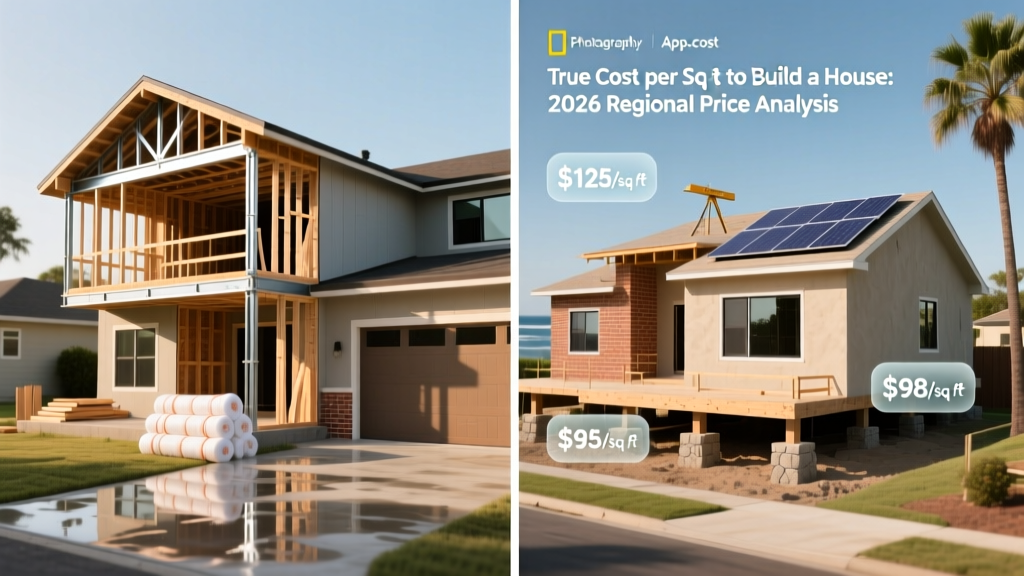
The Baseline: National Averages vs. Regional Realities
Calculating the exact cost sq ft to build house requires moving beyond misleading national averages. In 2026, the delta between building a standard 2,500-square-foot home in rural Ohio versus coastal California exceeds 140%. While the National Association of Home Builders (NAHB) tracks national construction cost indices, these macro-level figures obscure the localized labor rates, seismic code mandates, and material transport logistics that actually dictate your final budget.
When estimating the cost sq ft to build house, you must separate hard construction costs (lumber, concrete, labor) from soft regional costs (impact fees, specialized engineering, environmental mitigation). A production builder in Texas might quote $165 per square foot, but that figure assumes a flat slab-on-grade foundation, non-union labor, and standard asphalt shingles. Translating that same floor plan to the Northeast introduces frost-depth footings, union-scale prevailing wages, and strict energy codes that instantly push the cost sq ft to build house past $280.
Regional Cost Matrix: Where Your Dollar Goes Furthest
The following matrix breaks down the estimated cost sq ft to build house across the four major U.S. census regions for a mid-tier custom build (2,000–3,000 sq ft, mid-grade finishes, no luxury land prep).
| Region | Avg Cost Sq Ft | Primary Cost Drivers | Code Multiplier |
|---|---|---|---|
| Northeast | $240 - $320 | High union labor density, deep frost footings, strict IECC energy codes. | 1.25x |
| South | $165 - $235 | Lower labor costs, but coastal HVHZ wind codes add 12-15% in FL/TX. | 0.90x - 1.10x |
| Midwest | $180 - $250 | Moderate labor, expansive clay soil mitigation, heavy snow load roof trusses. | 1.00x |
| West | $260 - $410+ | Seismic retrofitting, Title 24 solar mandates, extreme wildfire zone materials. | 1.45x - 1.75x |

Deep Dive: The Three Biggest Regional Cost Variables
1. Structural Code Mandates and Climate Zones
Building codes are not uniform; they are localized responses to environmental threats. In Miami-Dade County, the High Velocity Hurricane Zone (HVHZ) requires impact-resistant glazing, reinforced concrete block (CBS) construction, and specialized roof tie-downs. This alone adds $22 to $35 per square foot compared to standard wood framing in Georgia. Conversely, in California, Title 24 mandates solar readiness, low-E glazing, and advanced insulation envelopes. The Department of Energy Building Codes portal highlights how these state-specific energy mandates can increase upfront shell costs by 8% to 12%, even if they yield long-term HVAC savings.
2. Frost Lines and Subsurface Engineering
The depth of your foundation is dictated by the local frost line. In central Florida, a slab-on-grade foundation requires minimal excavation, with footings sitting just 12 inches below grade. In Minnesota or upstate New York, footings must extend 48 to 60 inches below grade to prevent frost heave. This requires massive amounts of additional poured concrete, rebar, and excavation labor. Furthermore, regions with expansive clay soils—like the Dallas-Fort Worth metroplex—require post-tension slab engineering or deep-drilled piers, adding $5 to $8 per square foot to the foundation cost.
3. Labor Unionization and Prevailing Wage Laws
Labor accounts for 40% to 50% of the total cost sq ft to build house. In heavily unionized states like Illinois, New York, and Washington, prevailing wage laws and union scale requirements drastically elevate framing, plumbing, and electrical costs. A master electrician in Manhattan will cost upwards of $145 per hour, whereas the same licensed professional in rural Alabama may charge $65 per hour. This labor delta is the single largest reason the cost sq ft to build house in the Northeast and West Coast consistently outpaces the South.
Hidden Regional Costs That Break Budgets
When running your initial cost sq ft to build house calculations, amateur estimators often miss localized soft costs. Ensure your budget includes these regional variables:
- Impact and Capacity Fees: Fast-growing municipalities in Texas and Florida frequently levy water and sewer capacity fees that can exceed $15,000 per single-family lot.
- Wildfire Mitigation (WUI Codes): In California, Colorado, and Oregon, building in the Wildland-Urban Interface (WUI) requires Class A fire-rated roofing, ember-resistant vents, and non-combustible siding (like fiber cement), adding $12 to $18 per square foot to exterior costs.
- Snow Load Engineering: In the Mountain West and New England, roof trusses must be engineered for heavy snow loads (often 50-70 PSF), requiring closer truss spacing and heavier dimensional lumber.
- Geotechnical Soil Testing: Mandatory in regions with high water tables or seismic activity, comprehensive soil borings and engineering reports typically cost $3,000 to $6,500 before a single shovel hits the dirt.
Strategic Framework: Adjusting Your Build for Local Economics
To optimize the cost sq ft to build house in high-expense regions, you must employ value engineering rather than simply downgrading finishes. Value engineering means altering the structural and architectural approach to match local economic strengths.
"In high-labor-cost regions like the Northeast, shifting from traditional stick framing to prefabricated Structural Insulated Panels (SIPs) or Insulated Concrete Forms (ICF) reduces on-site labor hours by up to 30%. The material premium is offset by the labor savings and accelerated drying-in timeline."
Regional Adaptation Checklist:
- High Labor Cost Areas: Utilize panelized wall systems, pre-hung door assemblies, and modular roof trusses to minimize on-site carpentry hours.
- High Wind/Hurricane Areas: Skip the wood-frame and stucco upgrade; build with reinforced CMU (Concrete Masonry Units) from the start to avoid the premium of retrofitting and to secure lower insurance premiums.
- Remote/Supply-Chain Constrained Areas: Standardize your material list to match exactly what local big-box distributors stock in bulk, avoiding custom-order freight penalties on windows and dimensional lumber.
Frequently Asked Questions
Does the cost sq ft to build house include the land?
No. The cost sq ft to build house strictly refers to vertical construction costs (materials, labor, permits, and site prep). Land acquisition, well/septic installation (if off-grid), and long driveway paving are calculated as separate horizontal development costs.
Why is building a smaller house more expensive per square foot?
Fixed costs—such as the kitchen, HVAC systems, plumbing core, and permits—do not scale down linearly. A 1,200-square-foot home still requires a full kitchen, water heater, and electrical panel. Therefore, the cost sq ft to build house is always highest on the smallest structures and decreases as the total square footage increases.
How do I get an accurate regional estimate for my specific zip code?
Request detailed line-item bids from at least three local general contractors. National online calculators are often outdated by 12 to 18 months and fail to account for hyper-local municipal impact fees or recent shifts in local union labor agreements.
Written by
Priya KapoorPriya Kapoor is a real estate market analyst and construction economics researcher with expertise in housing affordability, development feasibility, and infrastructure investment. She holds a Master of Regional Planning from Cornell University and previously worked as a senior analyst at CBRE's Investment Properties group, where she modeled returns for $4B in mixed-use development pipelines. Priya now runs an independent research practice advising developers, municipalities, and REITs on construction cost forecasting and market timing. She publishes the quarterly "BuildMat Market Pulse" report tracking material price indices across 12 commodity categories. Based in Austin, TX, Priya serves on the board of Habitat for Humanity Austin and is a marathon runner.
More from Priya Kapoor
View all
Construction Cost
Cost to Build a 1600 Sq Ft Home in 2026: Full Breakdown
Accurate 2026 cost to build a 1600 sq ft home—material, labor, and regional pricing breakdowns included. Plan your budget with real-time estimates.
Aug 11, 2026

Wood & Lumber
Name the Types of Wood for Pressure Treatment and Preservation
Learn how to name the types of wood best suited for pressure treatment. Compare species treatability, chemical retention levels, and 2026 preservation costs.
Aug 4, 2026

Stone & Masonry
Stone Veneer Suppliers Lindenhurst: 2026 Cost Analysis
Analyze 2026 stone veneer costs in Lindenhurst, NY. Compare local supplier pricing, delivery fees, and Suffolk County installation labor rates.
Aug 4, 2026