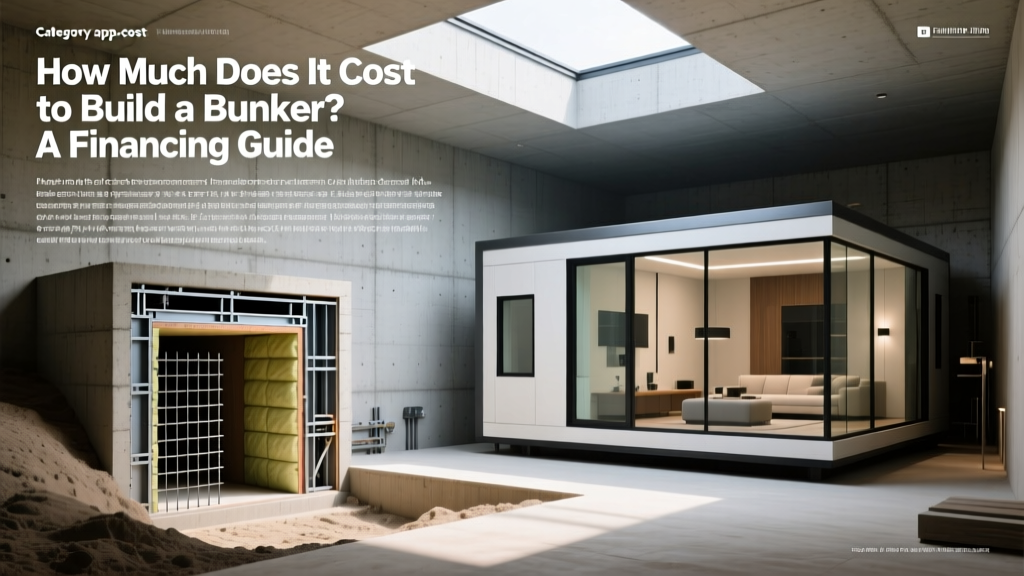
How Much Does It Cost to Build a Bunker? A Financing Guide
Discover how much it costs to build a bunker, from basic storm shelters to luxury underground homes, plus expert financing and loan strategies.
The True Cost Spectrum of Subterranean Construction
Answering the question of how much does it cost to build a bunker requires defining the structure's purpose. A basic tornado-safe room bolted to a concrete slab operates on an entirely different financial tier than a fully autonomous, nuclear-biological-chemical (NBC) rated subterranean estate. In the 2026 construction market, material costs for reinforced concrete and specialized steel have stabilized, but labor and excavation expenses remain highly localized.
According to FEMA Safe Room Guidelines, a compliant residential storm shelter designed to withstand EF5 tornadoes requires specific structural anchoring and impact-resistant materials. However, survival bunkers designed for long-term habitation require independent life-support systems, drastically altering the budget.
| Bunker Classification | Average Size | Cost Per Sq. Ft. | Total Estimated Cost | Primary Features |
|---|---|---|---|---|
| Prefab Storm Shelter | 50 - 100 sq ft | $100 - $200 | $5,000 - $20,000 | Steel/fiberglass shell, basic ventilation, bolted to slab |
| Mid-Tier Fallout Shelter | 400 - 800 sq ft | $250 - $450 | $100,000 - $360,000 | Poured concrete, NBC air filtration, manual blast doors |
| High-End Survival Bunker | 1,000 - 2,500 sq ft | $500 - $800 | $500,000 - $2,000,000 | EMP shielding, hydroponics, Swiss-made air filters, luxury finishes |
| Luxury Underground Estate | 3,000+ sq ft | $900 - $1,500+ | $2.7M - $10M+ | Multi-level, geothermal power, simulated windows, vehicle garage |
Financing Strategies for Bunker Construction
Securing capital for a bunker is fundamentally different from financing a standard home addition. Lenders view subterranean survival structures as specialty assets, which complicates traditional appraisal methods. Here is how to structure your financing based on project scale.
1. Home Equity Line of Credit (HELOC) and Cash-Out Refinance
For mid-tier bunkers ($50,000 to $250,000) built on an existing property, tapping into home equity is the most viable route. In 2026, HELOCs allow borrowers to draw funds as excavation and material milestones are met. The critical limitation is the Loan-to-Value (LTV) ratio. Most lenders cap combined LTV at 80% to 85%. If your bunker costs $150,000 and you need a 20% equity cushion, your home must appraise high enough to support the new debt load. Note that appraisers rarely assign a 1:1 dollar value to the bunker itself; it is often categorized as a 'specialty feature' rather than gross living area (GLA).
2. Construction-to-Permanent Loans
If you are purchasing raw land and building a primary residence with an integrated bunker, a construction-to-permanent loan is required. Lenders will finance the bunker as part of the overall build, but they will mandate a 15% to 20% contingency reserve specifically for the subterranean portion due to excavation unpredictability. You must provide engineered blueprints and soil bore tests before the underwriter will approve the draw schedule.
3. Unsecured Personal Loans
For basic prefab storm shelters under $40,000, unsecured personal loans offer rapid funding without putting your property on the line. Interest rates are higher, but the lack of appraisal requirements and underwriting red tape makes this ideal for simple backyard tornado shelters.
Do not attempt to finance a luxury survival bunker using government-backed loans. The FHA 203(k) rehabilitation loan and VA construction loans strictly prohibit funding for 'luxury amenities' or structures not permanently affixed as primary living space. You can only use these programs for basic, code-compliant storm shelters that meet the ICC 500 Standard for Storm Shelters.
Hidden Excavation and Site Preparation Costs
The most common reason bunker projects run out of capital is the failure to budget for subsurface anomalies. Excavation estimates are usually based on 'Type A' soil (easy to dig). Reality often differs.
- Bedrock Blasting: If excavators hit solid granite or limestone, mechanical blasting or hydraulic hammering is required. This increases excavation costs from $12 per cubic yard to $35–$50 per cubic yard.
- Dewatering Systems: Building below the water table requires continuous dewatering during construction and a permanent drainage solution. Installing a commercial-grade French drain and a dual sump pump system (e.g., Wayne CDU980E with battery backup) adds $4,500 to $8,000 to the budget.
- Soil Engineering and Shoring: Deep trenches (over 5 feet) require OSHA-compliant shoring or trench boxes to prevent cave-ins during the pouring of the concrete footer. Renting trench boxes and hiring a geotechnical engineer adds $3,000 to $6,000.
Specialty Systems: NBC Filtration and EMP Shielding
A concrete box is only a bunker if it can sustain life and protect against modern threats. Upgrading from a basic shelter to a hardened survival facility requires specialized mechanical and electrical systems.
NBC Air Filtration
Standard HVAC systems will pull radioactive dust or biological agents into the shelter. You must install a positive-pressure NBC filtration system. Swiss-made filter units (such as those from Andair or Temet) are the industry standard. A complete positive-pressure NBC system, including pre-filters, HEPA stages, and activated carbon beds, costs between $12,000 and $22,000. This system must be paired with manual blast valves (like the CBS blast valve) that automatically seal the intake pipes when an overpressure wave from an explosion is detected.
EMP and Faraday Shielding
To protect electronics from an Electromagnetic Pulse (EMP) or solar flare, the bunker's rebar grid must be electrically bonded and tied to a deep copper grounding rod. For higher-level protection, builders line the interior walls with copper mesh before framing. Murdock copper mesh or similar architectural shielding materials cost approximately $6 to $10 per square foot of surface area, adding $15,000 to $30,000 to a standard 1,000-square-foot bunker build.
Appraisal, Insurance, and ROI Realities
Will a bunker increase your property value enough to justify the financing? The answer depends entirely on geography and buyer demographics.
| Region / Market | Appraisal Impact | Insurance Implications | Estimated ROI at Resale |
|---|---|---|---|
| Tornado Alley (OK, TX, KS) | High (FEMA P-361 compliant safe rooms are recognized comps) | Potential windstorm premium discounts | 70% - 85% |
| Coastal / Hurricane Zones | Moderate (Valued as reinforced storage/storm refuge) | Neutral (Does not mitigate above-ground structural risk) | 40% - 60% |
| Urban / Suburban (Non-Disaster) | Low (Appraisers view as specialty/niche amenity) | Requires specialized rider for underground structures | 20% - 40% |
Insurance providers often require a separate rider for subterranean structures, particularly if they contain expensive mechanical systems or are prone to localized flooding. Always consult an underwriter before breaking ground to ensure the finished structure is insurable against water intrusion and structural collapse.
Step-by-Step Capital Allocation Plan
To prevent capital exhaustion mid-build, structure your bunker budget using this allocation framework:
- Site Analysis & Permitting (5%): Fund geotechnical soil boring, hydrology reports, and county zoning variances. Do not skip this; hitting a high water table after pouring the footer is a catastrophic financial failure.
- Excavation & Shoring (15%): Allocate funds for earthmoving, bedrock contingency, and trench safety.
- Shell & Waterproofing (35%): Poured reinforced concrete (minimum 4,000 PSI mix), exterior bentonite clay waterproofing membranes, and structural backfill.
- Mechanical & Life Support (25%): NBC filtration, positive pressure systems, backup generators, and EMP grounding.
- Interior Fit-Out & Contingency (20%): Framing, plumbing, electrical, and a hard cash reserve for unforeseen engineering pivots.
Understanding how much does it cost to build a bunker is only the first step; securing the right financing vehicle and respecting the hidden costs of subsurface engineering will determine whether your project becomes a secure asset or an abandoned excavation pit.
Written by
Sarah WhitfieldSarah Whitfield is a chartered quantity surveyor (MRICS) and construction cost analyst with 15 years of experience in material pricing, procurement strategy, and project budgeting. She earned her degree in Construction Management from the University of Reading (UK) and has worked on projects ranging from $2M custom homes to $180M mixed-use developments across North America and Europe. Sarah currently leads cost estimating for BuildMat Insight, maintaining a proprietary database of 4,000+ material price points updated quarterly. She is a frequent contributor to RSMeans cost data panels and has presented at the International Cost Engineering Council (ICEC) congress. Based in Denver, CO, Sarah is an avid trail runner and volunteer mentor for Women in Construction.
More from Sarah Whitfield
View all
Wood & Lumber
What Are the Different Types of Wood? A Builder's Guide
Compare structural softwoods, finish hardwoods, and engineered lumber. Analyze Janka ratings, MOE values, and 2026 pricing for construction.
Aug 4, 2026

Walls & Panels
Steel Framing vs Wood Framing: Corrosion and Moisture Defense
Compare steel framing vs wood framing for moisture resistance. Learn about galvanized coatings, condensation risks, and corrosion protection strategies.
Jul 21, 2026

Stone & Masonry
How to Cut Stone Veneer: Wet Saw vs Grinder Comparison
Compare the best tools for cutting stone veneer. We review wet saws, angle grinders, and chop saws to help you achieve clean, chip-free cuts.
Jul 21, 2026