How Much Does It Cost to Build an F1 Car in 2026?
Discover how much it costs to build an F1 car in 2026. We break down the composite materials, power unit fabrication, and structural scope.

The Structural Envelope: Monocoque and Composite Fabrication
Treating a Formula 1 car as a micro-construction project reveals a staggering bill of materials. The foundation of this build is the survival cell, or monocoque. Unlike traditional building framing that relies on structural steel or timber, the F1 structural envelope utilizes aerospace-grade carbon fiber composites. Specifically, teams procure T800 and T1000 series carbon fiber prepreg, which costs between $150 and $300 per kilogram in its raw state. However, the fabrication scope drastically inflates this price.
To achieve the required tensile strength and pass the FIA crash tests, the carbon fiber must be laid up in precise orientations using 5-axis CNC-milled aluminum molds. The assembly is then cured in an industrial autoclave at 7 bar of pressure and 120°C to 180°C. Once you factor in the mold machining, cleanroom labor, and autoclave operational costs, the fabricated cost of the monocoque rises to approximately $700,000 to $850,000 per unit. Furthermore, the cockpit is lined with Zylon anti-intrusion panels—a synthetic polymer that costs roughly $4,000 per square meter—to prevent debris penetration, adding another $45,000 to the structural material budget.
Mechanical Rough-In: 2026 Power Unit and Drivetrain Metallurgy
The mechanical systems of an F1 car represent the most complex procurement and assembly scope in the project. The 2026 FIA technical regulations introduced a massive shift in the power unit (PU) architecture, eliminating the MGU-H (Motor Generator Unit-Heat) and mandating a near 50/50 power split between the internal combustion engine (ICE) and the electrical systems. The new MGU-K must now deliver 350kW (nearly 470 horsepower), up from the previous 120kW.
This regulatory shift requires advanced metallurgy and precision machining. The gearbox casing is milled from a solid billet of Ti-6Al-4V titanium alloy. While raw titanium costs around $40 per kilogram, the 5-axis milling process, which takes over 100 hours and destroys multiple cutting tools, pushes the finished gearbox casing cost to roughly $150,000. The exhaust system is fabricated from Inconel 718, a nickel-chromium superalloy capable of withstanding 1,000°C thermal loads. Inconel tubing and 3D-printed Inconel exhaust manifolds cost upwards of $80,000 per set. According to the FIA Formula 1 Technical Regulations, teams are restricted in the number of PU components they can use per season, meaning the durability and material quality of these metals must be absolute, eliminating the use of cheaper, lower-grade alternatives.
2026 Power Unit Procurement Warning
With the increased electrical output required for the 2026 power units, thermal management of the battery energy store (ES) is critical. Teams must source advanced phase-change materials and liquid cooling micro-channels machined directly into the battery housing. Budget an additional $120,000 per chassis specifically for thermal management fabrication and specialized dielectric cooling fluids.
F1 Car Material and Fabrication Cost Matrix
Below is a detailed breakdown of the physical materials and direct fabrication costs required to assemble a single 2026-spec Formula 1 car. This matrix excludes R&D, wind tunnel operations, and engineering salaries, focusing strictly on the physical "construction" scope.
| Component Scope | Primary Materials | Estimated Fabrication Cost | Lifespan / Replacement Rate |
|---|---|---|---|
| Monocoque / Survival Cell | T800 Carbon Prepreg, Zylon, Nomex | $750,000 - $850,000 | 1 Season (Chassis Limit) |
| Power Unit (ICE + MGU-K) | Inconel, Titanium, Beryllium, Copper | $1,200,000 - $1,500,000 | 4-8 Races per element |
| Gearbox & Drivetrain | Ti-6Al-4V, Carbon Fiber, Maraging Steel | $350,000 - $450,000 | 6 Events per casing |
| Aerodynamic Bodywork | T300 Carbon, Kevlar, Polyurethane | $250,000 - $300,000 | 2-4 Races (High wear) |
| Suspension & Uprights | Carbon Fiber, Titanium, Inconel | $150,000 - $200,000 | 1 Season (Mileage based) |
| Electronics & Telemetry | Gold-plated connectors, Kevlar wiring | $100,000 - $120,000 | 1 Season |
| Total Physical Build Cost | $2,800,000 - $3,420,000 |
Exterior Cladding: Aerodynamic Bodywork Scope
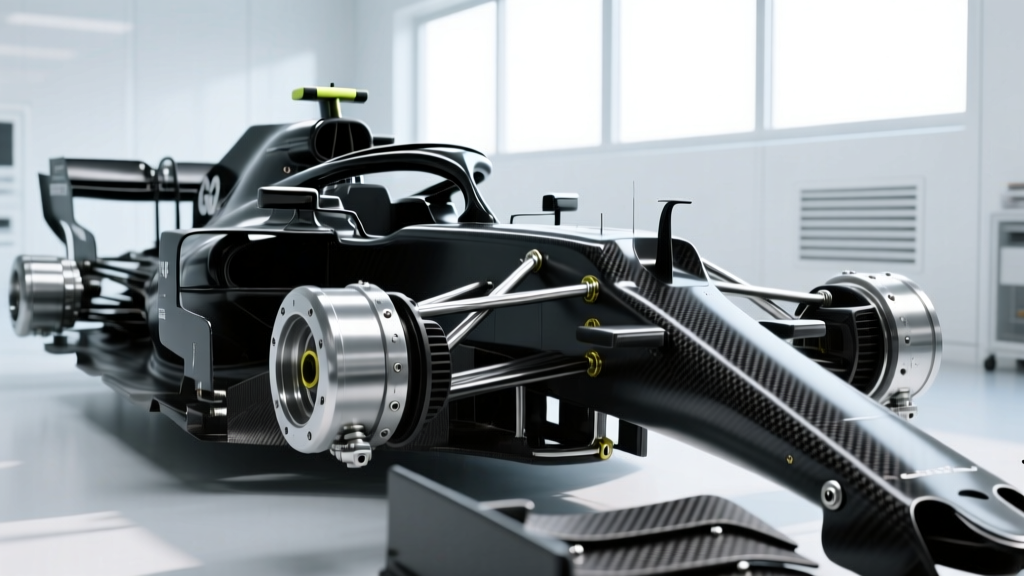
In construction, exterior cladding protects the envelope and defines the aesthetic. In F1, the aerodynamic bodywork dictates the car's entire performance profile. The front wing, floor, diffuser, and rear wing are constructed from lower-modulus T300 carbon fiber and Kevlar weaves to provide a balance of rigidity and impact resistance. The floor of the car, which generates the majority of the downforce via ground effect, is subjected to immense friction and spark-inducing titanium skid blocks.
Because aerodynamic components are highly susceptible to micro-fractures and track debris damage, the replacement scope is massive. A team will manufacture upwards of 150 front wings and 80 floor assemblies over a single season. According to CompositesWorld industry analysis on aerospace-grade carbon fiber manufacturing costs, optimizing the layup process and utilizing automated fiber placement (AFP) machines can reduce composite waste by 15%, a critical margin when operating under strict financial limits.
Electrical and Telemetry Infrastructure
The electrical rough-in of an F1 car involves routing over 1.5 kilometers of ultra-lightweight, Kevlar-shielded wiring. Every connector is gold-plated to prevent signal degradation and corrosion in high-humidity environments. The standard Electronic Control Unit (ECU), supplied by McLaren Applied, costs roughly $25,000, but the custom wiring harnesses and hundreds of piezoelectric sensors measuring tire loads, suspension travel, and thermal gradients add another $95,000 to the electrical scope.
Managing the 2026 FIA Cost Cap in Procurement
The physical cost of the car is only a fraction of the total expenditure. The real challenge for technical directors is managing the FIA F1 Cost Cap, which limits total team spending (excluding driver salaries and top-tier management). For 2026, the baseline cap is heavily scrutinized, with adjustments for inflation and the expanded sprint race calendar.
To stay compliant, teams have adopted construction-style Building Information Modeling (BIM) and Enterprise Resource Planning (ERP) software. Every gram of carbon fiber, every hour of autoclave time, and every machining tool is tracked against the cap. If a team designs a new rear wing, the cost of the wind tunnel testing, the CFD computing hours, the mold creation, and the final physical part must all be logged. This forces a shift from "build at all costs" to "build for maximum yield per dollar."
The Amortization Reality: While the physical materials and direct labor to assemble one F1 car sit around $3 million, the R&D, wind tunnel operations, and simulator time required to design that specific iteration push the true amortized cost of a single chassis to over $15 million. Procurement teams must balance raw material quality against the financial cap limits.
Sourcing High-Performance Composites for Specialized Projects
For engineers and project managers outside of motorsport looking to source similar high-performance materials for aerospace, defense, or specialized architectural structures, the F1 supply chain offers a blueprint. Procuring T800 prepreg requires establishing accounts with primary manufacturers like Toray or Hexcel. You must also secure access to industrial autoclaves capable of sustaining 7 bar pressures, as standard out-of-autoclave (OOA) vacuum bagging will not yield the necessary void-content percentages required for high-impact survival cells. Always specify the exact resin matrix—typically a toughened epoxy or bismaleimide (BMI) for high-heat zones near the power unit—when requesting quotes from composite fabricators to ensure your material scope aligns with your structural requirements.
Written by
Sarah WhitfieldSarah Whitfield is a chartered quantity surveyor (MRICS) and construction cost analyst with 15 years of experience in material pricing, procurement strategy, and project budgeting. She earned her degree in Construction Management from the University of Reading (UK) and has worked on projects ranging from $2M custom homes to $180M mixed-use developments across North America and Europe. Sarah currently leads cost estimating for BuildMat Insight, maintaining a proprietary database of 4,000+ material price points updated quarterly. She is a frequent contributor to RSMeans cost data panels and has presented at the International Cost Engineering Council (ICEC) congress. Based in Denver, CO, Sarah is an avid trail runner and volunteer mentor for Women in Construction.
More from Sarah Whitfield
View all
Wood & Lumber
What Are the Different Types of Wood? A Builder's Guide
Compare structural softwoods, finish hardwoods, and engineered lumber. Analyze Janka ratings, MOE values, and 2026 pricing for construction.
Aug 4, 2026

Walls & Panels
Steel Framing vs Wood Framing: Corrosion and Moisture Defense
Compare steel framing vs wood framing for moisture resistance. Learn about galvanized coatings, condensation risks, and corrosion protection strategies.
Jul 21, 2026

Stone & Masonry
How to Cut Stone Veneer: Wet Saw vs Grinder Comparison
Compare the best tools for cutting stone veneer. We review wet saws, angle grinders, and chop saws to help you achieve clean, chip-free cuts.
Jul 21, 2026