How Much Does It Cost to Build a Roller Coaster? Budget Guide
Discover how much it costs to build a roller coaster. Explore budget planning, steel vs. wood pricing, foundation costs, and hidden amusement park expenses.

Baseline Capital Requirements: Cost by Coaster Classification
When park developers and municipal planners ask how much does it cost to build roller coaster infrastructure, the answer requires moving beyond simple square-footage metrics. Amusement ride construction is a specialized discipline governed by extreme dynamic loads, stringent safety tolerances, and complex logistics. According to industry data tracked by the Roller Coaster DataBase (RCDB), capital expenditures vary wildly based on the ride's classification, propulsion method, and thematic integration.
Unlike commercial buildings where costs scale linearly with volume, roller coaster costs scale exponentially with height and speed due to the physics of kinetic energy and the resulting structural demands. Below is the baseline capital matrix for modern coaster construction.
| Coaster Classification | Typical Height | Track Length | Estimated Total Cost | Cost Per Linear Foot |
|---|---|---|---|---|
| Family / Kiddie | Under 50 ft | 1,000 - 2,000 ft | $1.5M - $4M | $1,000 - $2,500 |
| Standard Steel Thrill | 100 - 150 ft | 3,000 - 4,500 ft | $12M - $22M | $3,500 - $5,500 |
| Hybrid (Wood/Steel) | 150 - 200 ft | 4,000 - 5,500 ft | $18M - $30M | $5,000 - $7,500 |
| Mega / Giga Coaster | 200 - 300+ ft | 5,000 - 8,000 ft | $25M - $50M+ | $6,000 - $9,000 |
| LSM Launched Thrill | Varies | 2,500 - 4,000 ft | $20M - $35M | $8,000 - $15,000 |
Track Material and Fabrication Economics
The physical track represents roughly 30% to 40% of the total hardware budget. The choice of material dictates not only the initial capital outlay but the long-term maintenance liabilities.
Tubular Steel vs. Laminated Wood vs. Hybrid I-Box
- Tubular Steel: The industry standard for modern thrill rides. Fabricated from high-strength carbon steel (typically ASTM A500 Grade C or similar), the track is welded in precise jigs. The cost includes the spine, the running rails, and the internal stiffening plates. Expect to pay $4,000 to $6,000 per linear foot for fabricated, primed, and painted steel track.
- Laminated Wood: Traditional wooden coasters use Douglas Fir or Southern Yellow Pine laminated into structural beams, topped with a steel running rail. While the raw material is cheaper, the labor-intensive on-site assembly and the high maintenance cost (re-laminating and re-tracking every 10-15 years) alter the lifecycle budget.
- Hybrid (I-Box / Single Rail): Pioneered by manufacturers like Rocky Mountain Construction (RMC), hybrid tracks replace wooden running surfaces with prefabricated steel I-Box track. This costs 20% to 30% more upfront than traditional wood but reduces annual maintenance costs by up to 60%, offering a superior ROI for parks operating on tight annual OpEx budgets.
Geotechnical and Foundation Engineering
You cannot budget for a mega-structure without first budgeting for the dirt beneath it. Roller coasters subject their foundations to severe dynamic loading. A stationary support column might hold 15,000 lbs of static steel, but when a 12,000 lb train navigates a high-G pull-out at 75 mph, the dynamic load multiplier can reach 3.0 to 4.5, transferring over 60,000 lbs of instantaneous force into the concrete pier.
Before finalizing the foundation budget, a geotechnical survey is mandatory. If the soil bearing capacity is below 3,000 pounds per square foot (psf), engineers must design deeper spread footings or utilize driven steel piles. Piling can increase the foundation budget by 40% to 60%, adding $1M to $3M to a large-scale project.
Pier Sizing and Concrete Volumes
For a standard 150-foot-tall steel coaster, support piers range from 4 feet to 12 feet in diameter, extending 8 to 20 feet below grade. A single high-load pier may require 40 cubic yards of 4,000 PSI compressive-strength concrete, reinforced with a dense cage of #11 and #14 epoxy-coated rebar. At an installed cost of $180 to $250 per cubic yard (including excavation, forming, and pumping), a single major pier can cost $10,000 to $15,000. A 4,000-foot coaster with 150 supports will easily command a $1.5M to $2.5M foundation budget.
Propulsion and Control Systems
The method used to dispatch the train drastically alters the electrical and control budget.
Chain Lifts vs. Linear Synchronous Motors (LSM)
A traditional chain lift hill requires a massive central drive motor, a heavy-duty chain, and an anti-rollback dog system. It is mechanically simple and relatively inexpensive ($500,000 to $1.2M for a complete lift package). Conversely, an LSM launch system uses powerful electromagnets to propel the train. The copper windings, high-voltage capacitors, and cooling systems required for an LSM launch can push the propulsion budget past $3M to $5M. Furthermore, LSM systems require dedicated high-voltage substations, adding $500,000+ in utility infrastructure costs.
Block Zones and Safety PLCs
Modern coasters are divided into 'block zones' to prevent train collisions. Adherence to ASTM International Committee F24 standards requires redundant safety architectures. Parks must budget for fail-safe Programmable Logic Controllers (PLCs), such as Allen-Bradley GuardLogix or Siemens Simatic S7-1500F systems. Each block zone requires redundant proximity sensors, pneumatic brake fin actuators, and hardwired safety relays. The control package for a multi-train, launched coaster typically ranges from $800,000 to $1.5M.
Amusement ride safety is not an area for value engineering. Redundant block zone sensors and certified safety PLCs are non-negotiable requirements under modern ASTM F24 standards, and budget cuts in this sector will result in failed inspections and operational shutdowns.
Hidden Budget Killers in Amusement Construction
When calculating how much it costs to build roller coaster attractions, developers frequently underestimate the secondary construction elements that surround the ride.
- Freight and Logistics: Coaster track is shipped in 40-foot open-top containers or on specialized flatbed trailers. A mega coaster may require 400+ oversized load shipments. Budget $800,000 to $1.5M purely for global freight, port fees, and specialized heavy-haul trucking permits.
- Thematic Rockwork and GFRC: If the ride is themed, Glass Fiber Reinforced Concrete (GFRC) rockwork and sculpted facades can cost $150 to $300 per square foot. A heavily themed queue and station can easily add $5M to $10M to the project.
- Queue Architecture and ADA Compliance: Building the switchback queues, shade structures, misting fans, and ADA-compliant transfer stations requires standard commercial construction, often costing $1.5M to $3M before the ride hardware even arrives.
Budget Planning Framework for Park Developers
To ensure accurate capital allocation, developers should utilize the following percentage-based framework when structuring the master budget for a new, large-scale steel thrill coaster:
- Ride Hardware & Track (35%): Fabrication, trains, and raw materials.
- Civil & Foundation Work (20%): Excavation, piling, concrete, and grading.
- Controls & Electrical (10%): PLCs, sensors, lighting, and substations.
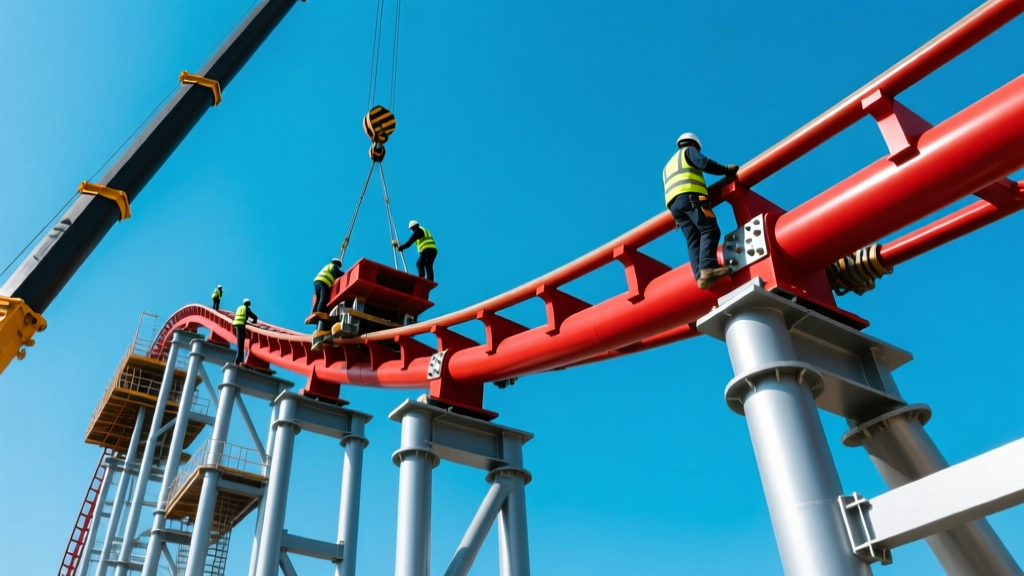
- Erection & Labor (15%): Specialized crane rentals, ironworkers, and millwrights.
- Theming, Queue & Station (15%): Architecture, landscaping, and GFRC rockwork.
- Contingency & Testing (5%): Commissioning, ASTM testing, and unforeseen geotechnical issues.
By understanding the deep structural, mechanical, and logistical realities of amusement construction, developers can move beyond generic estimates and build highly accurate, defensible capital budgets that satisfy stakeholders and ensure operational safety.
Written by
Marcus ChenMarcus Chen is a licensed structural engineer (PE) and building materials analyst with over 12 years of experience across residential, commercial, and industrial construction. He holds a Master of Science in Civil Engineering from UC Berkeley and spent six years at Thornton Tomasetti before transitioning to independent consulting and technical writing. Marcus specializes in material selection for seismic-prone regions, concrete reinforcement strategies, and lifecycle cost analysis. His work has been cited by the American Concrete Institute (ACI) and the Structural Engineers Association of California (SEAOC). When he is not on a job site or at his desk, you will find him hiking the Sierra Nevada or restoring a 1920s craftsman bungalow in Oakland, CA.
More from Marcus Chen
View all
Construction Cost
How Much Did the Eiffel Tower Cost to Build?
How much did the Eiffel Tower cost to build in 1889? We adjust for inflation and compare its budget to modern skyscraper construction.
Aug 4, 2026

Fire Resistance
What Is a Fire Resistant Material? Testing & Certification Guide
Discover what is a fire resistant material through ASTM and UL testing. Learn how fire ratings, certifications, and assemblies work in construction.
Aug 4, 2026

Construction Cost
How Much Did the Burj Khalifa Cost to Build?
How much did the Burj Khalifa cost to build? We break down the $1.5B project and extract 5 money-saving strategies for your next build.
Jul 30, 2026